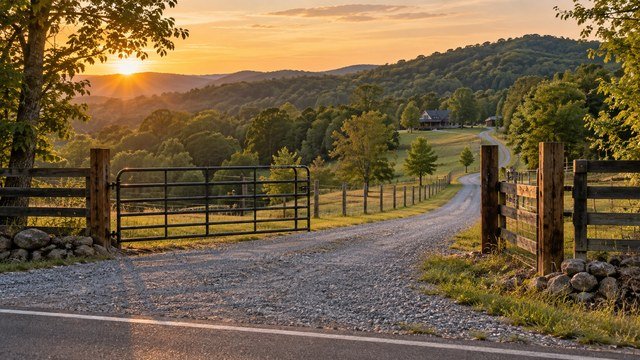
Road frontage does not always mean usable legal access
One of the most expensive mistakes a rural buyer can make is assuming that a visible driveway, gravel road, or trail automatically provides permanent legal access to the property.
A parcel can appear easy to reach while the actual access depends on a private road, an undocumented agreement, a neighbor's land, a shared driveway, or an easement with restrictions that do not fit your plans.
Before closing, verify both physical access and the legal right to use it.
Legal access and physical access are different questions
Physical access asks whether you can actually drive to the property today.
Legal access asks whether you have an enforceable right to cross the land between the public road and your parcel.
You want both. A legal easement that is too steep, narrow, wet, or blocked can still be impractical, while a perfectly maintained road can still create risk if your right to use it is unclear.
Start with the deed, title commitment, and recorded easements
The deed and title work should identify recorded rights that benefit or burden the parcel.
Look for easements for ingress and egress, utilities, shared driveways, pipelines, transmission lines, drainage, access roads, conservation restrictions, and other recorded interests.
Do not stop at the short legal description on a listing. Ask for the underlying easement documents and read the actual terms.
An easement is a right to use land you may not own
An easement generally gives one party a limited right to use another party's property for a defined purpose.
For rural land buyers, the most common examples involve access roads, driveways, utilities, drainage, and shared infrastructure.
The easement document may define location, width, permitted uses, maintenance obligations, who may use it, and whether it benefits a particular parcel.
Ingress and egress language matters
An ingress-and-egress easement is intended to provide access into and out of property, but the wording still matters.
A document may limit the route, width, vehicle type, number of users, or purpose of the access.
If you plan to build a house, shop, barndominium, short-term rental, business, or multiple residences, ask whether the easement language comfortably supports that use.
Private roads can create shared maintenance problems
A private road may serve only two parcels or dozens of homes.
Before buying, determine who owns the road, who has the right to use it, who maintains it, and how costs are allocated.
A well-maintained road today does not guarantee that every owner will agree on future grading, gravel, culvert replacement, snow or storm cleanup, or major repairs.
A written road-maintenance agreement is valuable
A clear written maintenance agreement can reduce uncertainty over who pays for recurring work and major repairs.
Useful provisions may address cost sharing, grading frequency, gravel, drainage, culverts, gates, emergency repairs, contractor selection, and how disputes are handled.
If no agreement exists, understand what has actually been happening and discuss the risk with the title professional or attorney reviewing the transaction.
Do not assume a visible road sits inside the recorded easement
The traveled road and the legal easement can be in different locations.
A survey can help show whether the driveway follows the recorded right-of-way or has drifted outside it over time.
This matters when you want to improve the road, install utilities, widen the entrance, add a gate, or obtain financing.
Width can determine whether the easement works for your project
A narrow easement may be adequate for a passenger vehicle but difficult for concrete trucks, delivery semis, well rigs, septic equipment, fire apparatus, RVs, or trailers.
Compare the recorded width with the actual road and the vehicles your construction and long-term use will require.
Ask the local building, fire, and road authorities whether additional access width or turnaround standards apply.
Utility rights should be verified separately
An access easement does not automatically guarantee the right to install electric, water, fiber, gas, or other utilities along the same route.
A utility provider may require its own easement or additional rights from neighboring owners.
Before closing on a parcel reached by private road, confirm not only that you can drive across the route but also that the required utilities can legally and physically reach the homesite.
Gates can become an access issue
Gates are common on rural Tennessee roads, but they can create practical and legal problems when several properties share access.
Find out who controls the gate, whether you will receive keys or codes, whether emergency services can enter, and whether the easement allows the gate to exist.
If you want to install a new gate, verify that doing so would not unreasonably interfere with other users' access rights.
Landlocked parcels deserve extra scrutiny
A parcel is commonly described as landlocked when it has no direct access to a public road and depends on crossing other property.
That condition can affect financing, construction, utility service, insurance, resale, and development cost.
Do not rely on the assumption that a court will create access later. Resolve the access issue before buying whenever possible.
Tennessee recognizes easements by necessity in some circumstances
Tennessee appellate decisions recognize easements by necessity as a form of implied easement in appropriate circumstances.
The courts have explained that the required necessity must be more than mere convenience, and whether sufficient necessity exists depends on the facts.
Because implied easement disputes can require litigation, buyers should not treat this doctrine as a substitute for a clear recorded access right.
An easement by necessity can end when the necessity ends
Tennessee appellate decisions have also explained that an easement by necessity depends on the necessity that created it.
If another lawful and reasonable means of access later becomes available, the legal basis for the necessity easement can change.
That is another reason a buyer should understand exactly what type of access right exists instead of assuming every easement is permanent in the same way.
Prescriptive easement claims are not a clean due-diligence strategy
Long-term use of another person's land can create legal disputes over whether rights have arisen through use, but these claims are fact-specific and often contested.
A seller saying that everyone has used the road for years is not the same as providing a recorded access document.
If the property's access depends on historic use rather than recorded rights, get legal review before closing.
Parcel GIS maps are useful but are not legal boundary surveys
Tennessee's Comptroller provides parcel mapping data that can help buyers understand parcel relationships and identify likely road or easement questions.
The Comptroller specifically warns that its mapping products are for planning and assessment purposes and should not be treated as legal boundary determinations.
Use GIS to identify questions, then use deeds, recorded documents, and a professional survey to answer them.
A survey can connect the paperwork to the ground
A boundary survey can show property lines, corners, roads, visible improvements, and recorded easements that the surveyor is asked to locate.
For access due diligence, ask the surveyor to show the public road connection, private access route, easement width, driveway location, and any encroachments that affect the route.
If the access is critical to the purchase, do not assume a basic lender sketch will answer all of those questions.
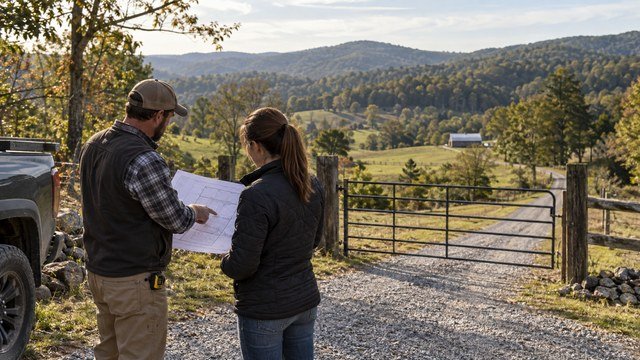
Road frontage should be confirmed, not estimated from GIS
A listing may advertise a certain number of feet of road frontage, but frontage measurements should be confirmed from reliable legal and survey information.
The shape of the parcel, right-of-way width, old road relocations, abandoned roads, and deed calls can all complicate what appears straightforward on an online map.
If your driveway depends on a specific section of frontage, confirm that section before closing.
An easement can burden the property you are buying
Not every easement benefits the parcel.
Your land may be subject to a neighbor's driveway, utility corridor, pipeline, drainage route, access lane, or other right-of-way.
Those rights can affect where you place a house, shop, fence, gate, pond, septic system, trees, or other improvements.
Read the easement width and location before laying out the homesite
An easement crossing the best building area can shrink the practical building envelope.
The recorded route may also affect setbacks, septic layout, utility trenching, driveway alignment, or future subdivision plans.
Overlay easements on the survey and concept site plan before spending money on architectural plans.
Shared driveways should be treated like shared infrastructure
A shared driveway can work very well when the legal rights, dimensions, drainage, maintenance, and expectations are clear.
Problems arise when users disagree about widening, paving, gates, visitors, commercial traffic, speeding, drainage, or repair costs.
Ask for the governing documents and speak with current users before closing if the relationship will materially affect the property.
Emergency and construction access are part of the access test
Legal access that is technically sufficient on paper may still fail the practical test for a rural build.
Fire trucks, ambulances, concrete trucks, delivery vehicles, well rigs, excavators, and trailers need width, grade, turning radius, bridge capacity, culvert capacity, and overhead clearance.
Walk the route with your builder or site contractor before closing on a difficult property.
Bridges and culverts on private access roads deserve inspection
A private access road may cross a creek or drainage channel through a bridge or culvert that was installed decades ago.
If several parcels depend on that structure, determine who owns it, who maintains it, and what happens if it fails.
A major private-road crossing can become a substantial unexpected shared expense.
Financing can expose access problems
Lenders and title insurers may ask questions about legal access, recorded easements, road maintenance, or whether the property has direct public-road frontage.
A deal that appears acceptable to a cash buyer may face additional scrutiny when financing is involved.
Resolve access documentation early so it does not become a last-minute closing problem.
Future subdivision plans make access even more important
If you may divide the land later, do not assume the existing easement automatically supports additional lots or residences.
Subdivision regulations, road standards, access width, utility capacity, and easement wording can all affect whether additional parcels can use the route.
Ask the local planning office and title professional before buying land based on future subdivision potential.
Questions to ask about any rural Tennessee access easement
Get the answers in writing or from recorded documents whenever possible.
- Where is the easement located?
- How wide is it?
- Is it recorded?
- Which parcels benefit from it?
- Which parcels are burdened by it?
- Is it limited to ingress and egress?
- Does it include utilities?
- Can it be widened or improved?
- Can gates be installed?
- Who maintains the road?
- How are repair costs divided?
- Are commercial or heavy vehicles restricted?
- Does the traveled road stay inside the easement?
- Are there bridges, culverts, or drainage structures?
- Does the easement support construction traffic?
- Could future subdivision increase the number of users?
A practical Tennessee legal-access due-diligence checklist
Before closing, confirm the access from the public road all the way to the proposed homesite.
- Review the deed
- Review the title commitment
- Obtain every referenced easement document
- Confirm whether the parcel has direct public-road frontage
- Identify every private-road segment
- Confirm who owns the access road
- Confirm who has rights to use it
- Review maintenance agreements
- Verify easement width
- Verify utility rights
- Order a survey when access is unclear
- Compare the road location with the recorded easement
- Check gates, bridges, culverts, and drainage
- Confirm construction and emergency access
- Ask the local planning office about future subdivision access
- Have a Tennessee real-estate attorney review unusual or disputed access conditions
Clear access is part of making acreage truly buildable
Rural land is not fully usable simply because you can reach it today.
A strong acreage purchase has a clear legal path from a public road to the property, a practical route for construction and emergency vehicles, documented utility access, and an understandable maintenance arrangement.
Resolving those questions before closing is far easier than trying to negotiate access with neighbors after you own the land.
Keep researching
Acreage Planning resources
Due diligence, development sequencing, utilities, access, and the decisions that shape a rural property project.
Sources & methodology
Where this information comes from
Cost figures are planning references rather than contractor quotes. Permitting, system-selection, and location-specific guidance should be verified with the appropriate local authority or qualified professional. AcreageReady uses source-backed, AI-assisted editorial workflows and remains responsible for the material it publishes. Read how we research, edit, and correct guides.
- Tennessee Courts: Walker v. CSX Transportation, Inc.
- Tennessee Courts: Lay v. Smalley
- Tennessee Comptroller: Parcel Data Stewardship
- Tennessee Comptroller: Land Use Mapping Disclaimer
- AcreageReady: Tennessee Land Surveys & Property Lines
- AcreageReady: Tennessee Rural Driveway Costs
- AcreageReady: Tennessee Flood Zones & Drainage
Common questions
Frequently asked questions
What is an access easement in Tennessee?
An access easement is a legal right allowing someone to cross property they do not own for ingress and egress. The exact rights depend on the easement document, location, width, purpose, and applicable law.
Does a gravel road automatically mean I have legal access?
No. A visible or long-used road does not by itself prove that your parcel has a recorded and enforceable right to use it. Review the deed, title work, easement documents, and survey.
Can a landlocked property have an easement by necessity in Tennessee?
Tennessee courts recognize easements by necessity in some circumstances, but the required necessity and other elements are fact-specific. Buyers should not depend on future litigation when a recorded access solution can be resolved before closing.
Does an access easement also allow utilities?
Not necessarily. The access document may grant only ingress and egress. Confirm whether electric, water, fiber, gas, and other utilities have the rights they need to reach the property.
Who pays to maintain a private road?
That depends on the recorded easement, maintenance agreement, ownership arrangement, and applicable law. Review the documents rather than assuming costs are divided equally.
Can a neighbor block an easement with a gate?
The answer depends on the easement terms and whether the gate unreasonably interferes with the rights of easement users. If a gate dispute exists, get legal advice before buying.
Is a Tennessee parcel GIS map enough to confirm an easement?
No. Tennessee's Comptroller notes that parcel mapping is for planning and assessment purposes and is not a legal boundary determination. Use recorded documents and a professional survey for legal location questions.
Should I hire an attorney for a rural access issue?
If access is shared, disputed, undocumented, landlocked, or depends on unusual easement language, a Tennessee real-estate attorney can review the title documents and explain the specific legal risk before closing.
Ready to talk with a local professional?
Share your location and project details so AcreageReady can identify relevant providers as the network grows.
Get a free quote