
Propane is a major utility decision for rural Tennessee homes
Many rural Tennessee properties do not have natural-gas service, which makes propane an important option for space heating, water heating, cooking, fireplaces, dryers, outdoor kitchens, pool equipment, and standby generators.
The tank itself is only part of the cost. A complete propane system can involve the tank, regulators, trenching, gas piping, concrete or other support, permits or inspections, appliance conversion, delivery access, and the first fuel fill.
For new acreage construction, propane should be planned alongside the house location, driveway, electrical service, generator, septic system, well, and future outbuildings.
Current Tennessee propane prices matter to the operating budget
The U.S. Energy Information Administration reported Tennessee residential propane at about $3.25 per gallon on March 30, 2026, the final weekly heating-season observation before EIA paused residential price collection for the offseason.
Propane prices move seasonally and vary by supplier, delivery volume, contract type, and location, so that statewide figure is a benchmark rather than a quote.
A rural buyer should budget both the installation cost and the recurring fuel cost.
A 500-gallon tank does not normally receive 500 gallons at a fill
Propane tanks are designed with vapor space so liquid propane can expand safely as temperature changes.
As a practical planning assumption, residential tanks are commonly filled to roughly 80 percent of their nominal water capacity.
That means a nominal 500-gallon tank commonly holds about 400 gallons of propane when filled to its normal service level.
A 500-gallon fill was roughly $1,300 at Tennessee's late-March 2026 benchmark
Using the EIA Tennessee residential price of about $3.25 per gallon and a typical 400-gallon fill quantity, a full-service refill for a nominal 500-gallon tank would be roughly $1,300 before any supplier-specific fees, taxes, discounts, or contract adjustments.
That does not mean every Tennessee customer pays the same amount. Large-volume deliveries, pre-buy programs, automatic delivery, ownership versus rental, and local competition can all affect pricing.
Use the statewide figure only for early budgeting and obtain current supplier quotes before construction.
Tank size should be based on actual appliance load
Choosing the tank by house square footage alone can produce a poor result.
A home using propane only for a cooktop has a very different demand profile than a house using propane for central heat, water heating, fireplace logs, dryer, range, pool heat, and a 22-kW standby generator.
Ask the propane dealer or mechanical contractor to calculate the expected connected load and seasonal consumption before selecting the tank.
Small tanks work for limited loads
Smaller residential tanks may be practical when propane serves only a few appliances such as a range, fireplace, or water heater.
The tradeoff is less stored fuel and potentially more frequent deliveries.
On remote acreage or homes that rely on propane during winter weather, larger storage can provide more operating margin.
A 500-gallon tank is common for whole-home propane use
A nominal 500-gallon tank is a common residential size for homes that use propane for multiple appliances or heating.
It can also support a standby generator, although generator runtime and winter heating demand need to be considered together.
A home with substantial propane heating plus generator use may benefit from a larger tank depending on load, delivery access, and the owner's desired reserve.
A 1,000-gallon tank can reduce delivery frequency for heavy users
Larger rural homes, high heating loads, multiple buildings, large generators, pool heaters, or agricultural uses can justify larger storage.
A 1,000-gallon tank requires more space and a larger upfront investment but can increase reserve capacity and reduce the number of deliveries.
The correct size should come from actual load planning rather than the assumption that bigger is always better.
Aboveground tanks are usually simpler and less expensive
Aboveground installation avoids the excavation, burial preparation, coating protection, and future access issues associated with underground tanks.
National 2026 cost guides commonly place residential propane installation around $600 to $2,500 overall, with larger aboveground whole-home systems often landing toward the upper part of that range.
Tennessee site conditions can push the price higher when the property needs long gas lines, difficult access, substantial grading, or specialized foundation work.
Underground tanks cost more but can improve appearance
An underground tank keeps most of the vessel out of sight, which can be attractive on landscaped or high-visibility acreage.
The higher cost comes from excavation, tank preparation, backfill, corrosion protection, access to fittings, and future service considerations.
National 2026 guides commonly show underground installations costing more than comparable aboveground systems.
Rocky Tennessee soil can make underground installation expensive
Shallow limestone, boulders, steep slopes, and limited equipment access can increase excavation cost quickly.
A site that looks easy from the surface may become much more expensive if the excavation encounters hard rock.
Ask the installer how rock work is priced and whether the quoted installation assumes ordinary soil conditions.
Tank purchase and tank rental are different ownership models
Some propane suppliers sell tanks while others lease or provide tanks under a fuel-supply agreement.
Owning the tank can give the homeowner more flexibility to shop among suppliers, while a leased tank may reduce the initial cash outlay but can limit fuel purchasing to the tank owner's company.
Before signing, ask who owns the tank, what happens if you change suppliers, who pays for maintenance, and whether minimum annual fuel purchases apply.
A low installation price may be tied to a fuel contract
A dealer may subsidize or discount the tank and installation because the customer agrees to purchase propane from that company.
That can be a good arrangement, but compare the entire agreement rather than only the initial installation price.
Ask about tank rent, delivery fees, minimum usage, early termination, pickup charges, fuel pricing, and whether the contract transfers when the property is sold.
Standby generators can materially increase propane demand
A whole-house standby generator can consume propane quickly during an extended outage.
Generator fuel consumption varies by generator size and electrical load, so the tank should be sized around realistic runtime rather than the generator's nameplate rating alone.
If the same tank also serves heat and hot water during winter, maintain enough reserve for both household use and outage operation.
Generator placement and propane-tank placement should be coordinated
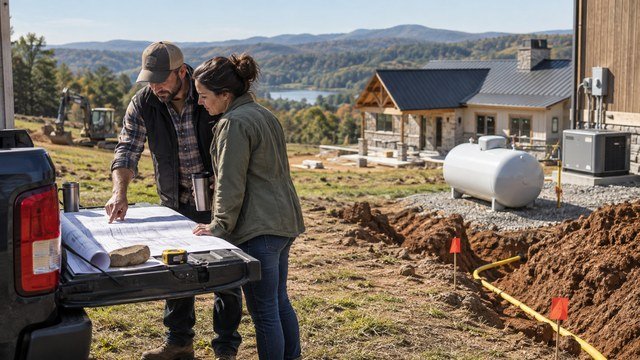
The generator, tank, electrical service, home, windows and openings, property lines, ignition sources, and service access all influence the final layout.
Exact separation and installation requirements depend on tank size, equipment, adopted codes, manufacturer instructions, and the authority having jurisdiction.
Do not select a permanent tank or generator location from an online diagram alone. Have the propane dealer, electrician, generator installer, and permitting authority coordinate the site.
Heating load changes the economics more than cooking does
A range or fireplace may use relatively little propane compared with central heating.
Once propane becomes the primary heat source, insulation, air sealing, house size, thermostat settings, climate, and HVAC efficiency become major drivers of annual fuel consumption.
Before comparing propane with heat pumps or other systems, compare the full annual energy model rather than only appliance purchase price.
Dual-fuel HVAC can combine a heat pump with propane backup
Some Tennessee homeowners use a heat pump for mild weather and propane heat during colder conditions.
A dual-fuel setup can reduce propane consumption while retaining high-output backup heat.
Whether it makes financial sense depends on equipment cost, electric rates, propane prices, climate, house efficiency, and control strategy.
Propane water heating can reduce electrical load
Propane tank water heaters and propane tankless systems can reduce the electrical demand associated with domestic hot water.
That can matter on rural projects where electrical-service sizing, generator capacity, or peak electrical load is part of the design.
The tradeoff is additional propane consumption and the need for properly designed venting, gas piping, combustion air, and equipment installation.
Outdoor kitchens, fireplaces and pool heaters should be planned early
A future pool heater, fire feature, outdoor kitchen, shop heater, or guest house can increase total connected load.
It is often easier to size the tank and plan underground gas piping during initial construction than to expand the system later.
Tell the propane dealer about likely future loads before the tank is selected.
Long gas-line runs can add trenching and material cost
On acreage, the desired tank location may be far from the house or generator.
Long runs increase trenching, piping, labor, and sometimes regulator or sizing requirements.
Coordinate the route with driveway work, utilities, septic areas, drainage, future buildings, and landscape plans before trenching begins.
Delivery-truck access is part of the design
A propane truck needs practical access for routine deliveries.
Long narrow driveways, weak culverts, steep grades, tight turns, locked gates, low branches, soft shoulders, or poor turnaround space can complicate service.
Ask prospective suppliers to review the property before finalizing the tank location.
Tennessee regulates the LP-gas business
Tennessee's State Fire Marshal administers licensing for businesses engaged in the sale, storage, delivery, or installation of liquefied petroleum gas and LP-gas equipment.
The state has multiple LP-gas dealer license classes and requires qualifying applicants to meet experience, examination, insurance, and other requirements.
For a residential system, use a properly qualified propane company rather than treating the tank and gas piping as a general DIY utility project.
Exact installation rules should be confirmed for the specific site
Propane installations are subject to safety codes, equipment requirements, and local or state enforcement that can vary with the tank, building, and jurisdiction.
Separation distances, regulator placement, burial requirements, ignition-source clearances, protection from vehicles, piping, and appliance connections are technical safety issues.
The installing dealer and local or state authority should determine the compliant layout before work begins.
Do not place the tank where future construction will conflict with it
A tank that works for the first house plan can become a problem if a future garage, pool, shop, driveway expansion, retaining wall, gate, or guest house occupies the same area.
Review the entire property master plan before finalizing the propane location.
Leave practical service and inspection access around the system.
Propane pricing programs can reduce seasonal surprises
Suppliers may offer budget billing, automatic delivery, pre-buy contracts, fixed-price programs, or price-cap plans.
Each structure shifts price risk differently. A fixed price can protect against increases but may not benefit from a market decline, while a capped program may work differently.
Read the terms carefully and compare the delivered price, fees, minimum gallons, and unused-fuel provisions.
Automatic delivery can be valuable on remote acreage
Running out of propane is more than an inconvenience when the fuel serves heat, water heating, cooking, or a generator.
Automatic delivery uses consumption history, weather assumptions, or tank monitoring to schedule deliveries before the tank becomes critically low.
Ask whether remote tank monitoring is included and whether the supplier charges additional fees for emergency or after-hours deliveries.
Questions to ask a Tennessee propane dealer
A good supplier should be able to explain both the installation and the ongoing service agreement.
- What tank size do you recommend for my connected appliance load?
- Should the tank be aboveground or underground on this site?
- Do you sell tanks, lease tanks, or both?
- Who owns the tank under the proposed agreement?
- What does the installation quote include?
- Are regulators, trenching and gas lines included?
- Are permits or inspections required for this location?
- How will rock excavation be handled?
- What delivery access does your truck require?
- What is the current delivered propane price?
- Are there delivery, hazmat, fuel-surcharge or minimum-gallon fees?
- Do you offer automatic delivery or tank monitoring?
- Do you offer pre-buy, fixed-price or budget plans?
- Can another supplier fill the tank if I own it?
- What happens to a leased tank if I sell the property?
Questions to answer before selecting a tank
The installer can size the system more accurately when the expected loads are known.
- Will propane heat the entire house?
- Will propane provide domestic hot water?
- Will the range or cooktop use propane?
- Will there be propane fireplaces?
- Will the clothes dryer use propane?
- Will a standby generator share the tank?
- Will a pool or spa heater use propane?
- Will a detached shop or guest house use propane?
- How long is the desired gas-line route?
- Can a delivery truck safely reach the site?
- Is the proposed tank area rocky or steep?
- Do you want the tank hidden underground?
- Is supplier flexibility more important than low upfront cost?
Build the propane budget as separate line items
Separating the system into individual costs makes supplier proposals easier to compare.
- Tank purchase or initial lease/setup cost
- Tank delivery
- Aboveground pad or underground excavation
- Rock excavation if needed
- Backfill and restoration
- Regulators
- Underground or exterior gas piping
- Trenching
- Interior gas piping
- Permit and inspection fees if applicable
- Appliance conversion or installation
- Generator fuel connection
- First propane fill
- Annual tank rent if leased
- Monitoring or service-plan fees
- Contingency
The bottom line
Propane can be an excellent utility for rural Tennessee homes that do not have natural gas, especially when it serves heating, hot water, cooking, fireplaces, and backup power.
The right system depends on actual appliance load, tank ownership, installation conditions, fuel pricing, delivery access, and future property plans.
Plan the tank before final site work, use a qualified Tennessee LP-gas dealer, compare complete supplier agreements, and budget both the installation and the long-term fuel cost.
Sources & methodology
Where this information comes from
Cost figures are planning references rather than contractor quotes. Permitting, system-selection, and location-specific guidance should be verified with the appropriate local authority or qualified professional. AcreageReady uses source-backed, AI-assisted editorial workflows and remains responsible for the material it publishes. Read how we research, edit, and correct guides.
- U.S. Energy Information Administration: Weekly Tennessee Propane Residential Price
- U.S. Energy Information Administration: Heating Oil and Propane Update
- Tennessee Department of Commerce & Insurance: LP Gas Licensing
- Tennessee Regulatory Licensing: Liquefied Petroleum Gas Dealer
- Angi: Propane Tank Installation Cost 2026
- This Old House: Propane Tank Installation Cost 2026
- AcreageReady: Tennessee Rural Power
- AcreageReady: Tennessee Rural Internet
- AcreageReady: Tennessee Rural Driveway Costs
- AcreageReady: Tennessee Zoning & Building Permits
Common questions
Frequently asked questions
How much does propane cost in Tennessee in 2026?
The U.S. Energy Information Administration reported Tennessee residential propane at about $3.25 per gallon on March 30, 2026, the final weekly observation of the 2025-2026 heating season. Actual delivered prices vary by supplier, location, volume and contract.
How much does it cost to install a propane tank?
National 2026 cost guides commonly place residential propane-tank installation around $600 to $2,500 for many projects, with underground, large-tank, rocky-site and long-line installations potentially costing more. Tennessee contractors should provide site-specific quotes.
How much propane does a 500-gallon tank actually hold?
A nominal 500-gallon propane tank is commonly filled to roughly 80 percent of its capacity, or about 400 gallons, to provide vapor space for safe expansion.
How much would a 500-gallon propane fill cost in Tennessee?
At the EIA Tennessee benchmark of about $3.25 per gallon from March 30, 2026, 400 gallons would cost roughly $1,300 before supplier-specific fees, taxes or discounts.
Is a 500-gallon tank large enough for a whole house and generator?
It can be, but the correct size depends on heating load, appliance use, generator size, desired outage runtime and delivery frequency. Have the propane dealer calculate the connected load rather than sizing only by house square footage.
Should I buy or lease a propane tank?
Buying usually provides more supplier flexibility but requires more upfront cash. Leasing can reduce initial cost but may require purchasing fuel exclusively from the tank owner and may include annual fees or minimum-use requirements.
Is an underground propane tank more expensive?
Usually. Underground systems add excavation, backfill, corrosion protection and site-restoration work. Rocky Tennessee soil can make the difference even larger.
Who can install propane equipment in Tennessee?
Tennessee regulates businesses engaged in the sale, storage, delivery and installation of liquefied petroleum gas and LP-gas equipment through the State Fire Marshal. Residential owners should use a properly qualified propane dealer or installer.
Ready to talk with a local professional?
Share your location and project details so AcreageReady can identify relevant providers as the network grows.
Get a free quote