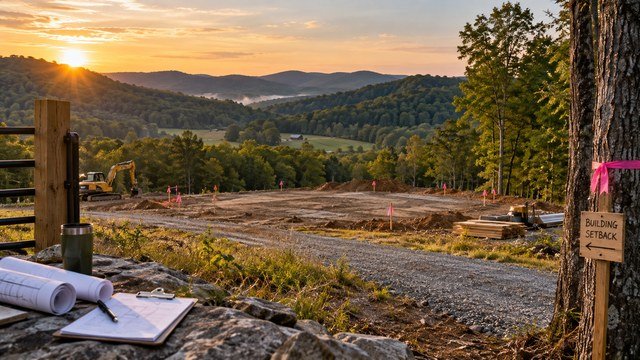
A rural Tennessee parcel can look buildable and still have permit or zoning limits
Buying acreage in Tennessee does not automatically mean you can place any home, shop, barndominium, driveway, septic system, or accessory building anywhere you want.
The key question is not simply whether the property is outside city limits. You need to know which government has jurisdiction, whether local zoning applies, who enforces residential building codes, and what separate approvals are required for septic, electrical work, floodplain development, grading, access, and utilities.
Because Tennessee uses a mix of state and local residential code enforcement, two rural parcels in neighboring counties can follow very different permitting paths.
Start by identifying the exact jurisdiction
Before evaluating permits, confirm whether the parcel is inside a municipality or in the unincorporated part of a county.
City limits, county boundaries, planning regions, utility districts, and mailing addresses do not always line up in an obvious way.
Use the parcel number and tax map, then contact the county planning or building office and the applicable city office if the property is near municipal limits.
- Confirm whether the parcel is inside city limits
- Identify the county planning and building departments
- Ask whether the property is inside a planning region or overlay district
- Confirm the parcel's zoning designation if zoning applies
- Ask which office issues residential building permits for the property
Tennessee does not use one single residential building-permit system everywhere
Tennessee's State Residential Building Code Enforcement Program applies to one- and two-family dwellings and townhouses in areas that have not received an exemption because the local government enforces qualifying codes and have not opted out of state residential code enforcement.
That means a rural buyer may deal with a local building department, the State Fire Marshal's Office, or an opt-out or non-code jurisdiction depending on the exact location.
Do not rely on a seller, listing agent, neighbor, or contractor saying that the county 'does not require permits.' Verify the current status with the responsible government office.
A state residential permit is only a building permit
A Tennessee state residential building permit does not replace other approvals.
The State Fire Marshal's Office specifically notes that its residential permit is not grading or fill approval, floodplain compliance, a septic or sewer permit, an electrical permit, or zoning approval.
A project can therefore have a valid building permit and still be unable to proceed until separate local or state requirements are satisfied.
Check zoning before you design the house
Where county or municipal zoning applies, the zoning district can control what uses are allowed and where structures may be placed.
Common issues include minimum setbacks, minimum lot size, building height, accessory structures, home occupations, livestock, manufactured housing, short-term rentals, commercial uses, and the number of dwellings permitted on one parcel.
Ask for the actual zoning ordinance and parcel zoning map rather than relying on a general description such as residential, agricultural, or unrestricted.
The word unrestricted can be misleading
Rural land listings often use terms such as unrestricted, no restrictions, or light restrictions.
Those phrases may refer only to the absence of private deed restrictions or an HOA. They do not necessarily mean the property is exempt from zoning, subdivision rules, septic requirements, floodplain rules, building codes, utility requirements, or state law.
Treat unrestricted as a marketing description until you verify the public and private restrictions that actually apply.
Separate public zoning from private deed restrictions
Zoning is a government land-use regulation. Deed restrictions and covenants are private restrictions recorded against the property.
A parcel can have permissive county zoning but restrictive private covenants, or it can have no private covenants while still being subject to zoning and permit requirements.
Review the deed, title commitment, recorded plats, covenants, easements, and any subdivision restrictions during due diligence.
Confirm setbacks before choosing the homesite
Front, side, and rear setbacks can reduce the usable building envelope, especially on narrow acreage, corner parcels, irregular lots, or tracts crossed by easements.
Additional setbacks may apply to streams, roads, utilities, septic systems, wells, floodways, or other site features.
A current boundary survey and a preliminary site plan help reveal these conflicts before you pay for final house plans or site work.

Do not assume a detached shop, barn, or garage follows the same rules as the house
Under Tennessee's state residential permit program, detached garages, sheds, barns, and other detached structures not used for living purposes generally do not require the state residential building permit.
That does not mean they are automatically exempt from local zoning, floodplain requirements, electrical permits, septic rules, or local building requirements.
If a shop will contain an apartment, office, bathroom, commercial activity, or other occupied space, describe the intended use accurately when asking the permitting office what is required.
Barndominiums need to be treated as dwellings when people will live in them
The term barndominium is a construction style, not a universal permit exemption.
If the building contains residential living space, expect the residential portion to be reviewed under the code and permit system that applies in that jurisdiction.
Ask how the jurisdiction treats mixed-use buildings that combine living space with a large shop, garage, agricultural area, or storage space.
Manufactured and modular homes have their own approval questions
Tennessee's state residential permit guidance says a state residential building permit is not required simply for installation of a manufactured or modular home, but custom site work associated with exiting the home, such as a deck, patio, or stoop, can require a permit.
Local zoning can still control whether manufactured homes are allowed in a district, what foundation or appearance standards apply, and where the home can be placed.
Confirm the exact home type because manufactured, modular, panelized, and site-built homes can be regulated differently.
Septic approval can determine the real buildable area
If the parcel will use a septic system, obtain septic approval before committing to the final homesite or beginning dirt work.
TDEC advises obtaining the septic permit before grading or construction of a building pad because disturbance can affect suitable disposal areas.
The house, primary drain field, reserve area, well, driveway, shop, pool, and future buildings should be planned together rather than one at a time.
Floodplain approval is separate from the building permit
A building permit does not establish floodplain compliance.
If the property contains a mapped floodplain, floodway, creek, river, drainage corridor, or low area, contact the local floodplain administrator before planning fill, a driveway crossing, a house pad, or another structure.
Floodplain rules can affect finished-floor elevation, fill, foundation design, access, utilities, and whether development is allowed in a particular part of the parcel.
Electrical permits and inspections may be separate
Tennessee's state residential permit guidance treats electrical permitting as a separate requirement from the residential building permit.
New rural homes, shops, wells, gates, RV connections, detached buildings, and service upgrades may therefore involve additional electrical permits or inspections.
Coordinate early with both the electrical authority and the serving utility so the planned service location works with the house, well, driveway, and future structures.
Driveway and road access deserve their own permit check
A parcel with road frontage does not automatically have an approved driveway location.
Depending on the road, access may be controlled by a county, municipality, or the Tennessee Department of Transportation.
Sight distance, culvert sizing, drainage, ditch crossings, road classification, and the number of entrances can affect where a driveway is allowed.
Grading, fill, drainage, and erosion controls can trigger separate requirements
Large cuts, fills, drainage changes, stream impacts, and significant land disturbance can create additional local or state requirements.
A residential building permit should not be treated as permission to reshape the site without checking grading, stormwater, erosion-control, or water-resource rules.
This is especially important on steep Tennessee terrain where a house pad, driveway, retaining wall, or culvert can materially change runoff.
Agricultural land does not automatically exempt a residence from every rule
Tennessee law includes special treatment for certain agricultural buildings and agricultural uses, but rural buyers should not assume that calling property a farm eliminates residential permitting or zoning questions.
A residence, guest house, commercial venue, event space, rental unit, or mixed-use building may be treated differently from a structure used only for agricultural purposes.
Describe the actual proposed use to the county or city instead of asking only whether barns are exempt.
More than one dwelling on the property can change the analysis
If you plan a main house plus a guest house, tiny home, apartment over a shop, second family home, or rental unit, ask whether multiple dwellings are allowed on the parcel.
The answer may depend on zoning, lot size, subdivision rules, septic capacity, utility service, fire access, and whether the second unit qualifies as an accessory dwelling.
Do this before designing the site around several buildings.
Subdivision rules matter if you plan to split the acreage later
Dividing one rural tract into multiple lots can trigger subdivision review even if the original parcel was easy to build on.
Each resulting lot may need compliant road frontage or access, septic suitability, utility planning, setbacks, and a legally approved plat.
If land for children, relatives, or future sale is part of the plan, discuss subdivision feasibility before placing the first house in a location that makes future lots harder to create.
An opt-out or non-code jurisdiction is not the same as no rules
Tennessee allows some counties and municipalities to opt out of statewide one- and two-family residential code enforcement.
That status does not erase zoning, septic, floodplain, electrical, access, subdivision, deed restriction, or other requirements.
The State Fire Marshal's Office also provides a process through which owners in certain opt-out or non-code areas can request a state inspection for compliance with statewide building construction safety standards.
Questions to ask the county or city before you buy
A short call to the right office can prevent expensive assumptions. Use the parcel number and be specific about the project you intend to build.
- Is the parcel inside city limits or unincorporated county?
- What zoning district applies to the parcel?
- What uses are allowed by right?
- Are there minimum lot-size or road-frontage requirements?
- What are the front, side, and rear setbacks?
- Who issues the residential building permit for this location?
- Is this a locally enforced, state-permit, opt-out, or non-code jurisdiction?
- Are a barndominium or manufactured home allowed?
- Can I build more than one dwelling?
- Are accessory dwelling units allowed?
- What rules apply to a detached shop or apartment over a shop?
- Is a driveway or culvert permit required?
- Is any part of the parcel in a regulated floodplain?
- Are grading or erosion-control permits required?
- What approvals are needed before site clearing?
- What is required to subdivide the property later?
Documents to collect during due diligence
Keep the answers in writing when possible and build a property file before closing.
- Current deed and title commitment
- Recorded plat
- Boundary survey
- Zoning map and zoning district designation
- Applicable zoning ordinance sections
- Building-permit jurisdiction confirmation
- Septic records or preliminary septic approval
- Floodplain map and local floodplain guidance
- Driveway or access requirements
- Utility availability letters or estimates
- Recorded easements
- Private covenants and deed restrictions
- Any prior permits, violations, or approvals tied to the parcel
Buildability should be verified before the inspection period ends
The safest time to resolve zoning and permit questions is before the purchase becomes nonrefundable.
A rural parcel should be evaluated as a complete development system: legal use, building envelope, septic, water, power, driveway, drainage, floodplain, grading, and future structures.
Once those pieces are confirmed, you can estimate the real cost and decide whether the land supports the property you actually want to build.
Keep researching
Acreage Planning resources
Due diligence, development sequencing, utilities, access, and the decisions that shape a rural property project.
Sources & methodology
Where this information comes from
Cost figures are planning references rather than contractor quotes. Permitting, system-selection, and location-specific guidance should be verified with the appropriate local authority or qualified professional. AcreageReady uses source-backed, AI-assisted editorial workflows and remains responsible for the material it publishes. Read how we research, edit, and correct guides.
- Tennessee State Fire Marshal's Office: Residential Permits
- Tennessee State Fire Marshal's Office: Residential Permit FAQs
- Tennessee State Fire Marshal's Office: Apply for a Residential Permit
- Tennessee State Fire Marshal's Office: Opt-Out or Non-Code Jurisdictions
- TDEC: Septic System Construction Permit
- TDEC: Online Application for Septic Related Services
- AcreageReady: Buying Rural Land in Tennessee
- AcreageReady: Tennessee Septic Permits & Soil Evaluations
- AcreageReady: Tennessee Well Drilling Cost Guide
Common questions
Frequently asked questions
Do I need a building permit to build a house in rural Tennessee?
It depends on the exact jurisdiction. Some areas use local residential code enforcement, some require a Tennessee state residential building permit, and some are opt-out or non-code jurisdictions. Confirm the parcel's current status with the county, city if applicable, and the Tennessee State Fire Marshal's Office.
Does a Tennessee building permit include zoning approval?
No. Tennessee's State Fire Marshal's Office states that a state residential building permit is not zoning approval and does not replace septic, floodplain, grading, sewer, or electrical approvals.
Can I build anything I want on unrestricted land in Tennessee?
Not necessarily. 'Unrestricted' may only mean there are few or no private deed restrictions. Government zoning, building codes, septic rules, floodplain regulations, access requirements, subdivision rules, and other laws may still apply.
Do I need a permit for a barn or detached shop in Tennessee?
Under the state residential permit program, detached garages, sheds, barns, and other detached non-living structures generally do not require the state residential building permit. Local zoning, electrical, floodplain, and other requirements can still apply.
Do barndominiums need permits in Tennessee?
If a barndominium contains residential living space, the residential portion should be treated as a dwelling for the permit and code system that applies in the jurisdiction. Local zoning and mixed-use requirements should also be confirmed.
Can I put two houses on one rural Tennessee parcel?
Possibly, but it depends on local zoning, lot size, septic capacity, utility service, access, and whether the second dwelling is allowed as a principal or accessory dwelling. Verify before designing the site.
Does an opt-out Tennessee county mean I do not need any permits?
No. Opt-out status relates to statewide residential building-code enforcement. Zoning, septic, floodplain, electrical, driveway, subdivision, and other requirements can still apply.
Should I get septic approval before clearing land?
Yes. TDEC advises obtaining the septic construction permit before dirt work or building-pad construction so grading does not damage or eliminate suitable disposal areas.
Ready to talk with a local professional?
Share your location and project details so AcreageReady can identify relevant providers as the network grows.
Get a free quote