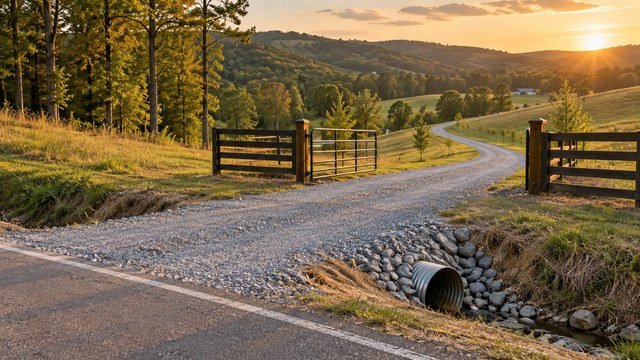
A rural driveway can be one of the biggest site-development costs
A driveway on rural Tennessee acreage can be anything from a short gravel entrance off a county road to a half-mile construction project involving clearing, excavation, culverts, retaining work, gates, drainage, and multiple truckloads of stone.
That is why driveway cost should be estimated before closing on land, not after the house plans are finished.
The total depends on length, width, slope, soil, drainage, rock, access, material choice, and whether the driveway connects to a county road, city street, or state highway.
Start with the road authority before you price the driveway
Before deciding where the driveway should enter the property, identify who controls the road.
If the entrance connects to a Tennessee state highway, TDOT requires a permit before constructing a driveway within state highway right-of-way, including certain modifications to existing driveway facilities.
County and municipal roads may have their own driveway, culvert, sight-distance, drainage, and right-of-way requirements, so contact the local road or engineering department early.
A driveway entrance is not automatically approved just because the parcel has frontage
Road frontage gives the parcel a physical relationship to the road, but the safest or legally permitted entrance location may be different from the spot that looks most convenient.
Sight distance, drainage ditches, curves, hills, guardrails, utilities, culvert needs, and road classification can all influence where an entrance can go.
If you are choosing between multiple homesites, the approved entrance location can affect the entire layout.
The biggest cost driver is usually length
Every additional foot of driveway adds some combination of clearing, excavation, grading, geotextile fabric, base stone, surface stone, drainage, and maintenance.
A 100-foot driveway and a 1,000-foot driveway are completely different projects even if they use the same gravel.
Long driveways also increase delivery time and trucking cost because aggregate has to be moved farther into the property.
Use planning ranges, not a single statewide per-foot price
There is no reliable statewide Tennessee price per foot that works for every rural property.
For early budgeting, a straightforward gravel driveway on favorable terrain may land in the low tens of dollars per linear foot once site work and aggregate are included, while difficult routes with steep grades, rock excavation, major drainage structures, retaining work, or long mobilization distances can cost substantially more.
Use any online per-foot number only as a rough screen. A contractor should walk the actual route before you treat the estimate as real.
A short driveway can still be expensive if the entrance is complicated
A 150-foot driveway can cost more than a much longer one if it requires a large culvert, deep ditch work, rock excavation, utility relocation, heavy clearing, or a difficult road tie-in.
The entrance often has to survive concentrated runoff and repeated construction traffic, so it deserves more attention than simply dumping gravel between the road and homesite.
Ask contractors to separate entrance work from the rest of the driveway in their bids.
Gravel driveways need a real base, not just surface stone
The visible gravel is only the top of the system.
A durable rural driveway typically depends on proper subgrade preparation, drainage, suitable base aggregate, compaction, and a surface course that can be maintained over time.
Putting expensive stone on soft soil without correcting drainage or base conditions can lead to rutting, potholes, and repeated re-graveling.
Geotextile fabric can be valuable on soft ground
Geotextile fabric is often used to separate weak soil from the stone base and reduce the amount of aggregate that disappears into mud.
It is especially worth discussing when the route crosses wet ground, clay, low areas, or soils that pump under vehicle loads.
Fabric is not a substitute for drainage, but it can improve the performance of a properly designed base.
Tennessee clay can change the driveway budget
Many Tennessee properties include clay-heavy soils that become slick, soft, or difficult to compact when wet.
If the driveway route stays saturated or carries runoff, contractors may need to undercut weak material, add larger stone, install fabric, improve ditches, or raise the roadbed.
The cheapest-looking route across the property may not be the cheapest route to build.
Rocky ground can add excavation cost quickly
Parts of Tennessee have shallow rock or difficult excavation conditions.
If the driveway requires cutting into a hillside, lowering a grade, building drainage ditches, or trenching utilities alongside the road, rock can materially increase equipment time and cost.
Ask whether the contractor's quote assumes ordinary excavation or includes an allowance for rock.
Culverts can be a small line item or a major engineering issue
Many rural driveway entrances cross a roadside ditch and require a culvert.
The pipe diameter, material, length, bedding, cover, headwalls, and ditch grading depend on drainage conditions and the road authority's requirements.
A simple residential culvert can be relatively modest, while a large crossing handling significant runoff can become one of the most expensive parts of the entrance.
Do not undersize drainage just to save money
An undersized culvert can back water up, wash out the driveway, damage the road shoulder, or send runoff onto neighboring property.
Heavy Tennessee rain can expose weak drainage design quickly.
If the crossing handles a meaningful drainage area, get the road authority or an experienced contractor or engineer involved rather than guessing at pipe size.
Cross drains can protect long and sloped driveways
Long driveways often need more than one drainage structure.
Cross drains can move water under the driveway before runoff gains enough volume and speed to erode the road surface.
The steeper the route, the more important it becomes to break up concentrated water and direct it into stable drainage areas.
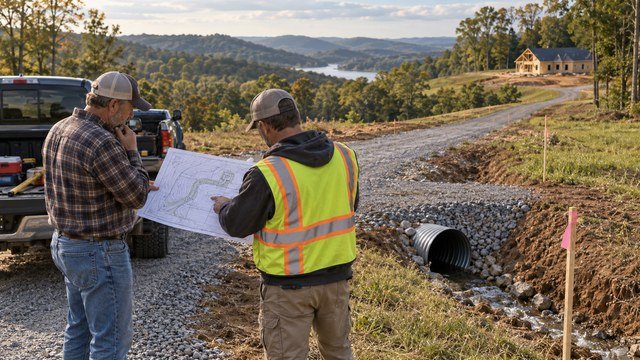
Ditches and crowns matter as much as the gravel
A rural driveway should shed water rather than trap it.
A crowned or properly sloped driving surface, stable shoulders, and functioning side ditches help keep rain from running down the wheel paths.
If a contractor's plan focuses only on aggregate quantities and not where the water goes, the driveway is not fully designed.
Steep driveways cost more to build and maintain
Steep Tennessee hills can create traction, erosion, and emergency-access problems.
A steeper route may require additional grading, switchbacks, larger drainage structures, stabilization, retaining work, or a different surface treatment.
Before choosing a dramatic hilltop homesite, compare the driveway cost with a lower or more accessible building area.
Construction traffic should influence the initial design
Concrete trucks, dump trucks, delivery semis, well-drilling rigs, cranes, and equipment trailers are much heavier and longer than normal passenger vehicles.
A driveway that works for a pickup may not work for construction.
Plan adequate width, turning room, overhead clearance, base strength, and turnaround space before the first major delivery.
Build the driveway in phases when it makes sense
Many rural projects begin with a construction driveway using a strong base course and add the final surface stone after heavy building traffic is mostly complete.
This can reduce damage to the finished surface and let the builder correct low spots or drainage problems discovered during construction.
Ask whether the contractor recommends a staged installation rather than finishing everything on day one.
Driveway width affects cost, access, and maintenance
A narrow private drive uses less material but leaves less room for large vehicles, snow or storm debris, guests, trailers, and emergency access.
Wider sections or passing areas can be useful on long one-lane drives.
Check local fire, building, and access requirements before choosing a width based only on cost.
Turnarounds are easy to forget
A long dead-end driveway needs a practical way for service trucks, delivery vehicles, emergency apparatus, and construction equipment to turn around.
Backing hundreds of feet down a narrow rural driveway is not a good long-term plan.
A hammerhead, circular drive, or widened turnaround near the house can add upfront cost but make the property much easier to use.
Gates add more than the price of the gate
A basic farm gate is very different from a powered estate gate.
Automated gates can require concrete footings, operators, power, keypads, remotes, safety devices, solar equipment, internet or cellular connectivity, and room for vehicles to wait without blocking the public road.
Coordinate the gate location with the road entrance and utility plan before pouring posts or running conduit.
A gate should not create a dangerous road backup
On busier roads, vehicles may need enough space to leave the travel lane completely before stopping at a gate.
The needed setback depends on vehicle length, trailers, road speed, local requirements, and the entrance configuration.
If you expect frequent trailers, contractors, RVs, or livestock equipment, design for those vehicles from the start.
Paving is usually a later decision on acreage
Asphalt or concrete can reduce dust and improve appearance, but paving a long rural driveway can be expensive.
Many owners first build a well-drained gravel road, allow the site to settle through construction, and consider paving later.
If paving is a future goal, tell the contractor so the base and drainage can be built with that possibility in mind.
A paved driveway does not fix bad drainage
Asphalt or concrete placed over a poorly prepared base can crack, settle, or wash out.
Water moving under or beside the pavement remains a problem regardless of the surface material.
Spend first on route selection, drainage, base preparation, and compaction.
Utilities can share the corridor, but coordinate before digging
The driveway corridor is often used for underground electric, water, communications, or gate wiring because it creates an accessible route into the property.
That can be efficient, but utility separation, depth, easements, access, and future maintenance all need to be coordinated.
Use Tennessee 811 before excavation so participating underground utilities can be marked before digging.
Stream crossings are a different level of project
If the planned driveway must cross a creek, stream, wetland, or other water resource, do not assume a standard culvert installation is enough.
Tennessee water-resource impacts can require state or federal review and permitting depending on the location and work involved.
A bridge or properly permitted crossing may be necessary, and this should be investigated before buying the parcel if it is the only practical route to the homesite.
Large land disturbance can trigger stormwater requirements
Tennessee's construction stormwater program regulates qualifying clearing, grading, and excavation activities.
Construction sites disturbing one acre or more generally require permit coverage, and smaller disturbances can also be covered when they are part of a larger common plan of development or sale.
A long driveway combined with a house pad, septic work, clearing, and grading can push the overall project into a larger disturbance category even when the driveway alone is narrower.
Driveway cost should be included in the land-development budget
When comparing parcels, add the driveway to the same budget as septic, well, power, clearing, grading, and the house pad.
A cheaper parcel with a 1,200-foot steep driveway may cost more to develop than a more expensive parcel with a short, easy entrance.
This is one of the most common reasons a low purchase price does not equal a low total project cost.
A practical Tennessee rural driveway budgeting framework
Instead of trying to force one average price onto every parcel, break the project into components and estimate each one separately.
- Road entrance and permit work
- Clearing and grubbing
- Topsoil stripping or undercutting
- Earthwork and grading
- Geotextile fabric
- Large base stone
- Crusher run or graded aggregate base
- Surface gravel
- Culverts and cross drains
- Ditch construction
- Rock excavation allowance
- Retaining or slope stabilization
- Turnaround or parking area
- Gate and gate automation
- Utility conduit placed during construction
- Final grading and cleanup
- Contingency for soft areas or drainage changes
Questions to ask a driveway contractor
A useful quote should describe how the driveway will be built, not just give a lump-sum price.
- How wide will the finished driveway be?
- How deep will the base be?
- What aggregate sizes and types are included?
- Is geotextile fabric included where needed?
- How will the subgrade be compacted?
- What culverts or cross drains are included?
- How will side ditches and runoff be handled?
- Does the estimate include clearing and stump removal?
- What happens if rock or very soft soil is encountered?
- Is the entrance work included?
- Will the road support concrete trucks and heavy construction equipment?
- Is a turnaround included?
- How many tons of aggregate are included?
- Are trucking and mobilization included?
- What maintenance should I expect during the first year?
Questions to ask before closing on Tennessee acreage
If the driveway will materially affect the purchase decision, answer these questions during due diligence.
- Who controls the road?
- Is a driveway or highway entrance permit required?
- Is the proposed entrance location likely to be approved?
- Is sight distance adequate?
- Will a culvert be required?
- Where does runoff from the road and property go?
- How long is the route from the road to the homesite?
- How steep is the route?
- Does the route cross wet ground, rock, streams, or easements?
- Will large construction vehicles be able to reach the house site?
- Can utility lines follow the driveway corridor?
- What clearing is required?
- Is there room for a turnaround?
- Where would a future gate be placed?
- What does a local contractor estimate for the complete route?
The best rural driveway is designed around water first
Gravel can be replaced. Drainage failures are harder and more expensive to live with.
A successful Tennessee rural driveway starts with the right route, a legal entrance, stable subgrade, adequate drainage, and a base strong enough for the vehicles that will use it.
If those pieces are correct, the driveway becomes a durable part of the property rather than a recurring repair project.
Keep researching
Acreage Planning resources
Due diligence, development sequencing, utilities, access, and the decisions that shape a rural property project.
Sources & methodology
Where this information comes from
Cost figures are planning references rather than contractor quotes. Permitting, system-selection, and location-specific guidance should be verified with the appropriate local authority or qualified professional. AcreageReady uses source-backed, AI-assisted editorial workflows and remains responsible for the material it publishes. Read how we research, edit, and correct guides.
- TDOT: Highway Entrance Permits
- TDEC: NPDES Stormwater Construction Permit
- TDEC: Erosion Prevention & Sediment Control Handbook
- Tennessee 811
- AcreageReady: Buying Rural Land in Tennessee
- AcreageReady: Tennessee Zoning & Building Permits
- AcreageReady: Tennessee Rural Power
- AcreageReady: Tennessee Land Surveys & Property Lines
Common questions
Frequently asked questions
How much does a gravel driveway cost in rural Tennessee?
There is no single statewide price because length, slope, soil, rock, drainage, aggregate, trucking, and site access vary widely. A straightforward route may cost far less per foot than a steep or wet driveway requiring major excavation and drainage. Get a site-specific quote before buying.
Do I need a permit for a driveway in Tennessee?
It depends on the road. TDOT requires a permit before constructing a driveway on state highway right-of-way. County and municipal roads can have separate entrance, culvert, drainage, or sight-distance requirements.
Who decides what size culvert I need?
The responsible road authority may specify requirements at the entrance. For significant drainage areas or crossings, an experienced contractor or engineer may also be needed to determine an appropriate design.
Is geotextile fabric worth using under a gravel driveway?
It can be valuable where the subgrade is soft, wet, or prone to mixing with the stone base. It helps separate soil from aggregate, but drainage and proper base design are still essential.
Should I build the final driveway before building the house?
Many rural projects install a strong construction base first and add the final surface course later. This protects the finished surface from heavy construction traffic and allows problem areas to be corrected before final grading.
Can I run utilities beside my driveway?
Often yes, and the driveway corridor can provide practical access for utilities. Coordinate depth, spacing, easements, and maintenance needs with each provider, and use Tennessee 811 before excavation.
What if my driveway has to cross a creek?
A stream or creek crossing can require additional engineering and state or federal approvals. Investigate the crossing before closing if it is the only practical access to the building site.
Does driveway grading count toward Tennessee construction stormwater disturbance?
It can. Tennessee's construction stormwater program generally applies to qualifying projects disturbing one acre or more, including smaller areas that are part of a larger common plan of development or sale. Consider the driveway together with the house pad, clearing, utilities, and other grading.
Ready to talk with a local professional?
Share your location and project details so AcreageReady can identify relevant providers as the network grows.
Get a free quote