
Internet should be part of rural land due diligence
Internet access is easy to overlook when shopping for acreage because a listing may simply say high-speed internet available or internet nearby.
For remote work, homeschooling, streaming, cameras, smart-home systems, farm operations, online business, and everyday communication, the difference between service at the road and service at the homesite can be substantial.
Before buying rural Tennessee land, verify internet availability at the exact property and understand what it will take to connect the future house.
Rural Tennessee internet is highly address-specific
Two properties on the same road can have different service options because provider networks stop at specific poles, cabinets, fiber routes, towers, or service boundaries.
A neighbor having fiber does not guarantee the parcel next door can order it. A provider website showing coverage in the ZIP code does not guarantee service at your address.
The safest approach is to verify availability using the exact street address or parcel location with each provider.
Start with the FCC National Broadband Map
The FCC National Broadband Map shows fixed broadband service reported by providers for individual broadband-serviceable locations.
The map can display technologies such as fiber, cable, DSL, fixed wireless, and satellite along with reported maximum advertised speeds.
Use the map as a starting point, then confirm directly with providers before relying on the information for a land purchase.
The FCC map can be challenged when the reported service is wrong
Tennessee's Broadband Office directs residents to the FCC National Broadband Map and explains that consumers can submit availability challenges when reported service is not actually available for purchase.
That matters in rural areas where a provider may report general coverage but cannot serve a particular driveway, building site, or new address.
If the map is incorrect, a challenge can help improve the underlying broadband data used for future planning and funding decisions.
Fiber is usually the strongest long-term option when available
Fiber-to-the-premises can provide high download and upload speeds, low latency, and strong long-term capacity.
For households that upload large files, run cloud backups, host video meetings, game online, operate a business, or use multiple cameras and smart devices, symmetrical or near-symmetrical fiber service can be especially valuable.
The main rural challenge is availability. Fiber may pass the road but still require a drop, easement, trench, pole work, or construction charge to reach the house.
Ask whether fiber is available to the parcel or only nearby
Provider maps often use terms such as available, serviceable, coming soon, or near network. Those terms are not interchangeable.
Ask whether the provider can create an order for the exact address today, whether a site survey is required, how far the service drop can run, and whether there is a construction charge.
For a long rural driveway, the distance from the road to the house can matter as much as the distance from the road to the nearest fiber line.
Cable internet can be excellent but may stop abruptly outside town
Cable internet can deliver fast service in suburban and semi-rural areas, but cable systems are often more concentrated around established neighborhoods and denser roads.
A property only a short distance beyond the current plant may require an expensive extension or may not be eligible for service at all.
Ask the provider for an address-level serviceability check rather than relying on a general coverage map.
Fixed wireless can be a strong rural alternative
Fixed wireless providers deliver internet from a tower or nearby access point to an antenna installed at the property.
Performance depends on the provider's technology, tower capacity, distance, terrain, trees, and line of sight.
In hilly or heavily wooded parts of Tennessee, a provider may need to complete an on-site signal survey before confirming service.
5G home internet is different from traditional fixed wireless
Major mobile carriers also offer home internet using 4G or 5G cellular networks in selected areas.
These services can be easy to install and may work well when the property has strong cellular coverage and sufficient tower capacity.
Availability can be capacity-limited by address, so a phone showing a 5G signal does not automatically mean the carrier will sell home internet service at that location.
Satellite internet can make otherwise difficult acreage usable
Modern low-earth-orbit satellite service has changed the rural internet equation for many properties that lack wired broadband.
Systems such as Starlink can provide useful speeds and lower latency than older geostationary satellite systems, but performance still depends on a clear view of the sky, network capacity, weather, equipment placement, and the plan available at the location.
Satellite can be a primary connection, a bridge until fiber arrives, or a backup connection for a property that depends heavily on internet access.
Tree cover matters for satellite service
A wooded Tennessee property may have excellent privacy and poor satellite visibility.
Low-earth-orbit systems require a broad unobstructed view of the sky, and nearby trees can cause interruptions if they block the antenna's field of view.
Before clearing a homesite, consider where the antenna could be mounted on the roof, a pole, or another elevated location while preserving as many trees as possible.
DSL is still present in some rural areas but may not meet modern needs
DSL uses telephone infrastructure and can remain available where newer wired technologies have not yet reached.
Performance generally declines with distance from provider equipment and can vary significantly by address.
If DSL is the only wired option, verify the actual speed tier the provider will sell at the parcel rather than assuming the maximum speed advertised for the region.
Tennessee's BEAD program is expanding broadband infrastructure
The federal Broadband Equity, Access, and Deployment program is funding major broadband expansion across Tennessee.
Tennessee's Broadband Office states that the state received more than $813 million through BEAD. Tennessee submitted its Final Proposal in September 2025, and NTIA approved it on February 2, 2026.
The state now publishes awarded BEAD areas showing selected providers and eligible broadband-serviceable locations.
BEAD does not mean every rural address will get fiber
Tennessee's BEAD program can use multiple qualifying technologies, and state program materials do not guarantee that every funded location will receive fiber.
The important question for a land buyer is whether the exact broadband-serviceable location is included in an awarded project area, which provider holds the award, and when construction is expected.
Treat future broadband expansion as a potential benefit, not as current service, until the provider confirms an installable connection.
Understand the difference between unserved and underserved
Tennessee's BEAD challenge materials classify unserved locations as having access below 25 Mbps download and 3 Mbps upload.
Underserved locations are those with at least 25/3 Mbps but less than 100/20 Mbps.
Those definitions are useful for state funding decisions, but your household may need much more than the minimum depending on work, school, streaming, gaming, cameras, and other uses.
Speed is only one part of internet quality
A service plan with a high advertised download speed can still perform poorly if upload speed is limited, latency is high, the connection is congested, or the provider imposes strict data limits.
For video calls, cloud services, security cameras, remote desktops, online gaming, and large file transfers, upload capacity and latency deserve special attention.
Ask providers about both download and upload speeds and whether the plan is subject to throttling, deprioritization, or data caps.
Remote workers should plan for redundancy
If your income depends on a reliable connection, consider whether the property can support a backup service.
A common rural strategy is a primary fiber, cable, fixed-wireless, or satellite connection plus a cellular hotspot or second provider.
Redundancy can protect against line cuts, tower outages, provider maintenance, severe weather, and equipment failures.
Cellular coverage should be tested at the homesite
Carrier maps are useful but do not fully capture hills, trees, building materials, or local tower loading.
Test multiple carriers at the actual building area if possible. Check signal quality outdoors and inside an existing structure when one is present.
A strong cellular connection can support backup internet, smart devices, emergency communications, and construction-site connectivity before permanent broadband is installed.
Long driveways can create installation challenges
Many rural Tennessee homes sit hundreds of feet from the public road.
Even when fiber or cable is available at the road, the provider may limit the included drop length or charge for additional trenching, conduit, aerial construction, or special equipment.
Ask for the maximum standard drop, the estimated route to the house, and who is responsible for trenching or conduit before finalizing the homesite.
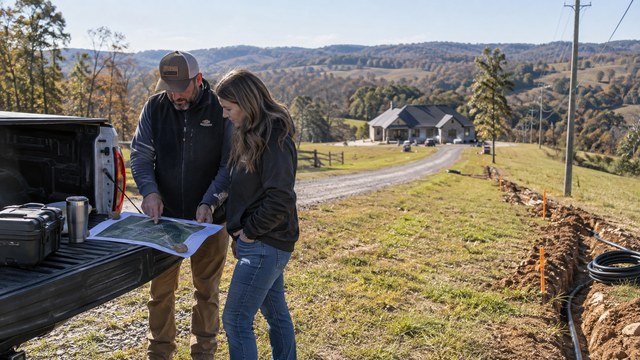
Coordinate broadband conduit with power and driveway construction
Rural sites are easier and cheaper to develop when underground infrastructure is coordinated.
If the driveway, power trench, gate controls, water lines, or other utilities are already being installed, ask providers and contractors whether empty conduit for future communications should be placed at the same time.
Never assume broadband cable can share a trench or conduit with electrical service without checking the applicable utility and code requirements.
New construction may need an address before service can be ordered
A vacant parcel can create a serviceability problem because provider systems are often built around recognized service addresses.
The county or local addressing authority may need to assign a new address before some providers can create an account, confirm availability, or schedule construction.
Ask both the provider and local jurisdiction what documentation is needed for a new rural residence.
Do not rely on a real-estate listing's internet description
Listing data can be incomplete, outdated, or based on provider coverage rather than actual serviceability.
Terms such as high-speed internet, fiber nearby, broadband available, or satellite available do not describe installation cost, speed, latency, data limits, or whether a wired connection can reach the future house.
Verify the exact property independently before the due-diligence period expires.
Ask the seller what service has actually been used
If the property already has a residence, ask the seller for the current provider, plan, speed tier, equipment type, and recent speed-test results.
Also ask whether there have been outages, construction charges, line-of-sight issues, or seasonal problems caused by foliage.
The seller's experience is useful evidence, but confirm that the service can transfer or be reordered by a new owner.
Check the FCC map and provider sites before making an offer
A practical sequence is to start with the FCC National Broadband Map, identify all reported providers, and then visit or call each provider for address-level verification.
Next, review Tennessee's broadband resources and awarded BEAD areas to see whether the property is part of a funded expansion project.
Save screenshots, emails, serviceability ticket numbers, and provider estimates as part of your land due-diligence file.
Questions to ask every internet provider
The goal is to move beyond a yes-or-no availability answer.
- Can you create an order for this exact address today?
- What technology serves the address: fiber, cable, DSL, fixed wireless, or cellular?
- What download and upload speeds are available?
- Is the service symmetrical?
- Are there data caps, throttling, or deprioritization rules?
- What equipment is required?
- How far can the standard service drop run?
- Will the provider charge for construction beyond the standard drop?
- Who supplies trenching or conduit on a long driveway?
- Is a site survey required?
- What installation lead time should I expect?
- Is the location part of a planned expansion project?
Questions to answer before buying rural acreage
Internet should be evaluated alongside power, water, septic, access, and the buildable area.
- Will anyone work or attend school from home?
- How many people will stream or video conference at once?
- Will the property use cloud-connected security cameras?
- Do you need reliable upload speed for business files or backups?
- Is fiber or cable actually orderable at the address?
- Can fixed wireless reach the site with clear line of sight?
- Does the property have a clear sky view for satellite?
- Which cellular carriers work at the homesite?
- How far is the future house from the public road?
- Will communications conduit be installed during site work?
- Is a backup internet connection important?
- Is the property included in a Tennessee broadband expansion area?
A cheap parcel can become less attractive when connectivity is poor
Internet availability can affect how practical a rural property is for work, education, security, entertainment, and resale.
A slightly more expensive parcel with existing fiber, strong cellular coverage, and straightforward utility access may offer better long-term value than cheaper acreage that depends on uncertain future service.
Connectivity should not decide every land purchase, but it deserves a place in the same feasibility review as septic, water, power, access, and drainage.
The bottom line
Rural Tennessee internet has improved substantially, and state and federal broadband investments are expanding options, but service remains highly address-specific.
Use the FCC National Broadband Map and Tennessee broadband resources to identify possibilities, then verify service directly with providers at the exact parcel.
For new construction, plan the service route, drop length, conduit, cellular backup, and satellite visibility before the driveway and utility work are finished.
Sources & methodology
Where this information comes from
Cost figures are planning references rather than contractor quotes. Permitting, system-selection, and location-specific guidance should be verified with the appropriate local authority or qualified professional. AcreageReady uses source-backed, AI-assisted editorial workflows and remains responsible for the material it publishes. Read how we research, edit, and correct guides.
- Tennessee Broadband Office: BEAD Program
- Tennessee Broadband Office: BEAD Challenge Process
- Tennessee Broadband Office: FCC Broadband Mapping Challenge
- FCC National Broadband Map
- Tennessee Broadband Office
- AcreageReady: Buying Rural Land in Tennessee
- AcreageReady: Tennessee Rural Power
- AcreageReady: Tennessee Easements & Legal Access
- AcreageReady: Tennessee Land Surveys & Property Lines
- AcreageReady: Tennessee Rural Driveway Costs
Common questions
Frequently asked questions
How do I check internet availability for rural land in Tennessee?
Start with the FCC National Broadband Map using the exact address or mapped location, then verify every reported provider directly. Tennessee's Broadband Office also provides state broadband resources and information about awarded BEAD expansion areas.
Is fiber available everywhere in rural Tennessee?
No. Fiber availability varies by address and provider network. A fiber line near the road does not guarantee the property can order service, especially when the homesite is far from existing infrastructure.
How much BEAD funding did Tennessee receive?
Tennessee's Broadband Office states that the state received $813,319,680.22 through the federal Broadband Equity, Access, and Deployment program.
When was Tennessee's BEAD plan approved?
Tennessee submitted its Final Proposal to NTIA on September 4, 2025, and the state reports that NTIA approved it on February 2, 2026.
What does unserved mean for Tennessee broadband funding?
Tennessee's BEAD challenge materials define an unserved location as one with access below 25 Mbps download and 3 Mbps upload. Underserved locations have at least 25/3 Mbps but less than 100/20 Mbps.
Is Starlink a good option for rural Tennessee land?
Low-earth-orbit satellite can be useful where wired service is unavailable, but performance depends on sky visibility, local capacity, equipment placement, weather, and the plan available at the address. Heavy tree cover can create obstructions.
Can I challenge incorrect internet availability on the FCC map?
Yes. The FCC National Broadband Map allows consumers to submit availability challenges when reported service is not actually available for purchase or when location information is incorrect.
What should I verify before buying land for remote work?
Confirm the exact service technology, available download and upload speeds, installation costs, data limits, latency, long-driveway construction requirements, cellular coverage, and whether a backup connection is practical.
Ready to talk with a local professional?
Share your location and project details so AcreageReady can identify relevant providers as the network grows.
Get a free quote