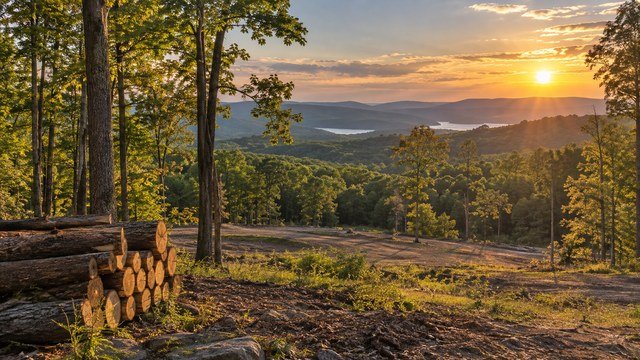
Wooded acreage can be an asset, a clearing cost, or both
When buyers look at rural Tennessee land covered in mature trees, it is easy to assume the timber will pay for clearing.
Sometimes merchantable timber can generate meaningful income. Other times the trees have low commercial value, access is difficult, the harvest is too small, or clearing costs exceed what a timber sale can offset.
The right starting point is to separate two questions: what is the timber worth as a forest product, and what will it cost to prepare the land for your intended use?
Timber value depends on more than acreage
Two 20-acre wooded tracts can have dramatically different timber values.
Species, tree diameter, height, quality, defects, stocking, terrain, road access, distance to mills, logging conditions, market timing, and sale size all affect what a buyer may pay.
A heavily wooded parcel is not automatically high-value timberland.
A professional inventory is more useful than guessing from tree size
A consulting forester can estimate species composition, merchantable volume, quality, stand age, stocking, access limitations, and likely sale options.
Tennessee's Division of Forestry encourages landowners to begin with a forest management plan and can provide technical assistance and referrals to private consulting foresters.
For a prospective buyer, even a basic forestry review can help distinguish valuable sawtimber from low-value pulpwood, cull trees, or stands that should be left to mature.
Tennessee Division of Forestry can help with planning but does not negotiate your timber sale
The Tennessee Division of Forestry provides technical assistance, forest planning, forest-health review, and other landowner support.
The state also makes clear that Division personnel do not perform timber valuations or appraisals, negotiate timber sales, open bids, handle the landowner's money, or decide which buyer receives the sale.
Those sale-specific services are better handled by a qualified consulting forester or other private professional.
A forest management plan can protect value before you build
A management plan starts with your goals rather than assuming every marketable tree should be harvested.
You may want to preserve a privacy buffer, shade around the homesite, mature hardwoods along a driveway, wildlife habitat, streamside forest, or future timber value.
A planned harvest can remove selected timber while keeping the parts of the woods that support the long-term value of the property.
High-grading can leave the forest worse than you found it
High-grading removes the best and most valuable trees while leaving lower-quality, poorly formed, damaged, or less desirable trees behind.
Tennessee's Division of Forestry specifically warns landowners about high-grade harvesting because it can reduce future timber quality and undermine long-term forest health.
A sale should be designed around silviculture and landowner goals rather than simply letting a buyer choose the most valuable trees.
Clear-cutting and selective harvesting solve different problems
A complete harvest may be appropriate when converting a defined building area, establishing pasture, regenerating a forest stand, or changing land use.
Selective harvesting can generate income while maintaining tree cover when the goal is to keep much of the property wooded.
The correct method depends on forest condition, species, regeneration strategy, access, and your development plan.
Do not log the homesite before you know the full site plan
Removing trees is easy compared with putting mature tree cover back.
Before logging around the future house, establish the likely building pad, driveway, septic area, utility routes, drainage paths, shop, pond, views, wind exposure, and privacy buffers.
A survey, site plan, and septic evaluation can prevent unnecessary clearing.
Timber buyers and clearing contractors are solving different jobs
A timber buyer is primarily interested in merchantable wood products.
A land-clearing contractor is paid to remove trees, brush, stumps, slash, and other material so the site can be used for construction, pasture, roads, or another purpose.
One contractor may do both, but the economics should be separated so you understand whether timber revenue is actually reducing the clearing bill.
Logging usually leaves work behind
A commercial timber harvest does not normally produce a finished building site.
Stumps, tops, limbs, ruts, landings, skid trails, disturbed soil, and unmerchantable trees may remain after logging.
If you intend to build immediately, budget separately for stump removal, grading, debris handling, erosion control, and pad preparation.
A good timber sale should use competitive marketing
Selling timber to the first buyer who knocks on the door can leave substantial value on the table.
A consulting forester can help identify the sale area, estimate volume, prepare sale information, contact qualified buyers, compare bids, and oversee contract compliance.
Competitive bidding is especially useful when the tract contains quality hardwood sawtimber.
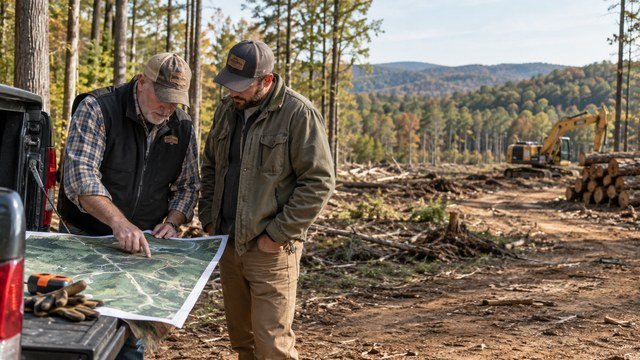
The timber-sale contract should be specific
University of Tennessee Extension publishes guidance for landowners on timber-sale contracts because a written agreement is one of the best protections in a harvest.
The contract can define which trees are sold, the sale boundary, payment terms, performance period, road and landing locations, stream protection, cleanup, insurance, damage responsibility, and what happens if contract terms are violated.
Do not rely on a handshake for a high-value timber harvest.
Define payment before cutting begins
Timber can be sold as a lump-sum sale, where the buyer pays an agreed amount for designated timber, or through other arrangements tied to measured products or volume.
Each method shifts measurement and market risk differently.
Landowners should understand exactly when title to the timber transfers, when payment is due, and what documentation will be provided.
Logging access affects what buyers are willing to pay
Timber has to be moved from the woods to a landing and then hauled to a mill.
Steep slopes, narrow access, weak bridges, poor private roads, wet ground, creek crossings, long skidding distances, and limited truck turnaround space can reduce harvest efficiency.
Hard access can make otherwise valuable trees less attractive to timber buyers.
Private-road agreements can affect logging plans
If the timber truck must use a shared private road or easement, verify that the access rights allow the proposed traffic.
Heavy log trucks can damage gravel surfaces, culverts, bridges, gates, and shoulders.
The earlier AcreageReady guide on Tennessee private-road maintenance explains why extraordinary construction or commercial traffic should be addressed before work begins.
Streamside protection matters during logging
Tennessee has forestry Best Management Practices intended to reduce sediment and protect water quality during forest operations.
The state's guidance includes streamside management zones, forest-road drainage, skid-trail practices, landing stabilization, revegetation, wetland considerations, and temporary sediment controls.
The Division of Forestry describes these BMPs as practical, nonregulatory guidelines designed to protect water quality during forestry operations.
Forest roads should be designed for drainage, not just truck access
A poorly located logging road can become a permanent erosion channel after the harvest is finished.
Proper grades, water turnouts, rolling dips, cross-drains, stabilized crossings, and closure practices can reduce runoff and long-term damage.
If a logging road may later become your driveway or equipment road, coordinate the design with the long-term development plan.
Wet weather can turn a harvest into a restoration project
Logging on saturated ground can create deep ruts, soil compaction, sediment movement, road failure, and damage to remaining trees.
Good contracts allow work to pause when conditions are too wet for responsible operations.
A short delay can be much cheaper than rebuilding roads and repairing erosion.
Stumps are one of the biggest differences between logging and clearing
Timber harvesting typically cuts merchantable trees near ground level but leaves the root system and stump.
Construction clearing may require stumps to be excavated, ground, buried where allowed, hauled away, or incorporated into an approved debris-management plan.
Stump removal is time-consuming and can disturb far more soil than felling the tree.
Forestry mulching is useful for brush and small growth, not large timber value
Forestry mulching is excellent for reclaiming overgrown areas, opening trails, reducing brush, and handling smaller trees.
It is not a substitute for a timber sale when the tract contains substantial merchantable sawtimber.
On mixed sites, a timber harvest followed by targeted mulching can make more financial sense than grinding valuable trees into mulch.
Timber revenue may help offset clearing, but never assume it will cover the project
A high-quality mature hardwood stand can produce meaningful revenue, while a young stand, low-grade timber, or difficult harvest may produce little.
Clearing costs also include work timber buyers do not need to perform: stumps, grading, debris, finish work, erosion control, rock, and construction access.
Get separate estimates for timber value and site preparation before making the development budget.
State forest sale results show how variable timber value can be
Tennessee's 2026 state-forest sale records show completed timber sales ranging from tens of thousands of dollars to several hundred thousand dollars depending on tract, volume and sale conditions.
Those public sales are large managed forest tracts and should not be used as direct pricing for a private parcel.
They do illustrate why acreage alone tells you almost nothing about timber value.
Timber taxes should be considered before the sale
Timber income can have federal tax implications, and the tax treatment can depend on ownership, holding period, timber basis, sale structure, and business facts.
Tennessee forestry planning materials encourage landowners to establish timber basis before harvest so taxable gain can be determined more accurately.
For a meaningful timber sale, talk with a tax professional familiar with timber before the contract is finalized.
Tree value and real-estate value are not always aligned
The highest timber-value tree may also be the tree that provides shade, privacy, erosion control, wildlife habitat, or visual appeal near the future home.
Removing every marketable tree can reduce the character that made the property attractive in the first place.
Mark trees to keep before the logger arrives, especially around the house site, road frontage, water features, and property boundaries.
Boundary mistakes can become expensive quickly
Timber trespass can create serious legal and financial problems.
Before a harvest, establish the property boundaries and sale boundaries clearly with survey information, marked lines, maps, paint, flagging, or professional assistance as appropriate.
Do not rely on old fences or verbal descriptions when valuable timber stands near a property line.
Insurance and liability belong in the contract
Logging involves heavy equipment, trucks, workers, road damage, trees, and significant risk.
The timber-sale contract should address insurance, indemnification, worker safety responsibilities, property damage, and proof of coverage.
A consulting forester or attorney can help identify the provisions appropriate for the sale.
A performance deposit can encourage cleanup and compliance
Performance bonds or deposits can give the landowner leverage if the buyer fails to repair roads, stabilize disturbed soil, remove trash, or meet other contract requirements.
Tennessee's own state-forest timber-sale procedures use performance deposits in state sales.
Private sales can use a similar concept when it fits the transaction.
Questions to ask a consulting forester
The forester should understand both your development plans and your forest-management goals.
- What species and products are present on the tract?
- Which stands are commercially mature?
- What timber should be retained for future value?
- Would you recommend a selective harvest or a regeneration harvest?
- How much merchantable volume is likely present?
- What access limitations affect the sale?
- Which mills or buyers are active in this area?
- How should the sale be marketed?
- How should streamside areas and roads be protected?
- Which trees should be retained around the homesite and driveway?
- How should the harvest coordinate with future clearing and construction?
- What sale-administration services do you provide?
Questions to ask a timber buyer or logger
A detailed written proposal makes buyers easier to compare.
- Which trees or areas are included in the sale?
- Is the offer lump sum or based on measured volume?
- When is payment due?
- What roads and landings will be used?
- Who repairs road or culvert damage?
- Who is responsible for stream crossings and BMPs?
- What insurance coverage do you carry?
- Will a certified Master Logger supervise or perform the work?
- What happens during wet conditions?
- How long does the buyer have to complete the harvest?
- What cleanup and stabilization are included?
- What performance deposit or security will be provided?
Questions to answer before clearing wooded acreage
The development plan should determine what gets removed.
- Where is the verified homesite?
- Where will the septic system and reserve area go?
- Which trees provide the best privacy and shade?
- Where will the driveway and utilities run?
- Will any logging roads become permanent roads?
- Are there streams, wetlands, steep slopes, or erosion-prone areas?
- Is there merchantable timber worth selling before clearing?
- Where will stumps and slash go?
- Will the cleared area become lawn, pasture, building pad, or open woods?
- How much grading will be needed after tree removal?
- Does the site need erosion-control or revegetation work?
- What areas should remain untouched?
Build the timber-and-clearing budget as separate line items
Keeping revenue and cost categories separate prevents optimistic timber assumptions from distorting the construction budget.
- Boundary survey or marking
- Consulting forester
- Timber inventory or appraisal
- Timber-sale administration
- Attorney or contract review if needed
- Expected timber-sale revenue
- Logging-road construction or improvement
- Private-road repairs
- Tree and brush removal outside the sale
- Stump removal or grinding
- Forestry mulching
- Slash and debris handling
- Grading and finish shaping
- Erosion and sediment control
- Culvert and drainage work
- Seeding and stabilization
- Contingency
The bottom line
Wooded Tennessee acreage can contain real timber value, but the only reliable way to understand it is to evaluate the actual forest, access, markets, and landowner goals.
Use a consulting forester for meaningful timber sales, keep the harvest aligned with the future site plan, use a written contract, and protect roads and water resources during logging.
Most importantly, do not confuse logging revenue with a finished building site. Timber harvesting and land clearing overlap, but they are not the same job.
Sources & methodology
Where this information comes from
Cost figures are planning references rather than contractor quotes. Permitting, system-selection, and location-specific guidance should be verified with the appropriate local authority or qualified professional. AcreageReady uses source-backed, AI-assisted editorial workflows and remains responsible for the material it publishes. Read how we research, edit, and correct guides.
- Tennessee Division of Forestry: Sell or Manage Timber
- Tennessee Division of Forestry: Ways We Help
- Tennessee Division of Forestry: Landowner Services
- Tennessee Division of Forestry: State Forest Timber Sales
- Tennessee Division of Forestry: Landscape Management Plan
- UT Extension: Marketing Timber in Tennessee for Family Forest Owners
- UT Extension: A Landowner's Guide to Timber Sale Contracts
- AcreageReady: Tennessee Land Clearing & Grading Costs
- AcreageReady: Tennessee Private Road Maintenance
- AcreageReady: Tennessee Land Surveys & Property Lines
- AcreageReady: Tennessee Flood Zones & Drainage
Common questions
Frequently asked questions
How much is timber worth on Tennessee land?
There is no dependable per-acre value. Timber value depends on species, size, grade, volume, access, terrain, logging conditions, local mills and current markets. A consulting forester can inventory the stand and help estimate sale value.
Can timber pay for clearing land in Tennessee?
Sometimes timber revenue can offset part of the cost, especially on mature high-quality stands. Logging normally leaves stumps, slash and disturbed ground, so construction clearing, grading and cleanup often remain separate expenses.
Who can appraise timber in Tennessee?
Tennessee's Division of Forestry provides technical assistance and forest planning but states that it does not perform timber valuations or appraisals or negotiate private timber sales. The state recommends working with a private consulting forester for sale-specific services.
Should I clear-cut wooded land before building?
Not automatically. First locate the house, septic area, driveway, utilities, drainage paths and privacy buffers. Selective harvesting can preserve valuable trees and reduce unnecessary clearing.
What are Tennessee forestry BMPs?
Tennessee forestry Best Management Practices are practical guidelines for protecting water quality during forestry operations. They address forest roads, skid trails, landings, streamside management zones, wetlands, drainage and stabilization.
Do timber buyers remove stumps?
Usually not as part of a normal timber harvest. Merchantable trees are generally cut and removed while stumps and much of the slash remain. Stump removal is commonly part of the later land-clearing or site-development work.
Do I need a written timber-sale contract?
A written contract is strongly recommended. It can define the timber sold, payment, boundaries, access, road repair, stream protection, cleanup, insurance, performance requirements and harvest deadline.
Can Tennessee Division of Forestry help me manage wooded acreage?
Yes. The Division provides technical assistance, forest planning, forest-health assessments and referrals to consulting foresters and other resources for private forest landowners.
Ready to talk with a local professional?
Share your location and project details so AcreageReady can identify relevant providers as the network grows.
Get a free quote