
A private road can be one of the biggest hidden risks in a rural land purchase
A long gravel lane may look simple during a property showing, but ownership and maintenance can become complicated when multiple parcels depend on the same road.
Before buying rural Tennessee property, determine who owns the land under the road, who has the legal right to use it, who pays for maintenance, and what happens when the road needs major work.
These questions matter for daily access, resale, financing, utilities, emergency vehicles, construction traffic, and relationships with neighboring landowners.
First determine whether the road is public or private
A road name, mailbox cluster, or county-style road sign does not always tell you who maintains the roadway.
Tennessee law places state maintenance responsibility on roads designated as part of the state highway system. Other public roads may be maintained by counties or municipalities under their own authority.
A private road, driveway easement, shared lane, or access easement may instead leave maintenance responsibility with the private property owners who use it.
Do not assume the county will repair a private road
If the road is privately owned and not accepted into a public road system, routine grading, gravel, culverts, ditch work, tree removal, snow or storm cleanup, and major repairs may remain private responsibilities.
Ask the county highway or public works department whether the road is county-maintained and whether it appears on the official public-road inventory.
Get the answer in writing when possible rather than relying on the seller's understanding.
The easement document and the maintenance agreement are not always the same thing
An easement may grant the legal right to cross another parcel without clearly explaining how maintenance costs are shared.
A separate road-maintenance agreement can address grading, gravel, culverts, drainage, gates, contractors, reimbursement, voting, emergencies, and major improvements.
When both documents exist, your closing attorney or title professional should review them together.
Written terms are much safer than neighbor custom
A seller may say the neighbors have always split the gravel bill or that one owner grades the road with a tractor.
That informal arrangement may work today and fail after one parcel is sold, subdivided, rented, or developed.
A written agreement creates a clearer framework for future owners and reduces reliance on memory or goodwill.
A recent Tennessee case shows what detailed agreements can look like
In a 2025 Tennessee Court of Appeals case involving a driveway easement and maintenance agreement, the written document stated that repair and maintenance were a mutual burden based on proportionate use.
The agreement also imposed an affirmative duty on the parties and their successors to keep the driveway and easement area in good repair.
The case is a useful reminder that maintenance obligations can be drafted to run with the land and bind future owners when properly documented.
Cost-sharing formulas should be explicit
A maintenance agreement can divide costs equally, by proportionate use, by road frontage, by number of homes, by distance traveled, or by another agreed formula.
Each method can produce a different result. A parcel using only the first 300 feet of a one-mile lane may object to paying the same amount as a property at the far end.
The agreement should define the formula before a dispute occurs.
Heavy construction traffic can change the fairness of ordinary cost sharing
A quiet residential lane may function for years with light maintenance and then deteriorate rapidly when a new owner starts building a house, shop, barn, pool, or driveway.
Concrete trucks, dump trucks, excavator trailers, cranes, material deliveries, and repeated contractor traffic can damage gravel surfaces, shoulders, culverts, bridges, and drainage.
A strong agreement can address extraordinary damage caused by one owner's construction or commercial use.
Gravel-road maintenance needs recurring money
Private gravel roads are not a one-time expense.
Typical recurring work can include grading, adding aggregate, filling potholes, reshaping crowns, cleaning ditches, trimming vegetation, repairing washouts, and maintaining culverts.
A reserve fund or predictable annual contribution can reduce conflict when routine maintenance is needed.
Drainage is usually the difference between a stable road and a failing one
Water destroys rural roads faster than normal passenger traffic.
A durable private road needs a functioning crown or cross-slope, ditches, culverts, outlets, stable shoulders, and a route that does not trap runoff.
Before buying, inspect the road after rain if possible and look for standing water, ruts, ditch erosion, plugged culverts, soft spots, and sediment.
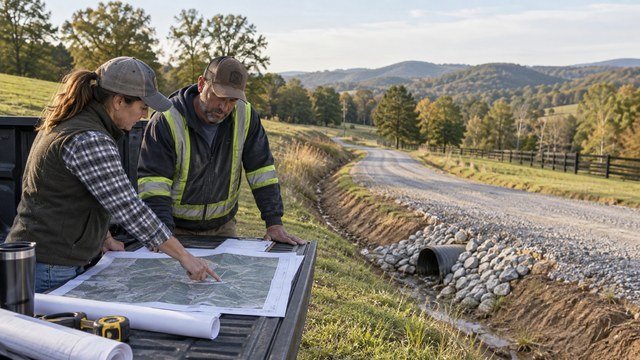
Culverts can become the most expensive shared repair
A failed driveway or road culvert can wash out the surface and cut off access.
Large replacements may require excavation, pipe or box culvert material, bedding, fill, compaction, erosion control, and sometimes engineering or environmental review.
The maintenance agreement should say who is responsible for culverts and how major repairs are approved.
Bridges deserve separate due diligence
Some rural private roads cross creeks or ravines using small private bridges.
A bridge that is adequate for passenger vehicles may not support concrete trucks, fire apparatus, delivery trucks, RVs, or construction equipment.
Ask about load limits, inspection history, ownership, maintenance obligations, and replacement responsibility before closing.
Emergency access should be considered before you buy
A narrow, steep, soft, gated, or poorly maintained private road can delay emergency vehicles.
Fire departments may have concerns about width, vertical clearance, grade, turning radius, bridge capacity, turnaround space, and gate access.
For remote acreage, ask the local fire department or authority having jurisdiction what access conditions they recommend.
Gates need rules too
Shared private roads often include manual or automated gates.
The agreement should address who owns the gate, who pays for repairs, who receives access codes or remotes, how emergency access works, and whether an owner can install a new gate without consent.
A gate that benefits one owner but inconveniences others can quickly become a source of conflict.
Utilities may share the same access corridor
Private-road easements sometimes also carry utility easements for electric, water, communications, gas, or sewer lines.
A utility company may require additional width, access rights, easement language, or vegetation clearance before extending service.
Tennessee law governing certain court-created private roads expressly addresses the possibility of extending utility lines within or alongside a private easement.
Road width matters for both access and utilities
An old driveway may be physically wider than the recorded easement, or the reverse.
The recorded width controls legal rights more reliably than tire tracks or mowing patterns.
Before planning a wider driveway, utility trench, gate, drainage ditch, or turn lane, verify the recorded easement dimensions and whether additional rights are needed.
Some court-created private roads come with statutory maintenance duties
Tennessee's private-road statutes allow certain landlocked owners to seek a private easement or right-of-way through court proceedings.
For rights created under that statutory process, Tennessee law places maintenance responsibility on the person granted the easement or right-of-way.
That statutory framework is different from a privately negotiated easement, so the source of the access right matters.
Use and maintenance can matter to continued rights under Tennessee's private-road statute
Tennessee Code also states that certain easements or rights-of-way established under the private-road chapter continue while they are used and maintained by the benefited owners.
The statute says that when such a right falls into nonuse or is not maintained, it can cease under the terms of that section.
That is another reason to understand exactly what type of easement serves the property rather than treating all private roads the same.
Title review should confirm that the access right benefits your exact parcel
A recorded easement may refer to an older parent tract, a survey, a prior owner, or a legal description that is difficult to interpret without professional review.
Your title company or real-estate attorney should confirm that the easement actually benefits the parcel you are buying and that the route reaches a public road.
Do not rely only on visible use or a real-estate listing.
Survey the private road when the location is unclear
The traveled path may drift outside the recorded easement over time.
A survey can show the legal easement corridor, property lines, encroachments, gates, culverts, and whether the existing road sits within the granted area.
This is especially important before widening the road or spending heavily on improvements.
Lenders may care about legal and practical access
A lender wants confidence that the property has durable legal access and can be reached in ordinary use.
Ambiguous easements, unwritten access, unresolved road disputes, poor bridges, or missing maintenance terms can complicate underwriting depending on the lender and loan program.
If financing is part of the purchase, provide the easement and maintenance documents to the lender early in due diligence.
Insurance questions can arise on shared private roads
Owners should ask their insurance professionals how liability is treated for privately maintained roads, bridges, gates, and common areas.
A maintenance agreement can also address insurance requirements for a road association or shared infrastructure if the owners choose that structure.
The appropriate arrangement depends on ownership and use, so discuss it with the relevant insurance and legal professionals.
Subdividing land can dramatically increase traffic and maintenance
A private road serving two homes may function well under a simple informal arrangement.
If one parcel is later divided into several homesites, traffic, delivery volume, utility work, drainage demand, and maintenance cost can rise sharply.
The agreement should address whether additional parcels can use the road and how new users join the maintenance obligation.
Short-term rentals and commercial use can change road impacts
A property that becomes a short-term rental, wedding venue, contractor yard, farm store, event site, or other high-traffic use can create far more road wear than ordinary residential use.
Deed restrictions, zoning, easement language, and maintenance agreements may each affect whether such use is permitted and how costs are allocated.
Review the rules before assuming the private road can support a future business.
A road association can make recurring management easier
Some groups of owners create a simple road association with annual dues, a bank account, maintenance standards, and a process for approving large projects.
That structure can reduce the need to renegotiate every gravel delivery or culvert repair.
The governing documents should be reviewed by a Tennessee attorney so collection, voting, liability, succession, and enforcement terms are appropriate.
Questions to ask the seller before buying on a private road
The seller's answers should be compared with recorded documents and independent verification.
- Who owns the land under the road?
- Is the road public, county-maintained or fully private?
- What recorded easement gives this parcel access?
- Is there a written road-maintenance agreement?
- How are routine costs divided?
- How are major repairs approved?
- Who maintains culverts, bridges and drainage?
- How much was spent on the road in the last three years?
- Are there unpaid balances or disputes?
- Who owns and maintains any gates?
- Can additional parcels use the road?
- Has construction traffic caused damage in the past?
- Are utilities located within the road easement?
- Has the road ever washed out or become impassable?
Questions to ask before signing a maintenance agreement
The agreement should answer practical problems before they become neighbor disputes.
- Which parcels are parties to the agreement?
- Does the obligation run with the land and bind future owners?
- How are routine costs allocated?
- How are extraordinary repairs allocated?
- Who chooses contractors?
- What spending can occur without a vote?
- What vote is required for major improvements?
- How are emergency repairs handled?
- Who pays for damage caused by construction traffic?
- How are new parcels or users added?
- How are delinquent contributions collected?
- Who maintains gates and access controls?
- Who carries any common-area liability insurance?
- How can the agreement be amended?
Include private-road costs in the rural development budget
Private-road ownership can be inexpensive in quiet years and expensive when resurfacing, culvert replacement, bridge work, drainage reconstruction or major storm damage occurs.
Budget for both annual maintenance and occasional capital repairs.
If the agreement has no reserve fund, keep enough personal contingency to cover your share of an unexpected project.
The bottom line
A private road can provide excellent rural access, but only when the legal rights and maintenance responsibilities are clear.
Before closing on Tennessee acreage, confirm whether the road is public or private, verify the recorded easement, read every maintenance agreement, inspect the road and drainage, and understand exactly how future costs are shared.
If the documents are vague or access is disputed, resolve that uncertainty before buying rather than hoping the neighbors will continue doing what they have always done.
Sources & methodology
Where this information comes from
Cost figures are planning references rather than contractor quotes. Permitting, system-selection, and location-specific guidance should be verified with the appropriate local authority or qualified professional. AcreageReady uses source-backed, AI-assisted editorial workflows and remains responsible for the material it publishes. Read how we research, edit, and correct guides.
- Tennessee Code § 54-1-126: Responsibility for Maintenance of Public Roads
- Tennessee Code § 54-14-102: Private Roads and Maintenance Responsibility
- Tennessee Code § 54-14-117: Use and Maintenance of Private Easements
- Tennessee Court of Appeals: Davis v. Edwards, 2025
- AcreageReady: Tennessee Easements & Legal Access
- AcreageReady: Tennessee Rural Driveway Costs
- AcreageReady: Tennessee Land Surveys & Property Lines
- AcreageReady: Tennessee Rural Power
- AcreageReady: Buying Rural Land in Tennessee
Common questions
Frequently asked questions
Who maintains a private road in Tennessee?
It depends on how the road and access rights were created. Private maintenance may be governed by a recorded agreement, easement terms, ownership documents, or Tennessee's private-road statutes. Do not assume the county maintains a road unless the county confirms it is part of the public-road system.
Does Tennessee require a private road maintenance agreement?
There is no single statewide rule requiring every privately shared driveway to have the same form of maintenance agreement. However, a written agreement is often valuable because it can define cost sharing, repairs, drainage, gates, construction damage and obligations of future owners.
Can a Tennessee easement require shared road maintenance?
Yes. Tennessee courts have enforced written driveway easement and maintenance terms that allocate repair and maintenance duties among property owners. The exact rights depend on the language of the recorded document.
Who maintains a court-created private road in Tennessee?
Tennessee Code section 54-14-102 states that maintenance of an easement or right-of-way granted under that private-road process is the responsibility of the person granted the easement or right-of-way.
Can a private road easement include utilities in Tennessee?
In some circumstances, yes. Tennessee's private-road statute includes provisions allowing additional easement area for utility lines when statutory requirements are met. Privately negotiated easements may also contain utility rights depending on their language.
Should I buy land with an unwritten shared-road arrangement?
An unwritten arrangement can create uncertainty. Before buying, have a Tennessee real-estate attorney and title professional review the legal access and consider whether a recorded maintenance agreement should be created before closing.
Can I widen a private road on an easement?
Not automatically. Widening may exceed the recorded easement width or interfere with the servient owner's rights. Review the easement, survey and applicable law before changing the road footprint.
What should I inspect on a private gravel road before buying?
Look at road width, grade, surface depth, crown, ditches, culverts, bridges, gates, turnarounds, soft spots, erosion, washouts and drainage. Also verify the legal easement and maintenance obligations separately from the physical inspection.
Ready to talk with a local professional?
Share your location and project details so AcreageReady can identify relevant providers as the network grows.
Get a free quote