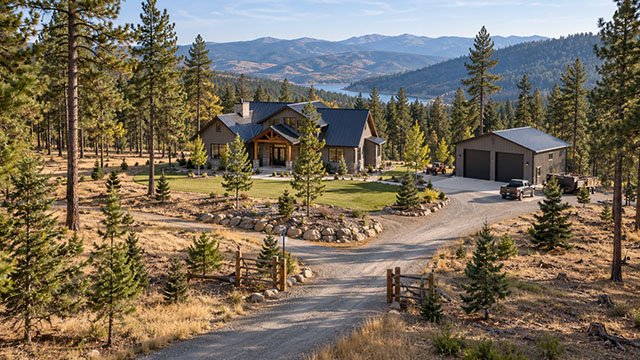
Wildfire planning should start before the house is built
For rural Idaho property, wildfire risk is easier and less expensive to address before the final house location, driveway, landscaping, and outbuildings are locked in.
The goal is not to strip the property bare. The goal is to reduce the amount and continuity of combustible material near structures, improve emergency access, and design the site so embers and surface fire have fewer opportunities to reach the home.
That makes wildfire planning part of site development, not just a landscaping project to think about after construction.
Idaho uses a home-protection-zone approach
Idaho Department of Lands publishes a Wildfire Home Protection Zone evaluation that breaks the area around a home into defensible-space zones.
The current 2026 homeowner evaluation focuses on the area immediately adjacent to the structure, an intermediate zone, and the area extending roughly 30 to 100 feet from the home.
The exact work needed depends on slope, vegetation, structure design, and local conditions, but the principle is consistent: fuel closest to the structure deserves the most aggressive treatment.
The first few feet around the house matter the most
The immediate zone is where embers are most likely to ignite material touching or directly adjacent to the home.
Idaho Firewise recommends a noncombustible area from the structure out to about five feet, using materials such as rock or pavers instead of combustible mulch and keeping shrubs, trees, leaves, needles, and other fuels away from the walls.
Deck edges, fence attachments, planters, doormats, firewood, patio furniture, and other ordinary items can become ignition pathways when wildfire conditions are severe.
Think about the home and the landscape together
Defensible space is more effective when it is paired with a home that is harder for embers to ignite.
Idaho Firewise emphasizes measures such as ember-resistant venting, clean roof valleys, maintained seals, fire-resistant exterior materials, and attention to decks, fences, and siding.
A well-thinned landscape cannot fully compensate for vulnerable vents, combustible debris on the roof, or a wood fence that carries fire directly to the structure.
The 5-to-30-foot zone should break up fuel continuity
The area outside the immediate zone should be maintained so fire has difficulty moving continuously toward the house.
That can include pruning lower tree limbs, separating shrubs, removing dead material, reducing ladder fuels, and avoiding dense continuous plantings that connect grass and shrubs to tree canopies.
The objective is spacing and separation, not necessarily removing every tree.
The 30-to-100-foot zone still matters
IDL's current homeowner evaluation recommends removing dead vegetation and ladder fuels in the 30-to-100-foot zone, pruning trees, spacing shrubs, and thinning tree crowns.
On larger rural parcels, this outer zone is where selective thinning, forestry mulching, pruning, mowing, and slash management can have the greatest effect without making the homesite look completely cleared.
On steep slopes or in dense timber, additional treatment beyond 100 feet may make sense because fire can move more aggressively uphill.
Slope changes the amount of defensible space you may need
Idaho Firewise recommends at least 100 feet of defensible space on flatter sites and notes that sloped sites may need 200 feet or more.
That is because flames, radiant heat, and convective heat can move uphill faster and preheat vegetation above the fire.
If the planned home sits above a steep draw or wooded slope, evaluate that exposure before choosing the building pad.
Do not clear more land than the wildfire plan requires
Wildfire resilience is about fuel arrangement and home ignition resistance, not maximum tree removal.
Overclearing can increase erosion, weed establishment, wind exposure, snow drifting, and loss of privacy or shade.
A better strategy is usually to create intentional spacing, remove dead and ladder fuels, separate vegetation groups, and protect the highest-risk areas closest to buildings.
Dead material deserves priority
Standing dead trees, dead branches, accumulated needles, dry grass, brush piles, and downed woody debris can carry fire rapidly through a property.
Removing or reducing those fuels is often one of the highest-value first steps because it improves both defensible space and day-to-day property maintenance.
Prioritize dead fuels near the house, driveway, utility corridor, propane tank, generator, and other critical infrastructure.
Ladder fuels allow surface fire to climb into trees
Tall grass, shrubs, small trees, and low branches can create a vertical fuel path from the ground into the forest canopy.
IDL's 2026 homeowner evaluation specifically calls for removing ladder fuels and pruning trees in the outer protection zone.
Breaking that vertical connection can reduce the chance that a lower-intensity surface fire becomes a faster-moving crown fire near the home.
Tree spacing should be adjusted to the site
IDL's homeowner evaluation includes crown-spacing recommendations, but the best spacing depends on tree size, slope, species, and overall stand conditions.
A forestry professional or wildfire-mitigation specialist can help determine which trees should remain and how much separation is appropriate without creating unnecessary windthrow or landscape damage.
For a building site in mature timber, selective thinning is usually more useful than applying one spacing number across the entire property.
Forestry mulching can be useful for defensible-space work
Forestry mulching is often effective for reducing brush, small trees, ladder fuels, and dense understory without grubbing every root system.
It can be especially useful in the outer defensible-space zone and along driveways where the goal is lower fuel continuity rather than a fully excavated surface.
The mulch layer still needs to be managed near the home because combustible woody material should not be concentrated in the immediate noncombustible zone.
Excavation is still needed in structural areas
Mulching is not a substitute for proper house-pad, driveway, septic, or utility excavation.
Stumps, roots, and organic material must be handled appropriately where structural fill, foundations, slabs, roads, or compacted aggregate will be placed.
Use wildfire fuel reduction and construction clearing as coordinated but separate parts of the site plan.
The driveway is part of the wildfire plan
A fire engine cannot protect a structure it cannot safely reach.
Idaho Firewise recommends maintaining vegetation along driveways so emergency vehicles can access the property.
Driveway width, grade, turn radius, overhead branches, gates, culverts, turnouts, and turnaround space should all be considered before the home is placed far from the public road.
Address visibility matters in an emergency
A clearly visible address can reduce the time emergency crews spend locating the property.
Place the address where it can be seen from the road in poor light, smoke, snow, or other difficult conditions.
If the driveway serves multiple homes, use clear directional markers so responders know which route leads to each structure.
Gate placement should not block emergency access
A gate that is too narrow, too close to the road, or difficult to open can slow fire apparatus and other emergency vehicles.
Coordinate gate width, setback, controls, emergency access provisions, and turnaround space with the local fire district where required.
Plan the gate before the driveway is finished so posts, utilities, drainage, and access geometry all work together.
Propane and fuel storage need separation from the house
Propane tanks, fuel containers, firewood, and other combustible or hazardous materials should not become part of the ignition path to the home.
Maintain vegetation around tanks and keep stored combustibles away from siding, decks, and the immediate zone.
Coordinate tank location with delivery access, utility clearances, code requirements, and the wildfire plan.
Firewood should not be stored against the house
A stacked woodpile is concentrated fuel.
During wildfire season, move firewood and other combustible storage away from the structure and avoid placing it under decks or against exterior walls.
A detached storage area can be safer, provided it does not create a continuous fuel path back toward the home.
Decks and attached fences can act like fuses
Idaho Firewise warns that decks, fences, and siding attached to the house can carry fire toward the structure.
Keep combustible debris from accumulating under decks and where fences meet buildings.
When building new, consider noncombustible or ignition-resistant materials in the areas most exposed to embers.
Vents are a major ember entry point
Windblown embers can enter attics, crawlspaces, and other concealed areas through openings.
Idaho Firewise recommends using fine metal mesh on vulnerable vents and maintaining seals around doors, windows, and other openings.
Ask the builder how the selected vent and soffit details address ember intrusion before the exterior package is finalized.
Roof maintenance is part of defensible space
Leaves, pine needles, cones, and other debris can collect in gutters and roof valleys.
That material can ignite from embers even when the surrounding landscape has been well maintained.
Design the roof and gutter system so it can be safely inspected and cleaned, especially where mature trees remain near the home.
Choose landscaping that does not create continuous fuels
Fire-resistant landscaping does not mean a yard with no plants.
Use lower-growing, higher-moisture vegetation near the home, separate plant groups, and avoid continuous layers of dry grass, shrubs, and tree limbs that allow fire to move uninterrupted.
Rock, gravel, patios, walkways, and other noncombustible features can double as functional landscape elements and fuel breaks.
Irrigation does not replace fuel management
Green vegetation can be less flammable than dry vegetation, but irrigation alone does not eliminate wildfire risk.
Dead material, woody stems, mulch, dense shrubs, and accumulated needles can still burn even in irrigated areas.
Use irrigation as one part of the landscape strategy while continuing to prune, thin, clean, and separate fuels.
Outbuildings should have their own protection zones
Shops, barns, guest houses, sheds, pump houses, and other structures can ignite and spread fire to the main house.
Apply the same basic defensible-space principles around important outbuildings and avoid allowing fuel to bridge from one structure to the next.
This is especially important when several buildings are clustered together on acreage.
A rural shop can contain additional ignition hazards
Welding, grinding, fuel storage, battery charging, generators, equipment, and other shop activities can create ignition sources.
Keep the area around the shop maintained, control dry vegetation, and avoid conducting spark-producing work during dangerous fire conditions.
Current fire restrictions can limit some outdoor activities when wildfire danger is very high.
Idaho uses Stage 1 and Stage 2 fire restrictions
Idaho Department of Lands coordinates a statewide fire-restriction system that can impose Stage 1 or Stage 2 restrictions when wildfire danger becomes severe.
IDL's 2026 restrictions guidance explains that restrictions can apply across designated areas regardless of ownership and may limit campfires, smoking, off-road motorized travel, and other activities.
Always check current restrictions before burning, grinding, welding, or performing other work that can create sparks.
Closed fire season runs from May 10 through October 20
Idaho's closed fire season runs from May 10 through October 20.
During that period, burning outside city limits is regulated and statewide burn permits are required for applicable burning, excluding campfires.
Additional restrictions from fire departments, local governments, tribes, or air-quality agencies can also apply.
A burn permit does not override fire restrictions
Having a burn permit does not guarantee that burning is allowed on a particular day.
IDL can suspend permits or decline to issue new permits when restrictions or dangerous conditions are in effect.
Check current restrictions immediately before burning rather than relying on a permit that was issued days or weeks earlier.
Slash disposal should be planned before fuel-reduction work starts
Thinning, pruning, and clearing can create large amounts of slash.
Possible disposal methods include chipping, mulching, hauling, piling and burning when legal, firewood processing, or other approved treatment.
A fuel-reduction project can temporarily increase wildfire hazard if slash is simply piled and left unmanaged near structures.
Do not mix construction waste into slash piles
Natural vegetation and construction debris are not the same waste stream.
Painted or treated wood, plastics, insulation, wire, roofing, petroleum products, and other construction materials should not be mixed into vegetation burn piles.
Keep the debris streams separate from the beginning of the project so cleanup and disposal remain legal and manageable.
Water supply can help, but access matters just as much
A well, pond, tank, hydrant, or other water source can support property protection, but firefighters still need safe access and compatible equipment to use it effectively.
A domestic well may not provide the flow rate needed for firefighting, especially if the electrical system is down.
Ask the local fire district whether any private water-storage or drafting provisions are recommended for remote properties.
Backup power can support essential water systems
If the property relies on an electric well pump, a power outage can eliminate household water at the same time wildfire conditions are severe.
A generator or battery system can support critical loads, but it should be properly sized for the well pump and other essential equipment.
Coordinate backup power with the electrician and well contractor rather than assuming a small portable generator will start a deep-well pump.
Insurance and wildfire mitigation can be related
Insurance availability and underwriting can be affected by property-specific wildfire exposure, access, construction features, and surrounding vegetation.
Insurers use their own criteria, so defensible-space work does not guarantee a particular premium or policy outcome.
For higher-risk acreage, speak with an insurance agent before buying or building so you understand whether the planned home and location are insurable on acceptable terms.
A professional wildfire evaluation can help prioritize work
IDL maintains a Wildfire Home Protection Zone evaluation process designed to educate homeowners about risk-reduction measures.
The current 2026 homeowner form evaluates structure conditions, access, water, vegetation, and other factors that influence wildfire response.
That type of review can help separate urgent work from lower-priority improvements when the property has a large amount of acreage or dense vegetation.
Wildfire work should be maintained every year
Defensible space is not a one-time construction project.
Grass grows back, limbs fall, needles collect, shrubs expand, mulch moves, and dead material accumulates.
Build annual maintenance into the property plan so the protection zone remains effective as the landscape changes.
Spring is a good time to prepare before peak fire season
Idaho Firewise emphasizes spring maintenance before summer wildfire conditions intensify.
That can include cleaning roofs and gutters, repairing vents and seals, cutting dry vegetation, pruning trees, mowing, removing debris, and improving driveway clearance.
Completing the work early also avoids trying to use saws, grinders, equipment, or open burning after restrictions are already in place.
A practical Idaho wildfire-readiness checklist
Use this checklist when planning a rural homesite or preparing an existing acreage property.
- Evaluate wildfire exposure before choosing the final house pad
- Create a noncombustible zone immediately around the home
- Remove dead vegetation near structures
- Reduce ladder fuels
- Thin dense tree and shrub groups where appropriate
- Prune lower tree limbs
- Keep combustible mulch away from walls
- Clean needles and debris from roofs and gutters
- Use ember-resistant vent details
- Protect decks and attached fences from fuel buildup
- Move firewood away from structures
- Maintain vegetation around propane and fuel storage
- Create defensible space around outbuildings
- Maintain adequate driveway width and overhead clearance
- Provide a usable emergency turnaround
- Make the address clearly visible
- Coordinate gate access with the fire district
- Plan slash disposal before clearing starts
- Check burn permits and current fire restrictions before burning
- Review backup power for well pumps and critical systems
- Repeat maintenance every year
Questions to ask the local fire district before you build
Local fire districts can identify access and response issues that are difficult to see on a site plan.
- What driveway width and vertical clearance do you recommend or require?
- Is a turnaround required for a long driveway?
- Are there maximum practical grades for fire apparatus?
- How should gates be configured for emergency access?
- What address-sign standards are recommended?
- Are private water tanks or drafting connections useful in this area?
- What vegetation-management priorities are common locally?
- Does the district provide wildfire home assessments or referrals?
Questions to ask a land-clearing or forestry contractor
The contractor should understand that the goal is defensible space, not simply maximum clearing.
- Which trees and shrubs would you remove first?
- How will you reduce ladder fuels?
- Would you use forestry mulching, hand thinning, excavation, or a combination?
- How will slash be processed or removed?
- How will you protect trees that remain?
- How will steep slopes and erosion be handled?
- Can you maintain emergency-vehicle clearance along the driveway?
- Will the work leave combustible mulch near the structure?
- What maintenance will be needed after the first season?
Coordinate wildfire work with the rest of the Idaho site plan
Wildfire readiness overlaps with access, clearing, grading, utilities, water, and building design.
AcreageReady's Idaho land-clearing guide can help compare mulching and excavation, while the rural-access guide covers driveway permits, culverts, gates, and emergency access.
The barndominium permit and code guide can help connect the site work with the building package and local permitting requirements.
The best wildfire plan reduces risk without wasting the property
A rural Idaho homesite does not need to look like a parking lot to be more resilient.
The strongest approach combines ignition-resistant construction, a noncombustible immediate zone, deliberate vegetation spacing, maintained access, annual cleanup, and awareness of current fire restrictions.
Design those elements before construction and they become part of the property instead of expensive retrofits after the home is complete.
Keep researching
Acreage Planning resources
Due diligence, development sequencing, utilities, access, and the decisions that shape a rural property project.
Sources & methodology
Where this information comes from
Cost figures are planning references rather than contractor quotes. Permitting, system-selection, and location-specific guidance should be verified with the appropriate local authority or qualified professional. AcreageReady uses source-backed, AI-assisted editorial workflows and remains responsible for the material it publishes. Read how we research, edit, and correct guides.
- Idaho Department of Lands: Wildfire Home Protection Zone Evaluation - Homeowner
- Idaho Department of Lands: Fire Restrictions Finder
- Idaho Department of Lands: Understanding Stage 1 and Stage 2 Fire Restrictions
- Idaho Department of Lands: Fire Management
- Idaho Department of Lands: Burn Permit Application
- Idaho Firewise: Wildfire Preparedness Starts at Home
- Idaho Firewise: Fire Resistant Landscapes
- AcreageReady: Idaho Land Clearing
- AcreageReady: Idaho Rural Property Access
- AcreageReady: Idaho Barndominium Permits, Building Codes & Snow Loads
Common questions
Frequently asked questions
How much defensible space should an Idaho rural home have?
Idaho Firewise recommends a minimum of about 100 feet around homes and outbuildings on flatter ground, with more distance potentially needed on sloped sites. The highest priority is the immediate area closest to the structure.
What should be in the first five feet around the house?
Idaho Firewise recommends a noncombustible immediate zone using materials such as rock or pavers and minimizing shrubs, trees, combustible mulch, leaves, needles, and other fuels directly next to the structure.
Does Idaho have statewide wildfire burn permits?
Yes. Burn permits are required for applicable burning outside city limits statewide from May 10 through October 20, excluding campfires. Local, tribal, and air-quality restrictions can also apply.
Does a burn permit mean I can burn during fire restrictions?
No. Fire restrictions can suspend or limit burning even when a permit has already been issued. Check current restrictions immediately before burning.
Should I remove every tree near a rural Idaho home?
No. Defensible space focuses on reducing fuel continuity, dead material, ladder fuels, and vegetation immediately adjacent to structures. Selective thinning and spacing can often preserve mature trees while reducing risk.
Why does driveway access matter for wildfire safety?
Emergency vehicles need adequate width, vertical clearance, grades, curves, gates, culverts, and turnaround space to safely reach and leave the property.
Can forestry mulching be used for defensible space?
Yes. Forestry mulching can be useful for reducing brush, small trees, and ladder fuels in outer protection zones, but combustible mulch should not be concentrated immediately against structures.
Is defensible space a one-time project?
No. Vegetation regrows and debris accumulates, so mowing, pruning, thinning, roof cleaning, and fuel removal need recurring maintenance.
Ready to talk with a local professional?
Share your location and project details so AcreageReady can identify relevant providers as the network grows.
Get a free quote