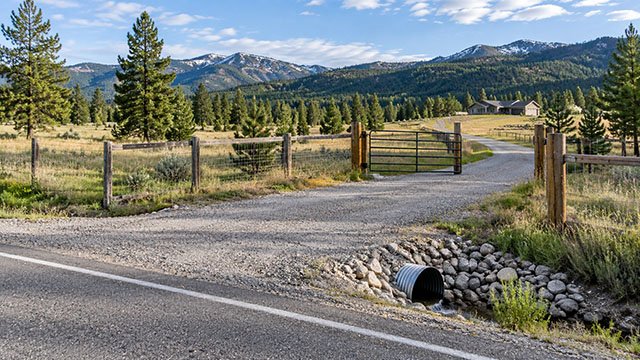
A rural parcel is only as useful as the access that actually works
Rural land can have great views, good soil, and enough room for a home, but access problems can still make the property expensive or difficult to develop.
The key questions are whether you have legal access, whether the existing road can physically handle construction traffic, whether a new driveway needs approval, whether culverts or sight-distance improvements are required, and who is responsible for maintaining a private road.
Those issues should be investigated before closing because fixing access later can require permits, easements, road work, neighboring cooperation, and substantial additional cost.
Legal access and physical access are not the same thing
A parcel can have a recorded right to reach the property while still having a poor road, steep grade, narrow gate, failing culvert, or seasonal route that is difficult for construction equipment.
The reverse can also happen: a road may physically cross the land, but the title documents may not clearly establish a permanent right for the buyer to use it.
Evaluate both. Title and easement documents address the legal side, while a site visit and contractor review address the physical side.
Start with the title report, survey, and recorded easements
Before relying on a road or driveway, review the preliminary title report, recorded plat, survey, and any easement documents affecting the route.
Look for the easement location, width, benefiting and burdened parcels, access purpose, maintenance language, utility rights, gate provisions, and any restrictions that could affect construction or future use.
If the access language is unclear, have the title company and an Idaho real-estate attorney explain what the recorded documents actually provide.
Do not assume an old road creates the access rights you need
A visible two-track, ranch road, logging road, or driveway is evidence of physical use, but it is not a substitute for reviewing the recorded legal access.
The road may be permissive, seasonal, shared, relocated over time, or subject to terms that are not obvious from the ground.
If the property depends on crossing another parcel, confirm the recorded access before treating the route as permanent.
Private-road maintenance should be understood before closing
A shared private road creates ongoing obligations that can matter as much as the original purchase price.
Ask who grades the road, plows snow, maintains ditches and culverts, repairs washouts, replaces gravel, removes fallen trees, and pays for major reconstruction.
If there is a road-maintenance agreement, read it. If there is no clear agreement, understand that future costs and disputes may be harder to predict.
A private road that works in summer may fail in winter or spring
Idaho access conditions can change dramatically with snow, freeze-thaw cycles, runoff, mud, and spring breakup.
A road that looks acceptable during a dry August property tour may become difficult for a moving truck, concrete truck, septic installer, or emergency vehicle during another season.
Ask neighboring owners and local contractors how the route performs through winter and spring rather than judging it from one visit.
State highway access requires an ITD approach permit
If a new driveway, private road, or street connects directly to an Idaho state highway, the Idaho Transportation Department regulates that approach through its right-of-way encroachment permit process.
ITD states that an approach permit is required for new approaches to a state highway and for changes to the use, width, or location of an existing highway approach.
Do not begin work in state highway right-of-way until the permit has been approved.
The ITD approach process is about safety as well as location
ITD reviews driveway and road approaches for factors such as sight distance, traffic conditions, spacing from other access points, drainage, culverts, and the design of the connection.
The department may require additional information, construction details, traffic-control plans, or local land-use approval depending on the project.
A parcel fronting a state highway does not automatically mean the owner can place a driveway anywhere along that frontage.
ITD may require local land-use approval first
ITD's approach-permit guidance notes that the department may require documentation of local land-use approval before processing the highway-access application.
That means the driveway decision can be connected to county or city planning, subdivision approval, or the final use of the property.
Coordinate the land-use and road-access processes early so one agency does not design around assumptions the other agency later changes.
An existing state-highway driveway may still need review if the use changes
ITD's guidance covers not only new approaches but also changes in the use, width, or location of an existing highway approach.
A driveway serving an agricultural field can create different traffic and design expectations than one serving multiple homes, a business, or a new subdivision.
If the property already has a state-highway access point, ask ITD whether the planned development changes the permitted use.
Local roads can have a different permitting authority
Many Idaho rural roads are managed by counties, highway districts, cities, or other local road agencies rather than ITD.
The required driveway or approach permit, culvert standard, inspection process, and fee can therefore vary by location.
Identify the road owner before assuming the state-highway process applies. The county planning office or local road agency can usually point you to the correct permitting authority.
The road name does not always tell you who maintains it
A road with a county-style name may still be private, while another road may be publicly maintained only up to a certain point.
Do not rely on map labels alone.
Ask the road authority whether the segment is public, who maintains it, where public maintenance ends, and whether the property has an approved approach.
Sight distance can control where a driveway goes
Curves, hills, vegetation, rock cuts, snowbanks, fences, and nearby intersections can limit how far a driver can see when entering a public road.
If the safe access point is different from the driveway location you prefer, the entire site plan may need to shift.
Confirm sight-distance requirements before placing the home, gate, mailbox, or driveway alignment.
Culverts are often part of rural driveway access
A driveway crossing a roadside ditch may need a culvert sized and installed to the road authority's requirements.
The culvert diameter, material, length, cover, end treatment, slope, and maintenance responsibility can all affect the final cost.
A poorly sized or poorly installed culvert can wash out the driveway, block drainage, or redirect water toward neighboring property.
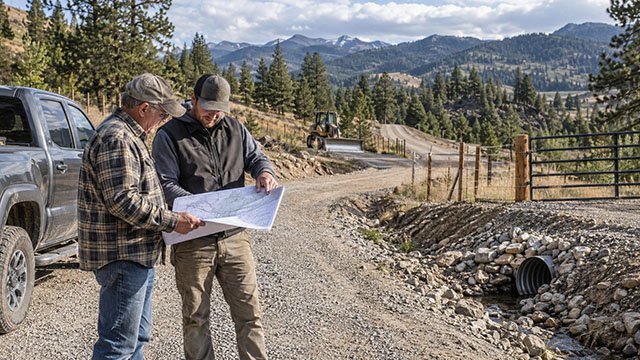
Driveway drainage should be designed before gravel is placed
The driveway needs to shed water without becoming the drainage path for the entire property.
Crown, cross-slope, ditches, rolling dips, water bars, culverts, and outlet protection can all be part of the design depending on terrain.
It is cheaper to establish drainage during initial excavation than to repair washed-out gravel and eroded shoulders after the first major runoff event.
Long rural driveways need more than a straight line on a map
A long driveway affects excavation, gravel volume, culverts, snow removal, utility routing, fire access, gates, turnouts, and future maintenance.
The cheapest-looking route may cross steep ground, soft soils, drainage channels, rock, or areas that complicate septic and utility placement.
Walk multiple possible alignments with an excavation contractor before finalizing the house location.
Steep grades can become a construction and winter problem
A driveway that is acceptable for a pickup may be difficult for concrete trucks, lowboys, propane deliveries, moving trucks, fire apparatus, or vehicles towing trailers.
Steep grades also become more difficult when covered with snow or ice.
Ask the road authority, fire district, and contractors what grades and transitions are practical for the planned use.
Switchbacks and tight curves can limit large equipment
Mountain parcels often use curves or switchbacks to manage grade, but turning radius matters.
A compact passenger vehicle can navigate a corner that a well-drilling rig, septic truck, modular-home delivery, or equipment trailer cannot.
Before construction starts, confirm the route works for the largest vehicles expected on the project.
Emergency access should be part of the driveway design
Local fire-district or building requirements can affect driveway width, vertical clearance, turnaround space, bridge or culvert capacity, addressing, and gate access.
A remote homesite may need a turnaround or pullout where ordinary residential driveways would not.
Contact the applicable fire district or building authority early, especially when the home will sit far from the public road.
Gates can create access problems if they are placed too close to the road
A gate placed immediately at the public-road edge can leave a truck, trailer, or emergency vehicle stopped in the traffic lane while someone opens it.
Local standards may require the gate to be recessed or set back far enough for a vehicle to clear the road.
Plan the gate, keypad, solar equipment, fencing, drainage, and turnaround together rather than adding them after the driveway is finished.
Winter maintenance can influence driveway width and layout
Snow plowing needs room to push and store snow without blocking ditches, gates, mailboxes, turnouts, or the main travel lane.
Narrow mountain driveways with steep banks can become progressively narrower as snow accumulates.
Include snow-storage areas and plow access in the layout if the property is in an area with significant winter snowfall.
Bridge and culvert load capacity matters for construction traffic
Private roads sometimes cross small bridges, large culverts, cattle guards, or other structures that were designed for ordinary local traffic rather than heavy construction equipment.
A concrete truck, well rig, excavator lowboy, crane, or septic delivery can weigh far more than a passenger vehicle.
If the route depends on a questionable structure, have its capacity evaluated before scheduling heavy deliveries.
Road width can become a hidden delivery constraint
A narrow access road with trees, rocks, ditches, mailboxes, or parked vehicles can prevent oversize materials or construction equipment from reaching the site.
This is especially important for trusses, steel-building components, modular sections, large tanks, and long equipment trailers.
Ask suppliers about delivery dimensions before assuming the existing access is adequate.
Utility easements and access easements should be coordinated
Rural projects often use the driveway corridor for electric, communications, water, or other utilities.
The recorded access easement may not automatically grant every utility right needed for trenching or utility maintenance across neighboring property.
Review the actual easement language and coordinate with the utility before assuming the road corridor can also serve as the utility corridor.
A driveway route can conflict with septic and well planning
Driveways can consume the same buildable ground needed for a drainfield, replacement area, well setbacks, utility trenches, and future buildings.
Heavy traffic over a drainfield or reserve area can damage soil and buried components.
Lay out access, septic, well, and utilities together before committing to one route.
A driveway can also become the utility trench
On some acreage projects, electric, communications, or water lines follow the driveway because the corridor already provides access for construction and future maintenance.
That can be efficient, but trench location, separation, conduit, culverts, road crossings, and future grading still need coordination.
Ask the utility and excavation contractor whether shared routing makes sense before the driveway base is installed.
Road improvements should be priced before you buy
An existing private road can look usable while still needing thousands of dollars in grading, drainage, culvert replacement, aggregate, widening, tree removal, or slope stabilization before construction traffic begins.
Have a local excavation or road contractor walk the route and identify the work needed to support the planned build.
Include that number in the land decision instead of treating access improvements as a future unknown.
Ask whether the road is maintained publicly, privately, or not at all
Public access and public maintenance are different concepts.
A road can be open for legal access while maintenance responsibilities still fall on private owners, an association, or a road group.
Verify who plows, grades, and repairs the route and whether those services are guaranteed, voluntary, or paid through an agreement.
Road associations can be useful but should be understood
Some private roads are managed through homeowner associations, road associations, or informal owner groups.
Ask for current dues, reserve balances, major planned repairs, meeting notes, maintenance standards, and any history of special assessments.
A low annual fee may not mean the road is inexpensive if a major bridge, culvert, or resurfacing project is approaching.
No maintenance agreement is itself useful information
If several parcels use the same private road but there is no written maintenance arrangement, the future cost-sharing process may be uncertain.
That does not automatically make the property unsuitable, but it should be treated as a due-diligence issue rather than ignored.
Understand how current owners handle snow, grading, gravel, culverts, and emergency repairs before assuming everyone will contribute equally.
Construction traffic can damage a road that was adequate before the build
Repeated dump trucks, concrete trucks, lowboys, and material deliveries can rut soft roads, crush culverts, break edges, and displace gravel.
A contractor may also require a wider or stronger route than the permanent residential driveway ultimately needs.
Budget for temporary construction access improvements and final road restoration when the route is marginal.
Seasonal road restrictions can affect scheduling
Some rural roads become vulnerable during spring thaw or prolonged wet periods.
Local agencies or private road managers may restrict heavy loads to avoid damage.
Ask about seasonal limits before setting foundation, well-drilling, excavation, or material-delivery schedules.
A driveway permit should be part of the preconstruction sequence
The approach permit may determine the approved entrance location before the private driveway can be fully designed.
That location then influences the driveway alignment, gate, utilities, house position, drainage, and construction staging.
Resolve the public-road connection first, then design the private portion of the access around it.
Do not clear the access corridor until the route is confirmed
Clearing a road path before confirming the legal easement, permit location, and practical grade can create unnecessary disturbance.
A later redesign may leave an abandoned cut, removed trees, erosion, or duplicated excavation.
Stake the approved route first, then clear only what the final access actually needs.
A practical Idaho rural-access due-diligence checklist
Use this checklist before removing the access contingency from a land purchase.
- Confirm the parcel has legal access
- Review the preliminary title report
- Obtain and read recorded access easements
- Compare the easement location with the actual road
- Confirm the road owner and maintenance authority
- Determine whether the road is public or private
- Ask where public maintenance ends
- Review any private-road maintenance agreement
- Check current dues or road-association obligations
- Identify the authority that issues the driveway or approach permit
- Confirm whether the road is an Idaho state highway
- Ask whether the existing driveway is already permitted
- Verify whether a change in use requires a new or modified permit
- Check sight distance and driveway-spacing constraints
- Identify culvert and drainage requirements
- Walk the road in wet or winter conditions when practical
- Measure steep grades, tight turns, gates, and overhead clearance
- Confirm access for construction and emergency vehicles
- Check bridge, culvert, and cattle-guard capacity for heavy equipment
- Coordinate access with septic, well, utilities, and future buildings
- Price needed road improvements before closing
Questions to ask the road authority
The correct road agency can often answer the most important access questions before you purchase the parcel.
- Do you maintain this road?
- Is this segment public or private?
- Does this parcel have an approved driveway or approach?
- Will a new driveway permit be required?
- Can the existing approach be used for a new residence?
- Are there sight-distance or spacing issues at the proposed location?
- Is a culvert required, and who specifies the size?
- Are there driveway-width, grade, or surface requirements?
- Are gates or setbacks regulated?
- Are there seasonal load restrictions?
- Are inspections required before the approach is accepted?
Questions to ask about a private road or easement
These questions help uncover obligations that may not be obvious during a property tour.
- Who owns the road surface?
- Who has the right to use it?
- How wide is the recorded easement?
- Can the route be relocated?
- Does the easement allow utilities?
- Who pays for grading and gravel?
- Who pays for snow removal?
- Who repairs culverts, bridges, and washouts?
- Is there a road association or written maintenance agreement?
- Are there unpaid assessments or planned major repairs?
- Can construction traffic use the road?
- Are there gates or access-control rules?
Questions to ask an excavation or driveway contractor
A contractor can help translate the legal access into a real buildable route.
- Can concrete trucks and lowboys safely reach the homesite?
- Where are the steepest grades?
- Which sections need widening?
- Are any curves too tight for construction equipment?
- What culverts or drainage improvements are needed?
- How much gravel or base material is required?
- Will geotextile be useful in soft sections?
- Are there rock cuts, retaining walls, or slope-stabilization needs?
- Where should snow be stored?
- What will construction traffic do to the existing road?
- What temporary and final road work should be budgeted?
Use the driveway cost and drainage guides for the next step
Once the legal and permit path is clear, move to the construction budget.
AcreageReady's Idaho gravel-driveway cost guide covers excavation, base, aggregate, culverts, and long rural driveways, while the Idaho rural-driveway drainage guide covers ditches, culverts, snowmelt, and erosion control.
For buyers comparing raw parcels, the Buying Rural Land in Idaho and Build-Ready Land Cost guides help connect access with wells, septic, power, grading, and total development cost.
Good access is part of the property's real value
Two parcels with the same acreage and similar views can have very different development costs if one has legal, all-season, construction-ready access and the other depends on a narrow private road, uncertain easement, major culvert work, or a difficult state-highway approach.
Treat access as infrastructure, not simply as a line on a map.
Verify the legal rights, permitting authority, physical condition, maintenance obligations, and construction needs before deciding what the land is really worth to your project.
Keep researching
Acreage Planning resources
Due diligence, development sequencing, utilities, access, and the decisions that shape a rural property project.
Sources & methodology
Where this information comes from
Cost figures are planning references rather than contractor quotes. Permitting, system-selection, and location-specific guidance should be verified with the appropriate local authority or qualified professional. AcreageReady uses source-backed, AI-assisted editorial workflows and remains responsible for the material it publishes. Read how we research, edit, and correct guides.
- Idaho Transportation Department: Right-of-Way Encroachment Permit FAQ
- Idaho Transportation Department: ITD 2109 Approach Permit
- Idaho Transportation Department District 3 Permit Reference
- Idaho Transportation Department District 1 Permit Reference
- Idaho Transportation Department: Department Directory and Permit Contacts
- AcreageReady: Rural Driveway Drainage in Idaho
- AcreageReady: How Much Does a Gravel Driveway Cost in Idaho?
- AcreageReady: Buying Rural Land in Idaho
- AcreageReady: How Much Does It Cost to Make Rural Land Build-Ready in Idaho?
Common questions
Frequently asked questions
Do I need a permit for a driveway onto an Idaho state highway?
Yes. ITD requires a right-of-way encroachment approach permit for new approaches to a state highway and for certain changes to the use, width, or location of an existing approach.
Who permits a driveway on a county or local road in Idaho?
The responsible agency varies by location and may be a county, highway district, city, or other local road authority. Confirm road ownership before applying.
Does a visible private road prove I have legal access?
No. Physical use of a road does not replace review of the recorded title, easement, plat, and other legal documents establishing access rights.
Can an existing driveway onto a state highway need a new permit?
Possibly. ITD guidance states that changes to the use, width, or location of an existing highway approach can require approval.
Why does sight distance matter for a rural driveway?
Road agencies use sight distance to determine whether drivers can safely enter or leave the roadway. Curves, hills, vegetation, intersections, and other features can limit where an approach is approved.
Who maintains a private road in Idaho?
Maintenance depends on the recorded documents, road agreement, association rules, ownership, and local arrangement. Buyers should review those documents rather than assume a public agency will maintain the road.
Should I inspect access before buying rural land?
Yes. Review both legal access and physical access, including road condition, grades, curves, culverts, drainage, bridge capacity, gates, winter conditions, and construction-equipment access.
Can a driveway affect septic and utility planning?
Yes. The access corridor can compete with septic reserve areas, well setbacks, utility trenches, drainage, and future buildings, so those systems should be laid out together.
Ready to talk with a local professional?
Share your location and project details so AcreageReady can identify relevant providers as the network grows.
Get a free quote