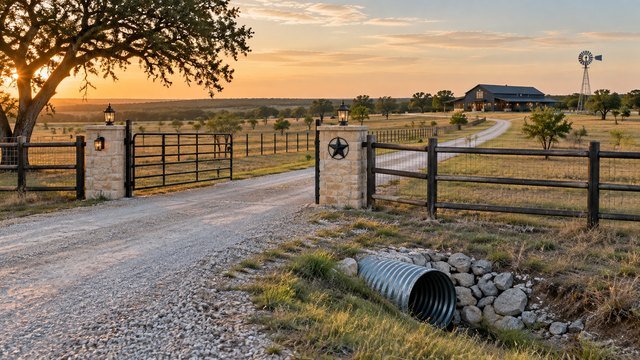
The driveway is one of the first real infrastructure costs on acreage
A rural driveway is more than a strip of gravel between the road and the house. It is the access route for surveyors, utility crews, excavation equipment, concrete trucks, septic installers, delivery vehicles, emergency responders, trailers, and eventually your daily traffic.
On a suburban lot, driveway cost may be a finishing decision. On acreage, it can be one of the first major development expenses.
The cost depends heavily on length, soil, drainage, clearing, grading, base depth, culverts, material availability, truck access, and whether the driveway must cross a state or county right of way.
A quick rural-driveway cost range
For planning purposes, national 2026 cost guides commonly place professionally installed gravel driveways around $4 to $10 per square foot, although simpler projects can fall below that range and difficult rural projects can exceed it.
A 100-foot-long driveway that is 10 feet wide contains about 1,000 square feet, which puts a rough national planning range around $4,000 to $10,000 before unusual site work.
Long acreage driveways can become much more expensive because clearing, excavation, drainage, multiple material layers, trucking distance, and culverts scale with length.
- 100 ft x 10 ft = about 1,000 sq. ft.
- 250 ft x 12 ft = about 3,000 sq. ft.
- 500 ft x 12 ft = about 6,000 sq. ft.
- 1,000 ft x 12 ft = about 12,000 sq. ft.
Why a 500-foot rural driveway is not simply five times a 100-foot driveway
Long rural drives often cross changing terrain. One section may be flat while another crosses a ditch, low spot, clay area, drainage swale, or slope.
Longer drives also need more truckloads of base and surface material, more equipment time, more compaction, more drainage control, and often more turnaround or passing space.
The result is that cost does not always scale perfectly by length. Difficult sections can dominate the budget.
The biggest cost factor is what is under the gravel
A durable gravel driveway depends on the foundation underneath it.
If the native soil is firm and well drained, preparation may be relatively straightforward. If the property has soft clay, organic soil, deep mud, expansive soil, or repeated water flow, the contractor may need to undercut material, add geotextile, bring in additional base, or raise the driveway elevation.
A cheap layer of decorative gravel placed directly over weak soil is one of the fastest ways to create ruts and potholes.
A rural gravel driveway is usually built in layers
The exact section depends on soil and expected traffic, but rural drives commonly use a compacted subgrade, larger aggregate or road base, and a finer top layer.
Heavy construction traffic may justify a stronger temporary or permanent base before the house is built.
The goal is to distribute vehicle loads, shed water, and keep the finished surface from mixing into the soil beneath it.
Gravel material cost is only part of the quote
Bulk gravel itself may look inexpensive when priced by the ton, but the installed driveway also includes trucking, spreading, grading, compaction, equipment mobilization, and site preparation.
Material delivery can become a major cost on rural property because a long driveway may require many truckloads.
Distance from the quarry or supplier matters, especially when the project needs hundreds of tons of base.
Clearing can add thousands before driveway construction begins
A wooded route may require tree removal, stump removal, brush clearing, and disposal before the first load of base arrives.
The cleared corridor also needs to be wider than the final driving surface in many areas so equipment can work, drainage can function, and visibility can remain safe.
Large trees near the entrance may also limit truck turning radius or sight distance.
Grading determines whether the driveway survives rain
A rural drive should not function like a shallow ditch.
The surface needs enough crown or cross slope to move water away, while the surrounding site needs ditches, swales, culverts, or other drainage features where appropriate.
Poor grading often shows up later as washouts, potholes, edge erosion, standing water, and repeated gravel replacement.
Culverts can be a small line item or a major one
Many Texas rural entrances cross a roadside ditch. That can require a culvert under the driveway so drainage continues along the road.
The pipe diameter, length, end treatments, excavation, bedding, backfill, cover, and erosion protection all affect cost.
Do not size a culvert by guessing. On state highway right of way, TxDOT requires drainage structures and design features to be approved, and the driveway cannot impede highway drainage.
If the property fronts a state highway, check TxDOT before building the entrance
TxDOT requires a driveway permit for new or modified access to property along the state highway system.
The property owner or authorized representative submits Form 1058 to the local TxDOT district, and construction in the right of way should not begin until the permit has been executed.
Texas guidance also addresses driveway geometry, drainage, culverts, and gate placement.
County-road entrances can have different rules
A driveway on a county road may be governed by county requirements rather than TxDOT.
Counties can have their own culvert, drainage, entrance, right-of-way, and permit standards.
Before budgeting the entrance, identify who maintains the road and ask that agency what approvals are required.
Gate placement matters more than most acreage buyers expect
A gate installed too close to the road can force a truck and trailer to stop partly in traffic while someone opens it.
TxDOT guidance for private farm and ranch driveways says the distance from the highway pavement to the gate should be sufficient to store the longest anticipated vehicle combination, with at least enough room for a pickup and trailer.
That setback can add driveway length, fencing, automation wiring, lighting, and grading to the entrance.
A wide entrance can save headaches during construction
The finished driveway may only need to serve passenger vehicles, but the construction phase must accommodate dump trucks, concrete trucks, equipment trailers, well rigs, septic equipment, and delivery vehicles.
A tight entrance can damage shoulders, fences, culverts, and nearby landscaping.
Design the entrance for the largest vehicle that will realistically use it, not only the truck you drive every day.
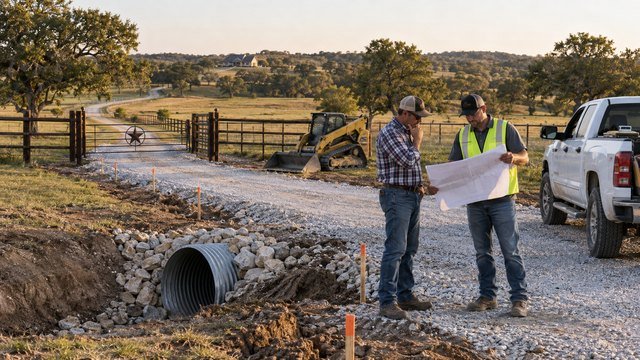
Driveway width affects both cost and usability
A narrow rural driveway costs less but can create problems when vehicles need to pass, turn around, or pull trailers.
Many private rural drives are built around 10 to 12 feet wide for a single travel lane, with wider areas at the entrance, curves, parking zones, or passing points.
If the drive will regularly serve large trailers, RVs, farm equipment, or two-way traffic, additional width may be worth the cost.
Curves cost more than straight runs
Curved drives can improve privacy and appearance, but they require more clearing, grading, material, and layout work than a direct route.
Tight curves can also create problems for long trailers and construction trucks.
Use curves intentionally for topography, trees, privacy, or safety rather than simply making the drive longer for appearance.
Slope can turn an easy driveway into a difficult project
Steep drives require careful grading, erosion control, drainage, and traction.
A driveway that climbs directly up a steep slope may wash out or become difficult for heavy trucks.
Sometimes a longer route across the contour is cheaper to maintain than a shorter but steeper route.
Low areas may require the driveway to be raised
If water routinely crosses the property, the driveway may need additional fill, larger culverts, stabilized crossings, or a raised road section.
That can dramatically increase the amount of material required.
Walk the proposed route after a heavy rain if possible before locking in the alignment.
Blackland clay changes the conversation
Many parts of Texas contain expansive clay that becomes sticky when wet and hard when dry.
A driveway built with insufficient base can pump, rut, and hold water as construction vehicles repeatedly cross it.
Local contractors who routinely build roads in that soil can often recommend a more realistic base section than a generic driveway estimate.
Rocky land can also raise costs
Shallow limestone, caliche, or rock can make excavation slower and harder on equipment.
Rock can be helpful when it creates a stable subgrade, but cutting a driveway through ledge or steep rocky terrain can be expensive.
The same site may contain both soft problem soils and difficult rock only a short distance apart.
Construction access and the finished driveway do not have to be identical
Some acreage projects benefit from building a strong gravel construction drive first, then adding the finished surface later.
This keeps concrete trucks and heavy equipment from damaging expensive finished paving.
The final driveway might remain gravel, receive a new top course, or later be upgraded to chip seal, asphalt, concrete, or pavers near the house.
Gravel is often the practical choice for long acreage driveways
Gravel is popular on rural property because it is comparatively affordable, easy to repair, and flexible when the site is still evolving.
A long concrete or asphalt driveway can quickly become a major budget item.
Many owners use gravel for most of the route and reserve concrete or another premium surface for the apron, parking court, garage approach, or residential core.
Concrete makes more sense in selected areas
Concrete can be useful where vehicles turn sharply, where slopes are difficult, around the garage, or near the home where dust and loose aggregate are less desirable.
Using concrete strategically can provide a finished residential appearance without paving the entire rural drive.
The transition between gravel and concrete should be designed so runoff does not erode the gravel edge.
Long rural driveways need turnaround space
A dead-end drive should give delivery trucks, trailers, moving vans, septic trucks, fire apparatus, and future construction vehicles a practical way to turn around.
A simple hammerhead or large turnaround near the house or shop can prevent vehicles from backing hundreds of feet.
Local fire or building requirements may influence the size and design.
Emergency access should influence the design
Rural driveways are part of emergency infrastructure.
Gate width, driveway width, vertical clearance, turning radius, bridges, culverts, grades, and address visibility can affect whether emergency vehicles can reach the house.
For long or unusual driveways, it is worth asking the local fire department whether they have access recommendations.
Dust becomes part of daily life on long gravel drives
Dry Texas weather can turn a heavily traveled gravel driveway into a dust source.
Good aggregate selection, moisture management, speed control, vegetation, and proper maintenance can help.
If the driveway runs close to the house, pool, guest home, or neighbors, consider dust when planning the route.
Maintenance belongs in the budget
Gravel driveways are repairable, but they are not maintenance-free.
Expect periodic grading, pothole repair, drainage cleanup, edge work, weed control, and additional surface material.
A well-built base usually reduces the amount of recurring repair compared with repeatedly adding gravel to a weak road.
How much can a very long rural driveway cost?
Published 2026 consumer cost guides show why length matters. HomeGuide places professionally installed gravel driveways around $4 to $10 per square foot and gives a quarter-mile 12-foot-wide gravel road example around $15,000 to $60,000.
Those figures are broad national references, not Texas contractor quotes. A straightforward Texas project with nearby aggregate may differ substantially from a wooded, wet, rocky, or steep property.
For acreage due diligence, the important step is to measure the route and obtain local site-specific pricing before closing when driveway cost could affect the purchase.
A simple way to compare two properties
Suppose one parcel has a homesite 150 feet from the road and another has the ideal homesite 900 feet back.
The second property may feel more private, but it can require hundreds of additional feet of clearing, base, gravel, drainage work, utilities, fencing, and maintenance.
That does not make the deeper homesite a bad choice. It simply means the driveway should be counted as part of the land price.
Questions to ask a driveway contractor
A useful quote should explain more than the price per foot.
- What width are you pricing?
- How much clearing is included?
- Will you strip topsoil?
- What subgrade preparation is needed?
- Is geotextile recommended?
- What base material and depth are included?
- What surface material and depth are included?
- How many truckloads are expected?
- Is compaction included?
- How will the drive be crowned or sloped?
- Are roadside ditches included?
- Are culverts included?
- Are entrance permits included?
- Is a turnaround included?
- How will soft spots be handled?
- What happens if rock is encountered?
- What maintenance should I expect?
Rural driveway budgeting checklist
Use this list when estimating access costs before buying or developing land.
- Entrance permit
- Survey or staking
- Tree and brush clearing
- Stump removal
- Topsoil stripping
- Earthwork and grading
- Geotextile if needed
- Road base
- Surface gravel
- Material delivery
- Compaction
- Roadside drainage
- Culvert and end treatments
- Gate setback
- Gate and opener
- Turnaround or parking area
- Construction staging
- Dust control
- Future resurfacing
- Contingency for soft soil, rock, and drainage surprises
Build the driveway for the property you are actually creating
The cheapest driveway is not always the lowest-cost driveway over time.
A rural access road that is too narrow, poorly drained, or built on weak soil can require repeated repair while creating problems for construction and emergency access.
Measure the full route, understand the soil and drainage, confirm entrance requirements, and build enough foundation for the vehicles the property will actually see.
Keep researching
Land & Site Work resources
Clearing, grading, drainage, driveways, pads, excavation, and preparing acreage for construction.
Sources & methodology
Where this information comes from
Cost figures are planning references rather than contractor quotes. Permitting, system-selection, and location-specific guidance should be verified with the appropriate local authority or qualified professional. AcreageReady uses source-backed, AI-assisted editorial workflows and remains responsible for the material it publishes. Read how we research, edit, and correct guides.
- TxDOT: Driveway Permits, Design, and Materials
- TxDOT: Driveway Design
- TxDOT: Driveway Drainage
- TxDOT: Driveways
- Angi: How Much Does a Gravel Driveway Cost? 2026
- HomeGuide: Gravel Driveway Cost 2026
- HomeGuide: Gravel Prices and Rural Road Cost
- AcreageReady: How to Lay Out 5, 10, or 20 Acres
- AcreageReady: How to Evaluate Raw Land Before Building a House
- AcreageReady: The Right Order for Developing Rural Land
Common questions
Frequently asked questions
How much does a gravel driveway cost in Texas?
Texas pricing varies significantly by location, material source, soil, drainage, clearing, and driveway length. National 2026 planning references commonly show professionally installed gravel driveways around $4 to $10 per square foot, but local Texas quotes may fall above or below that range.
How much does a 500-foot gravel driveway cost?
A 500-foot driveway that is 12 feet wide contains about 6,000 square feet. Applying broad national installed gravel-driveway ranges can produce a very wide budget, so site-specific quotes are important. Clearing, base depth, drainage, trucking distance, and culverts often determine the final cost.
Do I need a permit for a rural driveway in Texas?
It depends on the road. New or modified driveways connecting to the Texas state highway system require TxDOT approval. County roads may have separate county requirements. Verify the road authority before construction.
Who pays for a rural driveway culvert?
The property owner commonly bears the cost of private driveway construction, including required drainage features, but responsibility and specifications depend on the road authority and permit. Confirm requirements before ordering materials.
How wide should a rural driveway be?
Many single-lane rural drives are around 10 to 12 feet wide, with wider entrances, curves, turnarounds, or passing areas. The right width depends on trailers, construction equipment, emergency access, and local requirements.
Should I build the driveway before the house?
Usually some form of stable construction access is needed early so surveyors, utilities, well drillers, septic contractors, concrete trucks, and builders can reach the homesite. The final finish surface can be added later.
Ready to talk with a local professional?
Share your location and project details so AcreageReady can identify relevant providers as the network grows.
Get a free quote