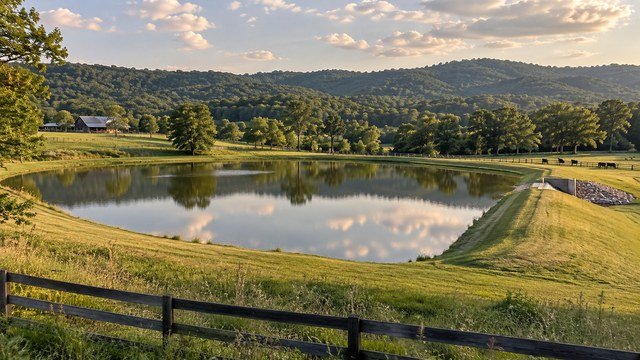
A Tennessee pond is a land-development project, not just a hole in the ground
A farm pond can add livestock water, irrigation capacity, fishing, wildlife habitat, recreation, fire protection, and visual appeal to rural Tennessee acreage. But successful ponds depend on far more than excavation.
The site has to collect enough water, the soil has to hold it, the dam and spillway have to handle storms, and the project has to avoid creating drainage, erosion, stream, wetland, or downstream-safety problems.
The most expensive pond is often the one that is dug before those questions are answered.
Pond construction cost varies more by earthwork than by surface acreage
National 2026 planning guides often place small farm ponds in the low five figures and larger one-acre projects well above that, but Tennessee costs can move sharply depending on excavation volume, rock, soil sealing, access, dam construction, and spoil handling.
A current national farm-pond guide places many small projects under one-half acre around $3,000 to $15,000 and one-acre projects commonly around $20,000 to $50,000 or more. These should be treated as rough planning numbers, not Tennessee bids.
For rural acreage, the better budgeting method is to estimate how much material must be moved, whether a dam is required, whether excavated soil can stay on site, and whether the pond can seal naturally.
Old Tennessee NRCS cost scenarios show why cubic yards matter
A historical Tennessee NRCS pond cost scenario described a low-hazard excavated pond involving about 3,100 cubic yards of excavation. Although the dollar figures in that old scenario are no longer useful for 2026 pricing, the document is still useful because it shows how engineers think about pond cost: volume moved, equipment hours, operator time, mobilization, and associated practices.
That is why two quarter-acre ponds can have very different prices. One may need shallow excavation in easy material while another requires deep cuts, rock removal, a compacted embankment, and extensive spoil placement.
Ask contractors to explain the expected excavation volume and equipment plan instead of comparing only a single lump-sum number.
Start with the pond's purpose
The intended use influences almost every design decision.
A livestock pond may prioritize dependable water and safe animal access. A fishing pond may prioritize depth, habitat, shoreline shape, water quality, and long-term management. A swimming or recreational pond may need different banks, access, water-quality measures, and liability considerations.
If the pond must serve several purposes, tell the designer or contractor before excavation begins.
Watershed size determines whether the pond can stay full
A pond fed primarily by runoff needs enough contributing drainage area to replace water lost through evaporation, seepage, livestock use, irrigation, and overflow.
Too little watershed can leave the pond chronically low. Too much uncontrolled watershed can overwhelm the spillway and damage the dam.
A good site evaluation looks beyond the pond basin and maps the land that drains toward it.
Soil can decide whether the pond works at all
Clay-rich soils are often favorable because properly compacted clay can form a low-permeability seal. Sandy, gravelly, fractured, or highly variable soils can create seepage problems.
A pond site should be evaluated before full excavation so the contractor understands the soil profile and whether suitable material exists for the basin and embankment.
If native soil will not seal reliably, the project may require imported clay, bentonite, a synthetic liner, or a different site.
Rock can turn a straightforward dig into an expensive excavation
Tennessee geology varies considerably, and shallow rock can change the equipment, schedule, pond shape, and budget.
Excavators can handle some rock, but hard ledge, large boulders, or extensive rock excavation can increase cost quickly and may make a different pond location more practical.
Before accepting a fixed-price bid, ask how the contractor handles unexpected rock and how change orders will be priced.
Excavated ponds and embankment ponds are different projects
An excavated or dugout pond is formed mainly by removing soil below existing grade. An embankment pond relies more heavily on a constructed dam that impounds runoff across a drainage path.
Embankment ponds require careful foundation preparation, suitable fill, moisture control, lift placement, compaction, slopes, outlet structures, and spillway design.
Do not treat dam construction as ordinary grading. Poor compaction or a weak foundation can create leaks, settlement, erosion, or failure.
The spillway is one of the most important parts of the project
Every pond needs a safe way to pass excess water.
A principal outlet, emergency spillway, or combination of structures must be sized for the watershed and expected runoff. If stormwater flows over an unprotected part of the dam, erosion can rapidly damage the embankment.
Tennessee's intense rainfall events make overflow planning a core design issue rather than a finishing detail.
A farm pond can be exempt from Tennessee Safe Dams regulation and still need other permits
Tennessee's Safe Dams Program states that qualifying farm ponds are exempt from regulation under the Safe Dams Act when they are used only for agricultural and domestic purposes such as livestock or poultry watering, irrigation, recreation, and conservation for the owner or occupant, family, and invited guests.
The same state guidance explicitly warns that a farm-pond exemption from the Safe Dams Act does not automatically exempt the project from other requirements.
That distinction is one of the most important permitting points for Tennessee landowners.
Tennessee's regulated-dam thresholds matter for larger projects
TDEC defines a dam for Safe Dams purposes as a structure that is at least 20 feet high or that impounds 30 acre-feet or more at maximum pool, subject to statutory and regulatory qualifications.
A non-federal dam that falls within the program generally requires state approval, and construction plans may have to be prepared and submitted by a Tennessee-licensed professional engineer.
If your project is anywhere near those thresholds, contact the Safe Dams Program before design and excavation.
Farm-pond status depends on how the impoundment is used
The Safe Dams farm-pond exemption is not simply based on rural location or acreage.
TDEC describes exempt farm ponds as impoundments used for specified agricultural and domestic purposes for the farm owner or occupant, family, and invited guests, and not where the water, privileges, or products of the water are available to the general public.
Commercial recreation, public access, fee fishing, events, or other uses can raise different questions. Ask TDEC rather than assuming the exemption applies.
Building a pond in a stream or creek can trigger ARAP review
Tennessee requires an Aquatic Resource Alteration Permit, or ARAP, for many physical alterations to waters of the state.
TDEC lists dams, weirs, dikes, levees, dredging, excavation, channel relocation, diversions, road crossings, and wetland filling among activities that can require authorization.
TDEC's Safe Dams guidance also states that construction of dams on streams or creeks in Tennessee requires an ARAP in most cases.
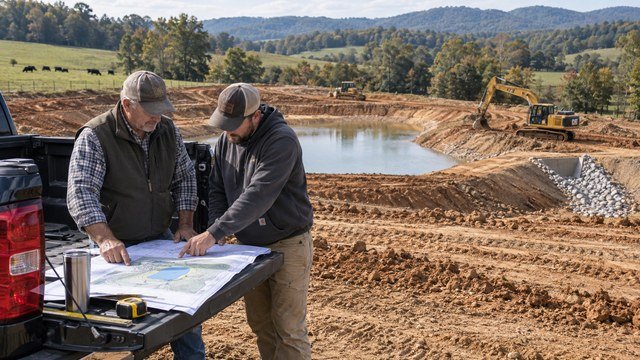
Wetlands can create a separate permitting problem
A low area that looks like an ideal pond location may contain regulated wetlands.
Excavating, draining, flooding, or filling wetlands can trigger Tennessee ARAP or Section 401 requirements, and federal Section 404 authorization from the U.S. Army Corps of Engineers may also apply to dredged or fill material placed in waters of the United States.
Do not clear or excavate a questionable wet area until jurisdiction and permitting have been reviewed.
Federal and TVA approvals may also apply
Tennessee's Safe Dams Program warns that some projects may require U.S. Army Corps of Engineers Section 404 authorization and, in TVA-regulated areas, a TVA Section 26a permit.
The agencies can evaluate different impacts, so satisfying one program does not automatically satisfy the others.
For a pond that affects a creek, wetland, reservoir shoreline, or other aquatic resource, regulatory coordination should happen before the contractor mobilizes.
Large disturbed areas can trigger construction stormwater requirements
Pond construction can disturb a surprisingly large footprint once the basin, dam, spoil areas, access routes, staging areas, and grading are counted.
Tennessee construction stormwater requirements can apply when land disturbance reaches applicable thresholds. Earlier AcreageReady Tennessee grading guidance discusses the one-acre construction-stormwater trigger and erosion-control planning in more detail.
Include erosion and sediment controls in the project plan rather than adding them after runoff problems begin.
Spoil management can save or destroy a budget
Every cubic yard removed from the pond has to go somewhere.
If suitable material can be used for the dam, building pad, berms, road improvements, or gentle grading elsewhere on the property, the excavation may create useful material.
If spoil has to be loaded, hauled, and disposed off site, trucking can become a major cost. Decide where material will go before digging.
Equipment access matters before excavation starts
Large excavators, dozers, articulated trucks, compactors, and service vehicles need safe access to the pond site.
Soft ground, narrow gates, steep approaches, weak bridges, overhead utilities, and long haul routes can slow production and increase mobilization or restoration costs.
If the future home, driveway, or utility route will use the same corridor, coordinate the work so one project does not damage another.
The pond should fit the property's broader drainage plan
A pond changes how water moves across the acreage.
The inlet, normal pool, outlet, emergency overflow, dam, and downstream discharge should be considered together with roads, culverts, homesites, septic areas, neighboring properties, and natural drainage paths.
A pond that solves one drainage problem can create another if overflow is redirected toward a driveway, structure, septic field, or neighboring parcel.
Do not place a house or critical infrastructure below a questionable dam
Downstream consequences should influence both pond location and home-site planning.
Even a pond outside the formal Safe Dams program can release significant water if an embankment fails.
A qualified designer can help evaluate the hazard, spillway capacity, freeboard, embankment geometry, and downstream path where the consequences justify professional review.
Pond leaks are usually cheaper to prevent than to repair
Leaks can develop through permeable soils, poorly compacted embankments, roots, animal burrows, improperly installed pipes, or connections between structures and fill.
Repairing an existing leaking pond can require lowering or draining the pond, excavating the failed area, recompacting soil, installing cutoff material, or adding sealants or liners.
Spend more effort on soil evaluation and compaction during construction rather than treating sealing as an optional upgrade.
NRCS can be a useful technical resource for agricultural landowners
USDA Natural Resources Conservation Service maintains Pond Conservation Practice Standard 378 and provides technical assistance through Tennessee field offices.
NRCS Tennessee states that conservation planners can provide resource assessment, practice design, monitoring, and information about potential financial-assistance programs for eligible agricultural producers and landowners.
Program eligibility and funding vary, so contact the local field office early if the pond is tied to livestock water, irrigation, conservation, or another agricultural resource concern.
A pond contractor should understand more than excavation
A skilled operator is important, but pond construction also requires judgment about soils, compaction, dam geometry, drainage, overflow, and water supply.
For more complex sites, the best team may include an experienced pond contractor plus an engineer, soil professional, surveyor, wetland consultant, or other specialist.
The contractor should also be willing to stop and refer the project for regulatory or engineering review when conditions fall outside ordinary excavation work.
Questions to ask a Tennessee pond contractor
A detailed conversation before mobilization can prevent expensive misunderstandings.
- How many farm or recreational ponds have you built in Tennessee?
- Will this pond be excavated, embankment-based, or a combination?
- How will you evaluate whether the native soil will seal?
- How much material do you expect to excavate?
- Where will the spoil be placed?
- What happens if rock or unsuitable soil is encountered?
- How will the dam foundation be prepared and compacted?
- How will the principal outlet and emergency spillway be designed?
- How much watershed drains to this site?
- Who determines whether ARAP, Safe Dams, Section 404, TVA, or local permits are required?
- Is erosion-control work included?
- Will disturbed slopes be seeded and stabilized?
- What work is excluded from the quoted price?
- How are unforeseen conditions and change orders handled?
Questions to answer before choosing the pond location
The best-looking location is not always the best engineering location.
- What is the pond's primary purpose?
- How much acreage drains toward the site?
- Does the basin have suitable clay or other low-permeability soil?
- Is shallow rock likely?
- Does a stream, wet-weather conveyance, spring, or wetland cross the site?
- What lies downstream of a potential dam?
- Can heavy equipment reach the site safely?
- Where will excavated material go?
- Could the pond interfere with the home, septic system, driveway, utilities, or future shop?
- Where will emergency overflow travel during a major storm?
- Could the project affect neighboring property?
- Which permits or agency reviews apply before excavation?
Build a pond budget as separate line items
A single excavation allowance makes it difficult to see where risk is hiding.
- Survey and site layout
- Soil investigation or test excavation
- Engineering if needed
- Wetland or stream review if needed
- State, federal, TVA, and local permits if applicable
- Equipment mobilization
- Clearing and grubbing
- Excavation
- Rock removal
- Dam construction and compaction
- Principal outlet or drain
- Emergency spillway
- Clay, bentonite, or synthetic liner if needed
- Spoil spreading or hauling
- Erosion-control measures
- Seeding and stabilization
- Dock, aeration, fencing, or livestock access
- Fish habitat and stocking
- Contingency
The bottom line
A good Tennessee farm pond begins with water supply, soil, drainage, and safe overflow, not excavation.
Small qualifying farm ponds may be exempt from the Tennessee Safe Dams Act, but stream, wetland, stormwater, federal, or TVA requirements can still apply. Larger or higher-hazard dams need more formal review.
Treat the pond as part of the property's full development plan. Verify the site, understand the permitting path, and get an itemized contractor scope before the first machine starts digging.
Sources & methodology
Where this information comes from
Cost figures are planning references rather than contractor quotes. Permitting, system-selection, and location-specific guidance should be verified with the appropriate local authority or qualified professional. AcreageReady uses source-backed, AI-assisted editorial workflows and remains responsible for the material it publishes. Read how we research, edit, and correct guides.
- Tennessee Department of Environment & Conservation: Safe Dams Program
- Tennessee Department of Environment & Conservation: Certificate of Approval and Safety for Dams
- Tennessee Department of Environment & Conservation: Aquatic Resource Alteration Permit
- USDA NRCS: Pond Conservation Practice Standard 378
- USDA NRCS Tennessee
- USDA NRCS: Ponds Planning, Design and Construction Handbook
- Pro Operator Network: 2026 Farm Pond Construction Cost Guide
- AcreageReady: Buying Rural Land in Tennessee
- AcreageReady: Tennessee Land Clearing & Grading Costs
- AcreageReady: Tennessee Flood Zones & Drainage
- AcreageReady: Tennessee Land Surveys & Property Lines
- AcreageReady: Tennessee Easements & Legal Access
Common questions
Frequently asked questions
How much does it cost to build a farm pond in Tennessee?
There is no dependable statewide flat price. National 2026 planning guides commonly place small farm ponds in the low five figures and one-acre ponds around $20,000 to $50,000 or more, but Tennessee pricing depends heavily on excavation volume, rock, soil sealing, dam and spillway work, access, spoil handling, and permits. Local bids are essential.
Do I need a permit to build a farm pond in Tennessee?
Possibly. A qualifying private farm pond can be exempt from the Safe Dams Act, but that does not automatically exempt it from ARAP, construction stormwater, federal Section 404, TVA Section 26a, or local requirements. Projects affecting streams, wetlands, or larger dams need particular attention.
What size dam is regulated in Tennessee?
TDEC describes a dam for Safe Dams purposes as a structure at least 20 feet high or one that impounds 30 acre-feet or more at maximum pool, subject to applicable exemptions and program rules. Contact the Safe Dams Program for a parcel-specific determination.
Are Tennessee farm ponds exempt from Safe Dams rules?
Certain farm ponds are exempt when used only for qualifying agricultural and domestic purposes for the farm owner or occupant, family, and invited guests and not made available to the general public. Other environmental permits may still apply.
Do I need an ARAP to dam a creek in Tennessee?
TDEC states that construction of dams on streams or creeks requires an Aquatic Resource Alteration Permit in most cases. ARAP requirements can also apply to excavation, diversions, wetland impacts, crossings, and other alterations to waters of the state.
Can NRCS help with a Tennessee farm pond?
NRCS Tennessee offers technical assistance to agricultural producers and landowners and maintains conservation standards for pond design. Eligible applicants may also qualify for financial-assistance programs depending on the resource concern, program, and current funding cycle.
How do I know if my soil will hold water?
Clay-rich, well-compacted soil is often favorable, while sandy, gravelly, fractured, or highly permeable material can leak. A contractor or qualified designer should inspect the soil profile before full excavation. Test excavation or soil evaluation may be appropriate.
What is the most important part of a pond dam?
Several components work together, but foundation preparation, proper compaction, stable embankment geometry, and correctly sized principal and emergency spillways are especially important. Poor overflow design can cause erosion and dam failure during major storms.
Ready to talk with a local professional?
Share your location and project details so AcreageReady can identify relevant providers as the network grows.
Get a free quote