There is no reliable statewide price per foot for rural electric service
The cost to bring electricity to Alabama acreage depends on the serving utility, distance to existing distribution facilities, required line extension, terrain, right-of-way, transformer needs, overhead or underground construction, road crossings, customer-owned equipment and the expected load. A generic per-foot number is useful only as a rough screening tool. The serving utility's written design and cost estimate should drive the actual budget.
Related: Power, water, septic and internet for rural Alabama land
Identify the serving utility before estimating anything
Alabama rural properties may be served by Alabama Power, an electric cooperative, a municipal system or a TVA-related local provider. Rules, extension allowances, customer contributions and construction standards are not identical. The Alabama Public Service Commission regulates Alabama Power as the state's investor-owned electric utility, while electric cooperatives and municipal systems are generally outside the Commission's electric rate-and-service jurisdiction. Start by confirming who actually serves the parcel.
Related: Buying rural land in Alabama
Distance to existing distribution is one of the biggest cost drivers
A parcel with a usable distribution line along the road is a different project from acreage where facilities must be extended hundreds or thousands of feet. Ask the utility where its existing facilities are, whether they have capacity for the proposed load and what extension is required to reach the approved service point. Do not assume a visible power line can serve the property.
Utility extension policies determine what the customer may pay
Alabama PSC general rules require regulated utilities to maintain an extension policy for projects where an extension exceeds what regular rates support and the customer must pay some or all of the cost. Alabama Power's filed rules contain specific line-extension and service-connection provisions. Cooperatives establish their own applicable policies. This is why two similarly sized rural projects can produce different customer contributions.
Separate utility-owned construction from customer-owned electrical work
A complete project often has two scopes. The utility handles the facilities it owns under its rules, while the property owner may be responsible for meter equipment, service equipment, conduit or trenching where applicable, grounding, panels, feeders to buildings and electrician work. Ask the utility to mark the ownership boundary so contractor quotes do not omit half the project.
Overhead service can be simpler, but the site still matters
Where overhead construction is permitted and practical, poles and overhead conductors may avoid some trenching. Costs can still rise with long distances, difficult pole locations, road or creek crossings, vegetation clearing, easements, unusual engineering or additional transformer requirements. The utility determines the acceptable route and construction method for its facilities.
Underground service changes the construction scope
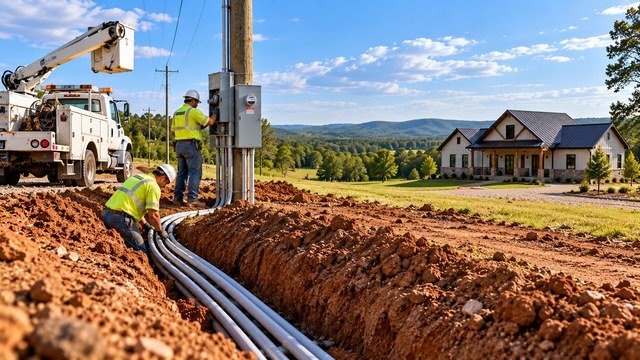
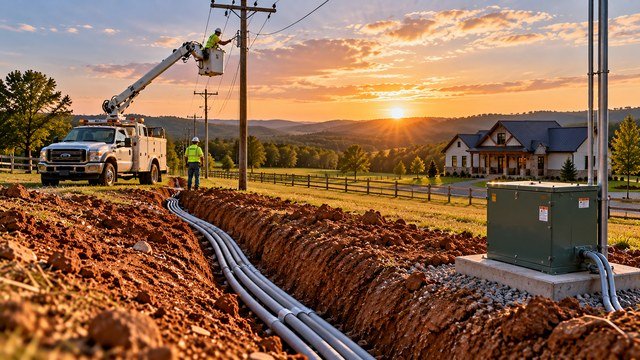
Underground service can reduce visible overhead lines but may require trenching, conduit, specified backfill, pull boxes or other facilities depending on the serving utility and design. Alabama Power's filed rules include provisions for residential underground service from overhead lines. Before hiring an excavation contractor, obtain the utility's current specifications and determine exactly which trenching or conduit work the customer is permitted or required to provide.
Long private driveways can create expensive service layouts
A house placed deep into acreage may require a much longer route than a homesite near the road. The preferred house location should therefore be evaluated alongside electric-service cost, not after the site plan is fixed. Sometimes moving the meter or building location can materially change the amount of utility and customer-owned infrastructure required.
Transformer requirements depend on the load and utility design
The serving utility evaluates the electrical demand and determines the distribution equipment required. A normal residence, large shop, well pump, electric HVAC, water heating, EV charging and other loads should be disclosed during planning. Large or unusual loads can affect transformer sizing, service configuration and potentially the cost or schedule.
Three-phase power is a different question from ordinary residential service
Buyers planning commercial shops, manufacturing equipment, large motors or other specialized uses should not assume three-phase service is available at the parcel. Confirm availability and extension requirements with the utility before purchasing land for a use that depends on it. Extending specialized facilities can be a very different project from establishing standard residential service.
Easements and rights-of-way can control the route
Utilities may need appropriate easements or rights-of-way to construct, operate and maintain facilities. Central Alabama Electric Cooperative's bylaws, for example, provide for member-granted easements and rights-of-way for distribution and service facilities. On any rural parcel, resolve ownership, access and easement issues before assuming a preferred route is available.
Vegetation clearing can become a separate land-development cost
A wooded route may require clearing or trimming before facilities can be installed and maintained. Determine who is responsible for clearing, how wide the required corridor must be and whether trees outside the immediate route create conflicts. Clearing should also be coordinated with the driveway, water line and other planned infrastructure to avoid paying for repeated disturbance.
Related: Alabama raw land development costs
Road crossings and other obstacles can increase complexity
Public roads, private roads, creeks, steep slopes, wetlands, rock and other obstacles can change routing and construction methods. The cheapest-looking straight line on a map may not be the approved or practical route. Have the utility evaluate the actual property rather than estimating solely from aerial imagery.
The meter location is a planning decision, not an afterthought
The utility will have standards for the service and meter location. If the meter is placed near the road while the home sits far back, the owner may still need substantial customer-owned distribution beyond the meter. Compare the complete cost and maintenance implications of the approved alternatives before finalizing the house pad.
Budget the meter base, service equipment and electrician separately
Even when the utility's extension is inexpensive, customer-side electrical work can be significant. A licensed electrical contractor can help budget the meter base or service equipment, main disconnect, grounding, panel, feeders, conduit and connections required for the planned buildings. Obtain the utility's current service specifications before equipment is purchased.
A well pump adds electrical requirements to a rural project
Properties using a private well need power at the well or pump controls as designed. Include that load and the route between the service, well and home when planning electrical work. Coordinating water and power trench routes can sometimes reduce site disturbance, but installations must still comply with applicable separation, electrical and utility requirements.
Powered septic equipment should be included in the load plan
Some onsite sewage designs use pumps, controls or treatment components. If the septic design requires power, include it in the electrical site plan rather than discovering the need after trenches and panels are complete. Coordinate the final septic layout with the electrician and other contractors.
Temporary construction power is not the same as permanent service
A builder may need temporary power before the permanent house service is ready. Alabama Power's filed rules separately address non-permanent and construction power or temporary service. Ask the serving utility and builder how temporary service will be handled, what equipment is required and whether any costs are separate from the permanent installation.
Construction timing can affect the entire build schedule
Utility design, easements, material availability, clearing, inspections and construction scheduling can take time. Contact the utility early enough that power does not become the critical-path delay after the foundation or house is ready. For raw land, begin utility conversations during due diligence whenever possible.
Do not clear or trench before the utility approves the route
A property owner can waste substantial money by preparing the wrong corridor. Get the utility's design, specifications and responsibilities before excavation or clearing. Confirm whether customer-provided trenching is allowed, who inspects it and what must happen before it can be backfilled.
Ask for a written utility estimate and understand its assumptions
A useful estimate should make clear the proposed route, facilities, customer contribution, customer responsibilities, expiration period and conditions that could change the price. Ask whether the estimate assumes a particular load, building type, service location, right-of-way condition or construction schedule.
Compare homesite alternatives before accepting a costly extension
If the first design is expensive, ask whether another approved service point or homesite would materially reduce the project. On large acreage, a change of several hundred feet can alter line-extension, trenching and private feeder requirements. Balance electrical savings against septic suitability, well location, driveway cost, drainage and the owner's long-term goals.
Coordinate electric service with the driveway
The driveway often provides the most practical access corridor into rural property, but electric facilities, drainage structures, road setbacks and future widening still need coordination. Plan both systems together so poles, underground facilities and culverts do not conflict with construction traffic or future improvements.
Plan for future barns, shops and accessory buildings
If the long-term plan includes a barn, detached shop, RV connection, gate, irrigation equipment or other loads, discuss them with the electrician and utility during initial planning. It may be cheaper to make sensible capacity and conduit provisions during initial construction than to reopen finished areas later.
Large loads should be disclosed before equipment is ordered
Electric resistance heating, large HVAC systems, welders, compressors, vehicle charging and other significant loads can affect service design. Give the utility and electrician realistic information. Designing around an artificially small load can create redesign costs when the actual equipment is selected.
Backup power needs should be planned with the service equipment
Rural owners who want a generator or other backup system should discuss transfer equipment and critical loads with a qualified electrical contractor before the service equipment is finalized. Private wells are particularly important because loss of electric power can also mean loss of normal household water pressure.
Build an all-in electricity budget instead of one line-extension number
For early planning, separate utility extension or contribution, clearing and access, easement-related work, customer trenching or conduit where permitted, meter and service equipment, electrician labor, private feeders, temporary construction power, inspections and contingency. Replace allowances with written estimates as the design becomes specific.
Electricity is only one part of making acreage build-ready
A low-cost power connection does not make a parcel inexpensive to develop if the well, septic, driveway or grading is difficult. Compare the combined infrastructure picture before buying. This is especially important when choosing between a cheaper remote parcel and a more expensive parcel with utilities already near the homesite.
Related: Alabama raw land development costs · Best places to buy acreage in Alabama
A pre-purchase electric-service checklist for Alabama acreage
Identify the serving utility, confirm the nearest usable distribution facilities, discuss the proposed house and load, ask whether a line extension is required, obtain a preliminary route and cost estimate, understand overhead versus underground options, identify easement and clearing needs, estimate customer-owned electrical work and allow enough schedule for utility construction.
Questions to ask the utility before buying or building
Ask whether the parcel is in the utility's service territory, where existing facilities are located, whether capacity is available, what extension is required, how the customer contribution is calculated, who provides clearing and trenching, what easements are needed, where the meter can be located, what temporary-power options exist and how long the estimate remains valid.
The most useful cost estimate comes from the actual parcel
Rural electric service is an engineered utility project, not a commodity priced by one statewide rate per foot. The best budget combines the serving utility's current written extension estimate with contractor pricing for the customer-owned side of the installation. Get those numbers before the homesite and construction budget are locked.
Sources & methodology
Where this information comes from
Cost figures are planning references rather than contractor quotes. Permitting, system-selection, and location-specific guidance should be verified with the appropriate local authority or qualified professional. AcreageReady uses source-backed, AI-assisted editorial workflows and remains responsible for the material it publishes. Read how we research, edit, and correct guides.
Common questions
Frequently asked questions
How much does it cost to run electricity to rural land in Alabama?
There is no dependable statewide flat price. Cost depends on the serving utility, distance to existing facilities, line-extension policy, overhead or underground construction, transformers, easements, clearing, obstacles and customer-owned electrical work. Obtain a parcel-specific utility estimate.
Who provides electricity to rural land in Alabama?
Depending on location, service may come from Alabama Power, an electric cooperative, a municipal utility or a TVA-related local provider. Confirm the serving utility for the exact parcel before estimating cost.
Does the Alabama Public Service Commission regulate every electric utility?
No. The APSC states that Alabama Power is the investor-owned electric utility under its electricity jurisdiction, while electric cooperatives and municipal systems are exempt from that state regulatory jurisdiction and TVA is not regulated by the APSC.
Is underground electric service more expensive than overhead service?
It can involve additional trenching, conduit and underground construction, but the actual customer cost depends on the serving utility's rules and the specific site. Request both approved options when available rather than relying on a generic comparison.
Can I trench the electric line myself?
Do not trench until the serving utility provides its current design and specifications. Some projects may allow or require customer-provided trench or conduit work, while others may not. The utility must define the acceptable route, materials, inspection and backfill process.
Do I need an easement for electric service on rural acreage?
An easement or right-of-way may be required for utility facilities. The serving utility determines what rights it needs for construction, operation and maintenance. Resolve easement issues before assuming a route is available.
Should I contact the power company before buying rural land?
Yes. A preliminary utility conversation can reveal whether usable facilities are nearby, whether a substantial extension is needed, possible routing or easement issues and what information is needed for a formal estimate.
What costs should I include beyond the utility line extension?
Budget for customer-owned service equipment, electrician work, private feeders, clearing, trenching or conduit where applicable, temporary power, site restoration and contingency in addition to any utility contribution.
Ready to talk with a local professional?
Share your location and project details so AcreageReady can identify relevant providers as the network grows.
Get a free quote