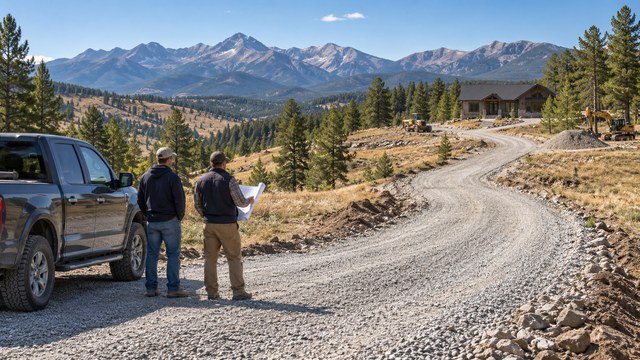
A rural Idaho driveway is more than a layer of gravel
The cost of a gravel driveway in Idaho depends on the length, width, depth, site preparation, drainage, slope, soil conditions, rock, and how much truck traffic the road must support during construction.
A short driveway on firm, well-drained ground may be relatively inexpensive. A long rural driveway that needs excavation, geotextile, multiple aggregate layers, culverts, ditching, imported rock, and heavy compaction can become a major development cost.
For acreage buyers, the driveway should be evaluated early because it controls whether drill rigs, septic equipment, concrete trucks, utility crews, and builders can reach the homesite.
A practical 2026 Idaho gravel driveway budget
Current 2026 national cost data puts many gravel driveway installations around $500 to $3,500, with costs commonly ranging from about $1 to $10 per square foot depending on material, driveway size, and site preparation.
Long rural driveways can run much higher. Angi lists a 2,000-square-foot long rural gravel driveway at roughly $3,500 to $6,000 or more before unusually difficult excavation, drainage, rock, or access conditions.
In Idaho, a conservative acreage budget should account for site preparation and drainage first, then calculate aggregate, hauling, spreading, and compaction based on the actual length and road section.
Driveway length is the first major cost driver
A 75-foot driveway and a 900-foot driveway are completely different projects even when they use the same gravel.
Long rural driveways require more excavation, more aggregate, more trucking, more grading, and more time to compact.
They may also need intermediate drainage crossings, turnouts, wider curves, and a larger turnaround near the house.
Width matters too
A narrow private drive uses less material, but it still needs enough width for construction traffic, emergency vehicles, snow removal, and safe passing at curves or steep sections.
Wider driveways increase the amount of excavation and aggregate required across the full length of the road.
Before choosing a width, check local access and fire requirements because some jurisdictions may require minimum travel widths or turnarounds.
Site preparation is often more important than the top layer
A gravel driveway performs only as well as the soil and base beneath it.
The site may need vegetation stripped, soft soil removed, high spots cut, low areas filled, and the subgrade shaped so water drains away from the travel surface.
Skipping this work can save money initially but often creates ruts, potholes, mud, frost damage, and repeated gravel replacement.
A strong driveway is usually built in layers
The visible gravel surface is only the final layer of a durable rural road.
A typical project may include prepared subgrade, geotextile where needed, larger crushed rock or road base, an intermediate aggregate layer, and a finer crushed surface course.
The exact section should reflect soil strength, drainage, vehicle loads, and local aggregate availability rather than using one standard depth everywhere.
Road base usually matters more than decorative gravel
Decorative rock can improve appearance, but it does not compensate for a weak base.
Crushed angular aggregate generally locks together better than rounded stone and is commonly used for structural driveway layers.
If the budget is limited, prioritize excavation, drainage, base thickness, and compaction before spending more on the final surface.
Current gravel prices vary by type and delivery distance
Angi's 2026 national pricing data places common driveway gravel roughly from $10 to $50 per ton for many basic materials, with some decorative products costing significantly more.
Material cost is only part of the delivered price. Trucking can become a major expense when the property is far from a quarry or gravel pit.
Ask contractors which local aggregate source they plan to use and whether the quoted price includes material, haul distance, fuel surcharges, spreading, and compaction.
Truck access can affect material cost before the driveway exists
Dump trucks need a safe way to reach the work area.
Weak culverts, soft entrances, tight turns, steep approaches, overhead branches, and narrow gates can limit the size of trucks that can deliver aggregate.
If large trucks cannot access the site, the contractor may need smaller loads or additional handling, which increases cost.
Geotextile fabric can be valuable on soft Idaho soils
Geotextile can help separate aggregate from weak native soil and reduce the tendency for road base to disappear into mud.
It is especially useful where the subgrade is wet, silty, clay-heavy, or repeatedly soft during spring thaw.
Fabric is not a substitute for drainage or proper base thickness, but it can improve the performance of the road section when used in the right conditions.
Drainage is the difference between a road and a mud trench
Water is one of the biggest causes of gravel driveway failure.
A durable driveway needs positive drainage so runoff moves off the road instead of collecting in wheel paths or saturating the base.
Crowning, cross-slope, roadside ditches, turnouts, water bars, and culverts may all be part of the drainage plan depending on terrain.
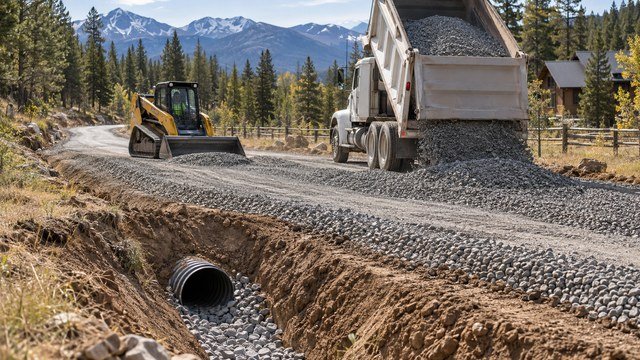
Culverts can add cost but prevent major washouts
Where a driveway crosses a roadside ditch, seasonal drainage, or concentrated runoff path, a culvert may be required.
The culvert must be sized, placed, bedded, and covered correctly so water can pass without washing out the driveway.
A poorly installed culvert can create erosion, backups, soft shoulders, or failure during spring runoff.
Driveway approaches onto state highways require approval
Idaho Transportation Department guidance states that private approaches and driveways within state highway right-of-way require an encroachment permit.
No work is allowed in the state highway right-of-way until the required permit has been approved.
For county roads or local highway districts, contact the agency that controls the road because local approach, culvert, and sight-distance requirements can differ.
Steep grades increase both construction cost and winter risk
A steep driveway requires more careful grading, drainage, traction planning, and erosion control.
It may also need deeper base material, switchbacks, larger turn radii, or a revised route to keep grades manageable.
In snowy parts of Idaho, a driveway that works in summer can become difficult for delivery trucks and daily vehicles during winter.
Snow removal should influence the driveway layout
Plan where snow will go before trees, fences, utilities, and landscaping are installed.
A long rural driveway needs room for plowing, snow storage, and turning equipment around.
Avoid creating narrow sections where snowbanks will reduce the usable travel width or block drainage during thaw.
Freeze-thaw cycles punish poorly drained roads
Idaho winters can freeze moisture trapped in the road base and subgrade.
When that moisture expands and later thaws, the road can soften, rut, and lose shape.
Good drainage, adequate structural aggregate, and compaction help reduce freeze-thaw damage far more effectively than simply adding another thin layer of surface gravel every spring.
Compaction is not optional on a construction driveway
Loose aggregate moves under heavy tires and does not provide the same support as properly compacted material.
The base should be placed in manageable lifts and compacted with equipment appropriate for the aggregate and road width.
Heavy construction traffic can expose weak sections quickly, so build the road for the trucks that will use it during construction, not only the cars that will use it after the house is complete.
A temporary construction road can become the permanent driveway
One efficient strategy is to establish the permanent driveway alignment early, build enough base for construction access, and complete the final surface after the heaviest construction traffic is finished.
This avoids paying for a temporary road that will later be abandoned.
The alignment should still be coordinated with the homesite, septic area, well, drainage, power route, and future shop before major work begins.
Basalt and rock can raise excavation costs
Some Idaho properties have shallow basalt, boulders, or rocky soils that make driveway cuts and drainage ditches more expensive.
Rock may require larger excavators, breakers, ripping, or additional grading time.
If nearby foundation, septic, or utility work has encountered rock, assume the driveway may encounter it too and carry a contingency.
Soft ground can cost just as much as rock
A wet or unstable subgrade may require over-excavation and replacement with structural material.
Simply placing gravel over deep mud often leads to repeated settlement and rutting.
Ask the contractor how much unsuitable soil removal is included and what unit price applies if weak areas extend deeper than expected.
Turnarounds and construction staging need space
Rural home construction requires more than a narrow lane to the house.
Concrete trucks, drill rigs, septic trucks, cranes, delivery vehicles, and fire apparatus may need a turnaround or large staging area near the homesite.
Including that space in the initial earthwork plan can be cheaper than expanding the driveway after the house is under construction.
Coordinate the driveway with the house pad
The driveway elevation and house-pad elevation should be designed together.
A driveway that approaches too low can create drainage problems at the garage, while one that climbs too aggressively near the house can create difficult transitions and winter traction issues.
Grading both as one site-work package can reduce rework.
Coordinate the driveway with septic and well locations
A driveway should not be routed across the primary or replacement septic drainfield.
Heavy construction traffic can compact suitable drainfield soil, and future road widening can eliminate usable septic area.
The well also needs protected access, so finalize likely septic and well locations before locking in the permanent driveway.
Coordinate the driveway with underground power
Long rural driveways are often logical corridors for underground electrical and communication lines.
If utilities will share the general alignment, coordinate trenching before the final road surface is completed.
This can reduce duplicate excavation and avoid tearing up a finished driveway later.
Maintenance should be part of the lifetime budget
Gravel driveways are not maintenance-free.
They may need periodic grading, pothole repair, additional surface material, ditch cleaning, culvert maintenance, dust control, and snow removal.
A properly built base and drainage system usually lowers long-term maintenance compared with repeatedly adding gravel to a poorly prepared road.
When does paving make sense?
Gravel is often the practical first surface for a long rural Idaho driveway because it costs less to install and is easier to repair after utility or site work.
Paving may make sense later on shorter high-traffic sections, steep approaches, or areas where dust and maintenance become significant concerns.
Idaho Transportation Department notes that asphalt paving depends on temperature and material handling, with cold conditions narrowing the workable season.
What should be included in an Idaho gravel driveway quote?
Compare bids based on the complete road section and drainage plan, not just the number of tons of gravel.
- Driveway length and width
- Clearing and stripping
- Subgrade excavation
- Cut-and-fill work
- Unsuitable soil removal
- Geotextile fabric
- Base aggregate type and depth
- Intermediate aggregate layers
- Surface gravel type and depth
- Delivered material quantities
- Truck haul charges
- Spreading
- Compaction
- Road crown or cross-slope
- Ditches and drainage turnouts
- Culverts
- Road approach work
- Turnaround or staging area
- Rock excavation allowance
- Final grading and cleanup
- Unit prices for extra material or hidden conditions
Questions to ask an Idaho driveway contractor
A strong contractor should be able to explain how the road will drain and what is underneath the visible gravel.
- What road section do you recommend for this soil?
- How deep will the base be?
- What aggregate will you use?
- Where is the material coming from?
- Is trucking included?
- Do you recommend geotextile?
- How will the driveway drain?
- Are culverts included?
- How will soft spots be handled?
- How is rock priced?
- What equipment will compact each layer?
- Is the road strong enough for concrete trucks and drill rigs?
- Is a road-approach permit required?
- What maintenance should I expect after construction?
The cheapest driveway is not always the cheapest road
A thin layer of gravel can make raw land look accessible, but it may fail quickly once heavy construction begins or spring runoff saturates the subgrade.
For Idaho acreage, spending money on alignment, drainage, structural base, and compaction usually delivers more value than repeatedly resurfacing a weak road.
Evaluate the driveway alongside grading, well, septic, power, and homesite costs so the total land-development budget reflects what it actually takes to build.
Keep researching
Land & Site Work resources
Clearing, grading, drainage, driveways, pads, excavation, and preparing acreage for construction.
Sources & methodology
Where this information comes from
Cost figures are planning references rather than contractor quotes. Permitting, system-selection, and location-specific guidance should be verified with the appropriate local authority or qualified professional. AcreageReady uses source-backed, AI-assisted editorial workflows and remains responsible for the material it publishes. Read how we research, edit, and correct guides.
- Angi: How Much Does a Gravel Driveway Cost? 2026 Data
- Angi: Average Gravel Prices 2026
- Idaho Transportation Department: Standard Drawings
- Idaho Transportation Department: Right-of-Way Permit Reference
- Idaho Transportation Department: Construction Manuals and Specifications
- Idaho Transportation Department: Cold Weather Paving in Idaho
- AcreageReady: How Much Does Land Clearing Cost in Idaho? 2026 Guide
- AcreageReady: How Much Does It Cost to Grade Land for a House in Idaho?
- AcreageReady: Buying Rural Land in Idaho
- AcreageReady: How Much Does It Cost to Bring Power to Rural Property in Idaho?
Common questions
Frequently asked questions
How much does a gravel driveway cost in Idaho in 2026?
A short, straightforward gravel driveway may cost a few thousand dollars, while long rural driveways with excavation, multiple aggregate layers, drainage, culverts, soft soil, steep grades, or rock can cost substantially more. Current national 2026 pricing commonly ranges from about $1 to $10 per square foot.
How much gravel does a rural driveway need?
The amount depends on driveway length, width, and the total depth of the road section. Durable rural driveways often use multiple aggregate layers rather than one thin surface layer, so contractors should calculate tonnage from the complete design.
Do I need a permit for a driveway in Idaho?
It depends on the road authority. Idaho Transportation Department requires an encroachment permit for private approaches and driveways within state highway right-of-way. County roads, highway districts, and city streets can have their own approach and culvert requirements.
Should I use geotextile under an Idaho gravel driveway?
Geotextile can be valuable where native soil is weak, wet, silty, or clay-heavy because it helps separate aggregate from the subgrade. It does not replace proper drainage, base thickness, or compaction.
What is the best gravel for a rural driveway?
Crushed angular aggregate is commonly preferred for structural driveway layers because it compacts and interlocks better than rounded decorative stone. The exact aggregate and gradation should reflect local material availability and the road's load requirements.
Should I build the driveway before drilling the well and installing septic?
You usually need reliable construction access early, but finalize the driveway alignment only after considering the homesite, septic areas, well location, drainage, and utility routes so the road does not conflict with other infrastructure.
Ready to talk with a local professional?
Share your location and project details so AcreageReady can identify relevant providers as the network grows.
Get a free quote