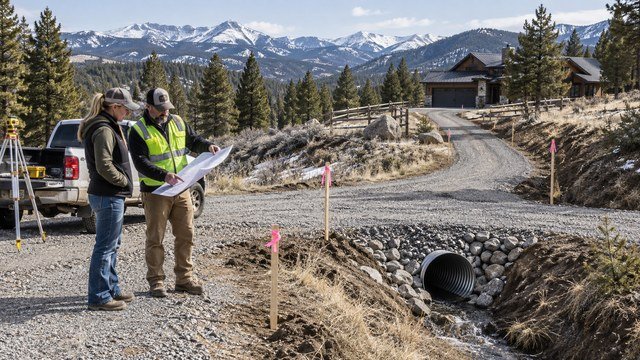
Most gravel-driveway failures are really drainage failures
A rural driveway can have good gravel and still fail if water is allowed to sit in the road base or run uncontrolled down the travel surface.
In Idaho, snowmelt, spring runoff, thunderstorms, frozen ground, and steep terrain can move a surprising amount of water across rural acreage.
The goal of driveway drainage is simple: get water off the road quickly, move it through controlled paths, and release it where it will not erode the driveway, neighboring property, or nearby waterways.
Start with the route, not the culvert
The best drainage system begins with driveway alignment.
A road that follows contours and avoids unnecessary low points is generally easier to drain than one that drops straight down a steep slope or crosses every natural drainage on the property.
Before finalizing the driveway, walk the parcel during or soon after rain and snowmelt if possible so you can see where water naturally collects and flows.
A crowned gravel driveway sheds water to both sides
A crown raises the center of the driveway slightly above the edges so runoff leaves the travel surface instead of following the wheel paths.
The amount of crown depends on road width, aggregate, traffic, and terrain, but the principle is the same: the road surface should not be flat enough to hold water.
Regular grading is needed because vehicle traffic can flatten the crown and create ruts that capture runoff.
Cross-slope can work better than a crown on some hillsides
On side-hill driveways, a controlled cross-slope may move water toward the uphill or downhill ditch depending on the design.
The wrong cross-slope can send water across the road at uncontrolled points and accelerate erosion.
Use the site topography and drainage plan to decide whether a crown, inslope, outslope, or combination makes sense.
Roadside ditches need somewhere to discharge
A ditch should collect runoff without becoming a permanent pond or high-speed erosion channel.
Its slope, shape, lining, and discharge point matter just as much as whether a ditch exists at all.
On steep ground, check dams, rock armoring, vegetation, or other erosion-control measures may be needed to slow water before it reaches the outlet.
Culverts move water under the driveway instead of over it
Culverts are commonly used where a driveway crosses a roadside ditch, swale, seasonal drainage, or concentrated runoff path.
A properly designed culvert carries water beneath the road while preserving the structural base above it.
A poorly sized, poorly aligned, or partially blocked culvert can back water up, erode the inlet, wash out the outlet, or undermine the driveway.
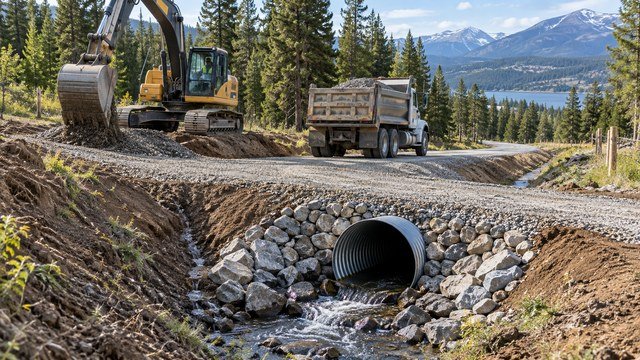
Culvert size should be based on water, not convenience
The correct culvert diameter depends on the drainage area, expected flow, slope, inlet conditions, debris, and the road authority's requirements.
The smallest pipe that is easy to buy is not always large enough for spring runoff or a cloudburst.
Where a county, highway district, or state agency controls the road approach, that agency may specify a minimum culvert size or require engineering.
State-highway approaches require an Idaho encroachment permit
Idaho Transportation Department requires an encroachment permit for private approaches and driveways within state highway right-of-way.
ITD's current right-of-way application specifically asks whether a culvert is needed and, if so, the minimum diameter and length.
No work should begin in state highway right-of-way until the required permit has been approved.
County roads and highway districts can have separate rules
Many Idaho rural roads are controlled by counties or local highway districts rather than ITD.
Those agencies can set their own driveway-approach, culvert, ditch, sight-distance, and drainage standards.
Before ordering pipe or excavating the road edge, confirm which agency owns the right-of-way and ask what it requires.
Snowmelt deserves its own drainage plan
Snow can accumulate for weeks and then release water quickly when temperatures rise.
Frozen or saturated ground may absorb very little of that runoff, pushing more water toward the driveway and drainage crossings.
Plan for where snow will be plowed, where meltwater will flow, and whether snowbanks could block ditches or culvert inlets.
Culvert inlets are vulnerable to ice, leaves, and debris
A culvert can be large enough hydraulically and still fail if the inlet plugs.
Pine needles, branches, leaves, sediment, ice, and snowplow debris can reduce capacity at exactly the time runoff is highest.
Keep the inlet visible and accessible so it can be inspected and cleared before and during spring runoff.
Outlet erosion can destroy a good culvert installation
Water leaving a culvert can move faster than the natural drainage below it.
Without protection, that concentrated flow can cut a gully, expose the pipe, erode the driveway shoulder, or damage neighboring land.
Rock riprap, energy dissipation, vegetation, or a stabilized outlet may be needed where the discharge has enough velocity to erode soil.
Culvert bedding and cover protect the pipe
The pipe needs appropriate bedding and enough compacted cover to support traffic above it.
A culvert placed directly on uneven rock or covered with loose material can deform, settle, or create a weak spot in the driveway.
The required cover depends on pipe material, diameter, manufacturer guidance, and the loads expected from trucks and equipment.
Driveway drainage should be designed for construction traffic
Concrete trucks, well-drilling rigs, septic equipment, dump trucks, cranes, and delivery vehicles can be far heavier than normal residential traffic.
A drainage crossing that works for pickup trucks may fail under repeated construction loads if the pipe, base, or cover is inadequate.
Build the driveway and culverts for the heaviest expected phase of the project, not just the vehicles that will use the property after move-in.
Water bars and rolling dips can help on long steep drives
On long grades, runoff can gain speed and stay on the road for hundreds of feet.
Water bars, broad-based dips, rolling grade breaks, and drainage turnouts can interrupt that flow and redirect it before it becomes destructive.
These features need to be shaped so normal vehicles can cross them comfortably while still moving water off the road.
Do not send driveway runoff into the septic area
Driveway drainage should be coordinated with the septic system and replacement drainfield.
Concentrated runoff can saturate soil, contribute to erosion, and create undesirable conditions around an onsite wastewater system.
Map the septic areas before finalizing ditch outlets, culverts, and drainage turnouts.
Protect the well from surface drainage
The wellhead should not sit in a low area where driveway runoff or snowmelt collects.
A grading plan should route water away from the well and maintain access for future pump service.
Coordinate driveway elevations, drainage, and well placement before the final gravel surface is installed.
Underground utilities can conflict with drainage work
Power, communications, water lines, and other utilities are often placed along or near rural driveways.
Culvert excavation and ditch maintenance can conflict with buried facilities if the utility corridor is not planned carefully.
Call 811 before excavation and keep utility locations in the site plan so future drainage maintenance does not become a utility-damage risk.
One acre of disturbed construction can trigger Idaho stormwater requirements
Idaho DEQ requires construction stormwater permit coverage for projects that disturb one acre or more and discharge stormwater, including clearing, grading, and excavation.
Smaller projects can also require coverage when they are part of a larger common plan of development or sale disturbing one acre or more.
Where coverage applies, the project needs a stormwater pollution prevention plan and best management practices to control sediment and pollutants.
Erosion control should go in before major earthwork
Drainage improvements can move water more efficiently, which also means they can move sediment more efficiently if the site is left unprotected.
Temporary erosion controls may include sediment barriers, stabilized outlets, diversion berms, inlet protection, mulch, rolled erosion-control products, and temporary seeding.
Permanent stabilization should follow as soon as practical after the driveway and drainage system reach final grade.
A ditch that is too flat can become a pond
Drainage channels need enough slope to move water, but not so much slope that water becomes erosive.
Low spots can collect standing water, soften the road shoulder, attract sediment, and freeze into ice during winter.
A contractor should grade the ditch continuously toward a stable outlet rather than simply excavating a trench along the road.
A ditch that is too steep can erode itself
Fast water can cut through bare soil quickly, especially after construction removes vegetation.
Rock lining, grade-control structures, vegetation, check dams, or additional drainage turnouts may be needed where the channel slope is steep.
The right treatment depends on flow, soil type, slope, and the consequences if the ditch fails.
Spring maintenance prevents expensive summer repairs
Inspect the driveway after major snowmelt and heavy storms.
Clear culvert inlets, remove sediment from ditches, repair small ruts, restore the crown, and stabilize minor erosion before it grows.
A few hours of early maintenance can prevent a plugged culvert or small washout from turning into a major excavation and aggregate replacement project.
Watch for these signs that drainage is failing
Most driveway drainage problems give warning before the road completely washes out.
- Standing water in wheel paths
- Persistent soft spots
- Gravel migrating downhill
- Ruts that deepen after storms
- Ditches holding water
- Sediment filling culvert inlets
- Erosion around culvert outlets
- Water crossing the road in unplanned locations
- Shoulder sloughing
- Ice forming repeatedly in the same section
- Water flowing toward the house, well, or septic area
What should be included in an Idaho driveway-drainage quote?
A drainage bid should describe the complete system rather than listing only a culvert pipe and excavation hours.
- Driveway drainage layout
- Crown or cross-slope grading
- Roadside ditch excavation
- Ditch lining or stabilization
- Culvert diameter and length
- Pipe material
- Culvert bedding
- Backfill and compaction
- Required cover over pipe
- Inlet protection
- Outlet armoring or riprap
- Water bars or rolling dips
- Drainage turnouts
- Road-approach permit coordination
- Erosion-control measures
- Rock excavation allowance
- Final grading and aggregate restoration
Questions to ask an Idaho site-work contractor
A good contractor should be able to explain where every major flow of water goes after construction.
- Where does runoff enter the property?
- Where will driveway runoff leave the road?
- How will snowmelt be handled?
- What culvert size do you recommend and why?
- Who confirms the road authority's culvert requirements?
- How will the outlet be protected from erosion?
- Where will snow be stored?
- Do the ditches have continuous fall?
- Will the system conflict with septic, well, or utilities?
- What maintenance will the culverts and ditches require?
- Does the project trigger stormwater permitting?
- What drainage conditions would create a change order?
The best driveway drainage is planned before the gravel arrives
Drainage is much cheaper to build correctly while the road is being excavated than to retrofit after washouts, potholes, and soft spots appear.
For Idaho acreage, coordinate the driveway with topography, snowmelt, septic, well, utilities, grading, and the road approach from the beginning.
A well-drained gravel road may still need periodic maintenance, but it has a far better chance of surviving Idaho winters, spring thaw, and heavy construction traffic without constant repair.
Keep researching
Land & Site Work resources
Clearing, grading, drainage, driveways, pads, excavation, and preparing acreage for construction.
Sources & methodology
Where this information comes from
Cost figures are planning references rather than contractor quotes. Permitting, system-selection, and location-specific guidance should be verified with the appropriate local authority or qualified professional. AcreageReady uses source-backed, AI-assisted editorial workflows and remains responsible for the material it publishes. Read how we research, edit, and correct guides.
- Idaho Transportation Department: Right-of-Way Permit Reference
- Idaho Transportation Department: ITD 2109 Right-of-Way Encroachment Application
- Idaho Department of Environmental Quality: Stormwater Permits
- Idaho Department of Environmental Quality: Stormwater
- AcreageReady: How Much Does a Gravel Driveway Cost in Idaho?
- AcreageReady: How Much Does It Cost to Grade Land for a House in Idaho?
- AcreageReady: How Much Does Land Clearing Cost in Idaho? 2026 Guide
- AcreageReady: Buying Rural Land in Idaho
Common questions
Frequently asked questions
Does a rural Idaho gravel driveway need a culvert?
Not every driveway needs one. Culverts are typically used where the driveway crosses a roadside ditch, swale, seasonal drainage, or other concentrated flow path. The controlling road agency may require a culvert at the approach.
What size culvert should I use for an Idaho driveway?
Culvert size depends on drainage area, expected runoff, slope, debris, inlet conditions, and local road standards. Idaho Transportation Department's approach-permit process can specify a minimum diameter and length where a state-highway approach requires a culvert.
Do I need a permit for a driveway culvert in Idaho?
It depends on the road authority. ITD requires an encroachment permit for approaches within state highway right-of-way. Counties and highway districts can have their own driveway and culvert permitting requirements.
How do I keep an Idaho gravel driveway from washing out?
Maintain positive drainage with a crown or appropriate cross-slope, roadside ditches, adequately sized culverts, stable outlets, and drainage turnouts or grade breaks on long slopes. Keep culvert inlets clear and repair erosion early.
Why does my gravel driveway get soft every spring?
Spring thaw can saturate the road base and subgrade while frozen ground limits infiltration. Poor drainage, weak native soil, insufficient aggregate depth, and blocked ditches or culverts can make the problem worse.
Does driveway drainage trigger an Idaho stormwater permit?
Idaho DEQ requires construction stormwater coverage when a project disturbs one acre or more and discharges stormwater, including clearing, grading, and excavation. Smaller sites can also qualify when part of a larger common plan of development.
Ready to talk with a local professional?
Share your location and project details so AcreageReady can identify relevant providers as the network grows.
Get a free quote