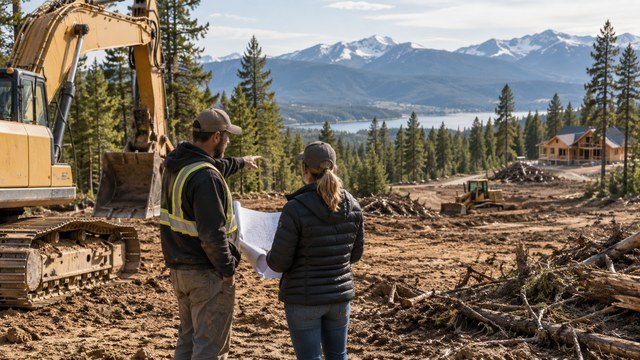
Land clearing in Idaho can range from light brush work to major site preparation
The cost to clear rural land in Idaho depends on what is growing on the property, how steep and rocky the site is, how much material must be removed, and what the land needs to look like when the contractor is finished.
A lightly wooded homesite with brush and small trees is a very different job from dense timber, large stumps, basalt, steep slopes, or a site that must be grubbed and graded for construction.
For acreage buyers, the key is to budget for the finished condition you actually need instead of assuming that all clearing work is priced the same.
A practical 2026 Idaho land-clearing budget
For early planning, light brush clearing in Idaho may fall roughly around $1,500 to $2,500 per acre, while medium brush and small-tree work often lands closer to $2,500 to $4,000 per acre.
Heavy forestry mulching or denser wooded acreage can move into roughly the $3,500 to $6,000 per acre range, while complete clearing, grubbing, grading, difficult haul-off, or rocky terrain can push costs above those ranges.
These are screening numbers, not bids. Published Idaho cost guides vary, and contractor pricing can change significantly by region, terrain, vegetation, equipment, access, disposal method, and project size.
Forestry mulching and traditional clearing are not the same thing
Forestry mulching uses a machine-mounted mulching head to shred brush, saplings, and smaller trees into material that remains on the ground.
Traditional clearing may involve excavators, dozers, loaders, chainsaws, stump removal, grubbing, piling, hauling, burning, or some combination of those methods.
Mulching can be efficient when you want to reclaim overgrown acreage or open selective areas without removing every root. Traditional clearing is usually more appropriate where the soil must be prepared for foundations, roads, septic work, utilities, or finished grading.
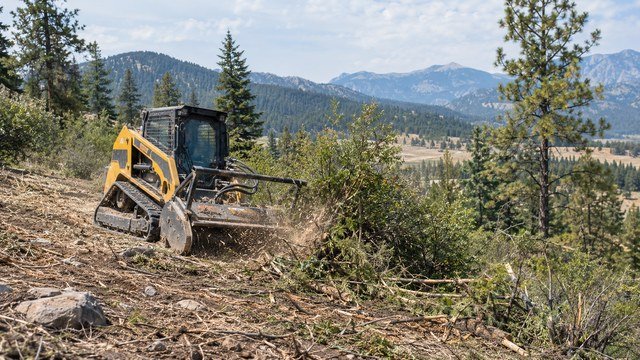
Light brush is usually the least expensive clearing
Grass, weeds, sagebrush, light undergrowth, and scattered small saplings can often be cleared quickly with a brush cutter, compact track loader, or mulcher.
Production can be high when the terrain is open and accessible, which lowers the per-acre cost.
Price rises when brush hides rocks, wire, old fencing, irrigation components, dumped material, or other hazards that slow the operator.
Small trees and dense understory increase machine time
Acreage with thick saplings, juniper, lodgepole pine, fir regeneration, or heavy underbrush usually takes longer than open brush land.
Tree diameter matters because larger stems require more cutting time and may exceed the practical capacity of smaller mulching equipment.
If the goal is selective clearing rather than clearing every tree, flag the trees and areas that must stay before equipment arrives.
Large trees can turn the project into timber and excavation work
Mature timber changes both the equipment and the project plan.
Large trees may need to be felled, limbed, processed, stacked, chipped, hauled, sold, or burned, and the stumps may still remain after the trees are gone.
If the property contains merchantable timber, ask whether a forester or logging contractor should evaluate the trees before you pay a site contractor to destroy material that may have value.
Stump removal and grubbing can cost more than cutting the trees
Removing a tree above ground does not create a construction-ready site.
House pads, roads, slabs, and many utility corridors need roots, stumps, and organic material removed so the soil can be properly shaped and compacted.
Grubbing adds excavator time, creates large piles of root material, disturbs more soil, and often generates debris that must be hauled, burned, chipped, or otherwise managed.
Idaho's rock and basalt can slow clearing dramatically
Many Idaho properties include basalt, lava rock, boulders, shallow bedrock, or rocky mountain soils.
Even if the vegetation is light, hidden rock can slow mulching, stump excavation, driveway preparation, grading, and utility trenching.
A contractor may price visible rock into the base quote and charge extra when subsurface conditions require larger equipment, hydraulic breakers, ripping, or additional excavation.
Slope affects production, safety, and equipment choice
Flat acreage is usually faster and less expensive to clear than a steep hillside.
Steep ground can limit which machines can safely operate, reduce production, increase erosion risk, and require more careful access.
If the site is mountainous or heavily sloped, ask the contractor which areas are practical to clear and whether the quoted price assumes normal machine access.
Access can matter as much as acreage
Large equipment needs room to reach the work area, unload safely, turn around, and move material.
Narrow gates, weak bridges, soft roads, tight switchbacks, steep approaches, overhead branches, snow, and spring mud can all make rural Idaho projects more difficult.
A contractor may need to improve access before the clearing work can even begin.
Do not clear the entire property just because you own it
Many rural projects only need selective clearing for the driveway, home, septic area, utility routes, well access, shop, defensible space, and specific recreation or pasture areas.
Keeping mature trees can preserve privacy, reduce erosion, protect habitat, block wind, provide shade, and lower the clearing budget.
A site plan should identify what must be removed and what should remain before machines start working.
Clear the driveway and homesite in the right sequence
The driveway is often one of the first areas to clear because it provides construction access for drilling rigs, septic equipment, utility crews, concrete trucks, and builders.
The homesite should then be opened enough for surveying, geotechnical work if needed, grading, and foundation layout.
Avoid clearing large areas that may later move after the septic system, well, drainage, or utility route is finalized.
Coordinate land clearing with the septic system
Septic drainfields and replacement areas should be protected from unnecessary compaction and excavation.
Heavy equipment can damage suitable soil or change drainage across an area intended for wastewater treatment.
Complete the septic site evaluation early enough that the clearing contractor knows which areas must remain undisturbed.
Coordinate land clearing with the well and power routes
Well drillers and utility crews need equipment access, but the shortest clearing route is not always the route that will ultimately be approved.
Before clearing a long utility corridor, confirm the likely power alignment and the well location so you do not pay to open a path that will not be used.
The best site-development sequence treats clearing, driveway access, well, septic, power, and grading as one coordinated plan.
What happens to the slash can change the price
Cutting vegetation is only part of the job. The branches, tops, logs, brush, stumps, and root balls still need to be managed.
Common options include mulching material in place, chipping, stacking firewood, creating slash piles, hauling material off site, or burning allowed natural vegetation when conditions and rules permit.
Hauling is usually more expensive than leaving processed material on site because it adds loading, trucking, disposal, and additional machine time.
Idaho burning rules matter when slash piles are part of the plan
Idaho DEQ allows certain outdoor burning of natural vegetation when no burn ban or other restriction is in effect, but air-quality and fire-safety rules still apply.
DEQ states that allowable slash and yard-waste burning may require a fire-safety burn permit from the Idaho Department of Lands or a local fire department.
For most allowable burning other than crop residue, Idaho requires a fire-safety burn permit from May 10 through October 20 each year. Always check current DEQ restrictions and local fire requirements before ignition.
Forest land can trigger additional Idaho requirements
Idaho Department of Lands administers the Idaho Forest Practices Act for forest operations, including standards related to logging, road building, reforestation, streamside protection, and other forest practices.
IDL also uses a compliance and notification process for certain timber-harvest activities, commonly associated with a slash or brush form.
If your clearing project involves a timber harvest rather than ordinary residential site clearing, contact IDL before work begins so the project follows the correct forestry and fire-hazard requirements.
Streamside areas and drainage deserve extra care
Clearing near creeks, wetlands, drainage channels, and steep slopes can create erosion and water-quality problems if the ground is disturbed aggressively.
Forest-practice rules include stream-protection and soil-conservation standards for covered forestry activities.
Even outside a formal timber operation, preserving vegetation near drainage features can reduce erosion and help stabilize the property.
Forestry mulching can reduce haul-off but does not eliminate site prep
Mulching is attractive because it processes vegetation in place and can leave a relatively clean surface with minimal hauling.
However, mulch, roots, stumps, and organic material are not structural fill. A building pad, slab, road base, or other load-bearing area still needs the organic material removed before proper earthwork begins.
Use mulching for the parts of the property where leaving roots and organic material is acceptable, and use grubbing where construction requires clean mineral soil.
Acreage size can lower the per-acre price but raise the total
Mobilization is a large part of small projects, so contractors may charge minimums that make a quarter-acre homesite expensive on a per-acre basis.
Larger projects can become more efficient once the machine is on site, but the total cost still rises as more acres are cleared.
Ask whether the contractor prices by acre, hour, day, or complete project, and how minimum charges are handled.
Hourly and daily equipment pricing can make sense on uncertain sites
Some contractors quote a flat price when the vegetation and finish condition are easy to define.
Others use hourly or daily rates when rock, buried debris, stump volume, terrain, or selective clearing makes the production rate difficult to predict.
If the job is time-and-materials, establish the machine rate, mobilization, operator cost, fuel treatment, and expected production before work begins.
What should be included in an Idaho land-clearing quote?
Compare the finished scope rather than the headline price because two contractors may be quoting very different outcomes.
- Acres or specific areas to be cleared
- Vegetation size and density assumptions
- Selective tree retention
- Tree felling
- Forestry mulching
- Stump removal or grinding
- Grubbing and root removal
- Rock or boulder handling
- Slash piling
- Chipping
- Haul-off and disposal
- Burn-pile preparation if appropriate
- Equipment mobilization
- Access improvements
- Final rough grading
- Erosion-control measures
- Hourly rates for hidden conditions
- Cleanup and finish condition
Questions to ask an Idaho land-clearing contractor
The best contractor should be able to explain not only how the vegetation will be removed but what condition the site will be in when the work is complete.
- What equipment will you use?
- Is the job forestry mulching, traditional clearing, or both?
- Are stumps and roots included?
- What happens to logs, brush, slash, and root balls?
- Is haul-off included?
- How is rock handled?
- What areas should remain untouched?
- Can you work safely on the site's slopes?
- Will you protect the septic and replacement areas?
- Does the quote include rough grading?
- Are burn permits or forestry notifications relevant to this job?
- What conditions would create a change order?
A practical budgeting example for Idaho acreage
Suppose you buy five wooded acres but only need one acre opened for the home, driveway, septic access, and shop.
Selective clearing or mulching of that one-acre development envelope can be far less expensive than clearing all five acres, while also preserving privacy and mature trees.
If the homesite later requires grubbing, rock excavation, heavy grading, or large-tree removal, carry those as separate site-work allowances instead of assuming the per-acre clearing price includes everything.
Land clearing should be part of the total development budget
The clearing price is only one line in the cost of turning raw Idaho acreage into a buildable property.
Compare it alongside the driveway, well, septic system, power extension, grading, drainage, homesite preparation, and future structures.
A parcel with heavy timber, steep terrain, rock, and difficult access may cost more to develop than a higher-priced parcel with a simpler site.
Keep researching
Land & Site Work resources
Clearing, grading, drainage, driveways, pads, excavation, and preparing acreage for construction.
Sources & methodology
Where this information comes from
Cost figures are planning references rather than contractor quotes. Permitting, system-selection, and location-specific guidance should be verified with the appropriate local authority or qualified professional. AcreageReady uses source-backed, AI-assisted editorial workflows and remains responsible for the material it publishes. Read how we research, edit, and correct guides.
- Idaho Department of Environmental Quality: Can I Burn?
- Idaho Department of Environmental Quality: Information for the Public
- Idaho Department of Lands: Forest Practices Act
- Idaho Department of Lands: Compliance/Notification
- Clear My Land Directory: Idaho Land Clearing & Forestry Mulching Cost Guide
- OWNR OPS: Land Clearing in Idaho Costs, Services & Regulations
- AcreageReady: Buying Rural Land in Idaho
- AcreageReady: How Much Does It Cost to Bring Power to Rural Property in Idaho?
- AcreageReady: How Much Does a Septic System Cost in Idaho?
Common questions
Frequently asked questions
How much does it cost to clear one acre of land in Idaho?
A practical 2026 screening range is roughly $1,500 to $6,000 per acre depending on vegetation density, tree size, slope, rock, equipment access, stump removal, and whether material is mulched, burned, or hauled away.
How much does forestry mulching cost in Idaho?
Published Idaho estimates commonly place forestry mulching around $2,000 to $5,000 per acre, with lighter brush potentially lower and dense timber, steep ground, or difficult access higher.
Is forestry mulching cheaper than traditional clearing in Idaho?
It often can be when the goal is brush removal, selective tree clearing, trails, defensible space, or pasture reclamation because material is processed in place. It does not replace grubbing and structural site preparation where roots and organic material must be removed.
Do I need a permit to burn slash in Idaho?
Burning rules depend on the material, season, air quality, fire conditions, and local requirements. Idaho DEQ says allowable slash and yard-waste burning may require a fire-safety burn permit, and most allowable non-crop burning requires an Idaho Department of Lands fire-safety permit from May 10 through October 20.
Should I clear my entire Idaho acreage before building?
Usually not. Many owners save money and preserve privacy, erosion protection, habitat, and mature trees by clearing only the driveway, homesite, septic and utility access, shop area, and selected recreation or pasture zones.
Does land clearing include stump removal?
Not automatically. Forestry mulching and tree cutting may leave stumps and roots in place. Grubbing, stump removal, haul-off, and rough grading should be specifically included in the contractor's scope if the area must become construction-ready.
Ready to talk with a local professional?
Share your location and project details so AcreageReady can identify relevant providers as the network grows.
Get a free quote