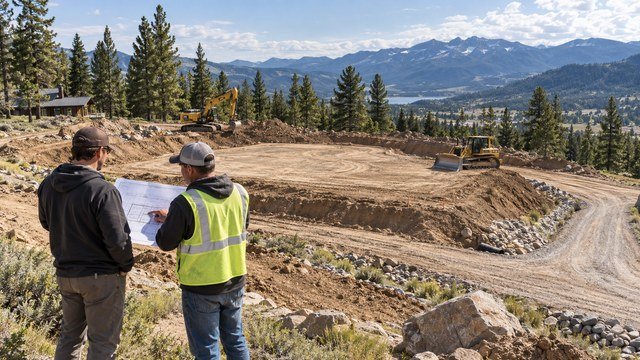
Land grading can be a small site-work line item or one of the biggest costs on rural Idaho acreage
The cost to grade land for a house in Idaho depends on how much soil must move, how steep the property is, whether rock or basalt is present, how much fill must be imported or hauled away, and how precise the final building pad needs to be.
A relatively flat rural homesite with usable native soil may need only moderate rough grading and drainage shaping. A steep or rocky property can require major cut and fill, retaining work, imported structural fill, compaction testing, erosion control, and specialized excavation equipment.
For land buyers, grading should be evaluated before the homesite is finalized because moving the house a short distance on the property can materially change the earthwork budget.
A practical 2026 Idaho grading budget
For early planning, a basic residential grading project may fall in the low thousands, while a rural homesite with substantial cut and fill, rock, drainage work, or imported material can move into the $10,000 to $30,000 range or higher.
Current 2026 national pricing data places common residential grading around $500 to $5,000 for smaller or average projects, with rough grading commonly priced around $1 to $2 per square foot where the work is more extensive.
For Idaho acreage, a conservative budget should account for local terrain, rock, access, haul distance, and the larger footprint that often comes with a house pad, driveway, utility corridors, drainage, and future shop areas.
Rough grading and finish grading are different phases
Rough grading is the heavy earthwork stage. It establishes the general elevations of the house pad, driveway, drainage paths, and surrounding site.
Finish grading happens later and brings the site to final elevations around the house, walkways, patios, driveway edges, landscaping, and drainage features.
A contractor may quote both together or price them separately, so confirm which phase is included before comparing bids.
The house pad is the most important graded area
A house pad is not simply a flat patch of dirt. It must support the foundation, drain properly, and meet the elevation and compaction requirements of the builder, engineer, and foundation design.
Poorly compacted fill, buried organic material, loose soil, or uncontrolled lifts can create settlement problems later.
The grading contractor should know the required pad dimensions, finished elevation, fill type, lift thickness, moisture conditioning, and compaction targets before major earthwork begins.
Cut and fill determines how much dirt actually moves
Cut and fill is the process of excavating soil from high areas and placing it in lower areas to create the planned elevations.
A balanced site can reuse suitable native soil and reduce hauling. An unbalanced site may need imported fill or generate excess material that must be removed.
The more material that must be handled, moved, conditioned, compacted, loaded, or hauled, the more expensive the project becomes.
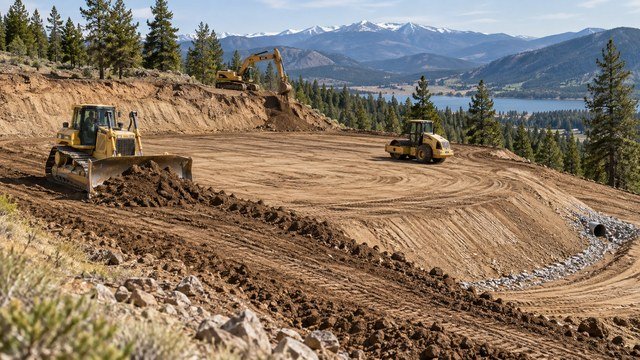
Imported fill can quickly increase the grading budget
If the property does not have enough suitable native material, the contractor may need to import structural fill, select fill, gravel, or other specified material.
The cost includes more than the material itself. Trucking, spreading, moisture conditioning, compaction, and testing all add to the final price.
On a large rural house pad, even a modest elevation increase can translate into many truckloads of material.
Hauling excess dirt away can be just as expensive
A site with too much excavated material can create a disposal problem.
Excess soil may be reused elsewhere on the property, placed in approved areas, or hauled off site. Haul-off adds loader time, trucking, fuel, disposal coordination, and road wear.
When possible, a good grading plan balances cut and fill on the property so the project minimizes both imported fill and off-site disposal.
Basalt and shallow rock are major Idaho cost drivers
Many Idaho properties contain basalt, lava rock, boulders, shallow bedrock, or rocky soils that are much slower to excavate than ordinary native soil.
Rock can require larger excavators, hydraulic breakers, ripping, drilling, specialized attachments, or additional haul-off.
If rock is visible on the surface or common in nearby wells, septic excavations, or foundations, include a rock contingency before buying the property.
Slope can change the entire site design
A gently sloping site is usually easier to grade than a steep mountain or canyon property.
Steep sites may require deeper cuts, taller fills, stepped pads, retaining walls, longer drainage transitions, and more careful access for equipment.
Before committing to a homesite, compare several potential locations on the parcel. The best view is not always the most economical place to build.
Drainage should be designed before grading begins
Good grading directs water away from the house while preserving safe drainage paths across the property.
Idaho snowmelt, spring runoff, mountain storms, and frozen ground can make drainage especially important on rural sites.
The grading plan may need swales, berms, culvert approaches, ditches, shallow channels, or other features that route runoff around the home, driveway, septic area, and neighboring properties.
Construction disturbing one acre or more can trigger Idaho stormwater permitting
Idaho DEQ states that construction activities disturbing one acre or more, including clearing, grading, and excavation, require coverage under the Idaho Pollutant Discharge Elimination System construction stormwater program.
Smaller projects can also be covered when they are part of a larger common plan of development or sale.
Where the permit applies, the project needs stormwater planning and erosion-control measures rather than treating grading as unrestricted dirt movement.
Erosion control is part of responsible grading
Bare soil can move quickly on sloped Idaho property during heavy rain or snowmelt.
Current Idaho construction guidance emphasizes installing best management practices before excavation, fill, or grading begins when stormwater permit requirements apply.
Common measures can include silt fencing, stabilized drainage paths, sediment barriers, inlet protection, covered stockpiles, and temporary or permanent vegetation.
Local grading and excavation rules can add another layer
State stormwater requirements are not the only rules that can apply. Counties, cities, highway districts, and floodplain programs may have their own excavation, grading, drainage, erosion-control, and right-of-way requirements.
For example, Valley County's current development code requires best management practices to control erosion and drainage during grading and excavation and includes additional protections in riparian areas.
Before moving dirt, check the county or city rules for the specific parcel rather than assuming rural land is unregulated.
Call 811 before excavation begins
Idaho's Damage Prevention Board directs excavators to contact a one-number notification service at least two business days and no more than ten business days before excavation.
The proposed excavation area must be marked and utilities must have time to respond before digging starts.
This applies to grading work that could conflict with buried electrical, communication, gas, irrigation, water, or other underground facilities.
Driveway grading should be coordinated with the house pad
The driveway elevation affects the house-pad elevation, drainage, culvert location, and how construction traffic reaches the homesite.
A steep driveway can create winter traction problems, while a low or flat section can collect water and become soft during spring thaw.
Plan the road entrance, culvert, driveway grade, turnaround, parking areas, and house pad as one earthwork system.
Do not grade the septic area like the rest of the site
Septic drainfields and replacement areas rely on suitable native soil and should be protected from unnecessary excavation and compaction.
Heavy grading equipment can damage the soil structure or change drainage across the approved area.
Complete the septic site evaluation before final grading so the contractor knows which zones must remain undisturbed.
Coordinate grading with the well location
The wellhead should remain accessible and protected from surface runoff.
Grading should not create a low area that directs water toward the well or make future pump-service access difficult.
When the well location is known early, the driveway, house pad, drainage, utility trenches, and septic layout can be coordinated around it.
Utility trenches can undo finished grading if the sequence is wrong
Power, water, communications, propane, and other buried utilities often require trenching after the rough site is established.
If finish grading happens too early, later utility work can tear through completed slopes and drainage paths.
The efficient sequence is usually rough grading, major utility and septic work, building construction, then final grading and stabilization.
Compaction matters most where structures or roads will sit
Fill placed beneath a home, garage, shop, driveway, retaining wall, or other load-bearing improvement should not be treated like ordinary landscape fill.
Structural areas may require controlled lift thickness, moisture conditioning, specified materials, and density testing.
Ask the builder or engineer what compaction standard is required before the grading contractor starts placing fill.
Compaction testing can be inexpensive insurance
Density testing documents whether structural fill has been compacted to the specified standard.
Testing is particularly valuable on pads with deep fill, imported material, or variable native soils.
A small testing cost can reduce uncertainty about what is buried under the foundation and driveway.
Topsoil should be treated differently from structural fill
Topsoil contains organic material that is valuable for landscaping but generally unsuitable under foundations and structural pads.
A grading contractor may strip topsoil before major earthwork, stockpile it, and replace it later in landscaping areas.
Do not pay to haul away good topsoil if it can be stored safely and reused on the property.
Frozen ground and seasonal mud can affect Idaho grading schedules
Idaho site work is often sensitive to season.
Frozen soil can be difficult to excavate and compact properly, while spring thaw can turn unpaved access roads and exposed pads into soft working surfaces.
Ask local contractors when the site is typically workable and whether the project schedule needs temporary stabilization, imported rock, or delayed finish grading.
Large equipment is not always the most economical choice
Dozers, excavators, loaders, graders, compactors, skid steers, and articulated dump trucks each fit different parts of a grading project.
A larger machine may cost more per hour but move substantially more material, while smaller equipment can be more practical on tight or selective sites.
Ask why the proposed equipment mix is appropriate for the volume, access, slope, and finish requirements of your property.
Hourly, cubic-yard, and lump-sum pricing each have tradeoffs
Some Idaho grading contractors charge by the hour or day, others price material by the cubic yard, and many provide a lump-sum project price when the plans are defined.
Hourly pricing can work well when the amount of hidden rock or excavation is uncertain, but the owner carries more production risk.
A lump-sum bid is easier to budget when the elevations, cut-and-fill quantities, drainage features, and finish condition are clearly documented.
A practical Idaho homesite grading example
Imagine a rural parcel with a gently sloping homesite that needs moderate clearing, a raised building pad, driveway tie-in, and drainage shaping.
A basic grading allowance of several thousand dollars may be realistic if native soil can be reused and rock is minimal. If the pad needs significant imported fill, rock breaking, retaining work, or long haul-off, the same site can quickly move well above $10,000.
That is why land buyers should ask for a local site-work opinion before using a generic per-square-foot number as the development budget.
What should be included in an Idaho grading quote?
The strongest bids define the site condition at completion, not simply the number of machine hours.
- Mobilization
- Survey control or benchmark assumptions
- Topsoil stripping and stockpiling
- Rough grading
- House-pad dimensions and elevation
- Cut-and-fill quantities
- Imported fill allowance
- Haul-off allowance
- Rock excavation or breaker rates
- Moisture conditioning
- Compaction
- Density testing if required
- Driveway tie-in
- Drainage swales and berms
- Culvert grading
- Erosion-control measures
- Utility trench restoration
- Finish grading
- Site cleanup
- Hourly or unit rates for hidden conditions
Questions to ask an Idaho grading contractor
A good grading contractor should be able to explain the elevations, drainage, material movement, and finish condition rather than simply quoting machine time.
- What elevations are you building to?
- How will you establish and protect grade benchmarks?
- How much cut and fill do you expect?
- Can native soil be reused?
- How much imported fill is included?
- How much haul-off is included?
- How do you price basalt or unexpected rock?
- What compaction standard will be used?
- Is density testing included?
- How will the site drain during and after construction?
- Does the quote include erosion control?
- Are septic and well areas shown on the plan?
- Is finish grading included?
- What conditions would trigger a change order?
The grading budget belongs in the total land-development budget
Grading affects the foundation, driveway, drainage, septic, well, utilities, landscaping, and nearly every other improvement on rural acreage.
A cheap parcel can become expensive if the best homesite requires major excavation, rock removal, deep fill, retaining work, and long utility runs.
Compare Idaho properties using the combined cost of clearing, grading, driveway access, well, septic, power, drainage, and construction rather than land price alone.
Keep researching
Land & Site Work resources
Clearing, grading, drainage, driveways, pads, excavation, and preparing acreage for construction.
Sources & methodology
Where this information comes from
Cost figures are planning references rather than contractor quotes. Permitting, system-selection, and location-specific guidance should be verified with the appropriate local authority or qualified professional. AcreageReady uses source-backed, AI-assisted editorial workflows and remains responsible for the material it publishes. Read how we research, edit, and correct guides.
- Idaho Department of Environmental Quality: Stormwater Permits
- Idaho Transportation Department: 2026 Construction Site Erosion and Sediment Control Field Guide
- Idaho Damage Prevention Board: Excavation Requirements
- HomeGuide: Cost to Level or Regrade Land 2026
- Angi: Excavation Cost 2026
- Angi: Site Preparation Cost 2026
- AcreageReady: How Much Does Land Clearing Cost in Idaho? 2026 Guide
- AcreageReady: Buying Rural Land in Idaho
- AcreageReady: How Much Does a Septic System Cost in Idaho?
- AcreageReady: How Much Does It Cost to Bring Power to Rural Property in Idaho?
Common questions
Frequently asked questions
How much does it cost to grade land for a house in Idaho?
A simple residential grading project may cost a few thousand dollars, while rural Idaho homesites with significant cut and fill, imported material, rock, drainage work, or steep terrain can reach $10,000 to $30,000 or more.
How much does rough grading cost in 2026?
Current 2026 national cost data commonly places rough grading around $1 to $2 per square foot, although rural Idaho projects are often priced by machine time, cubic yards moved, or complete project scope rather than square footage.
Does Idaho require a stormwater permit for grading?
Idaho DEQ requires construction stormwater permit coverage for activities disturbing one acre or more, including clearing, grading, and excavation. Smaller sites may also qualify when they are part of a larger common plan of development or sale.
Do I need to call 811 before grading in Idaho?
Yes when the work involves excavation that could affect underground facilities. Idaho's Damage Prevention Board directs excavators to contact a one-number notification service at least two business days and no more than ten business days before digging.
Does grading include compaction?
Not automatically. Compaction, moisture conditioning, and density testing should be specifically included when fill will support a home, shop, driveway, retaining wall, or other structural improvement.
Should I grade before or after septic installation?
Major rough grading should be coordinated with septic planning, but approved drainfield and replacement areas should be protected from unnecessary excavation and compaction. Final grading is usually completed after major utility and septic work.
Ready to talk with a local professional?
Share your location and project details so AcreageReady can identify relevant providers as the network grows.
Get a free quote