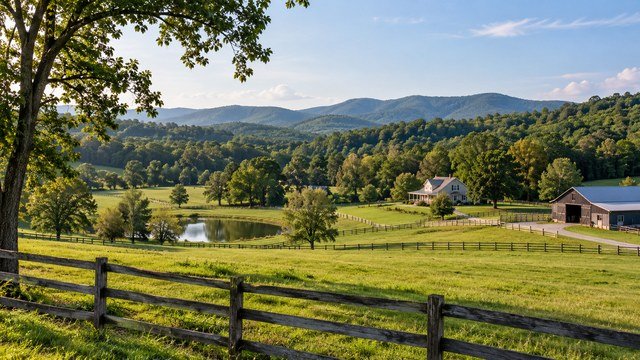
Greenbelt can change the carrying cost of Tennessee acreage
Large rural parcels in Tennessee are often marketed with phrases such as Greenbelt eligible, Greenbelt enrolled, farm tax status, or reduced agricultural taxes. Those phrases can be valuable, but they should never replace a careful review of the parcel's actual classification and the rules that apply to the buyer's intended use.
Tennessee's Agricultural, Forest and Open Space Land Act of 1976, commonly called the Greenbelt Law, allows qualifying land to be valued for property tax purposes according to its current qualifying use rather than a potentially higher market value tied to development pressure.
For buyers planning a house, barndominium, shop, pasture, timber tract, subdivision, or long-term land hold, Greenbelt should be part of the due-diligence conversation before closing.
Greenbelt is a property-tax valuation program, not a zoning designation
Greenbelt does not give you permission to build, operate a business, subdivide land, install septic, drill a well, or change access. Those questions are controlled by separate county, municipal, environmental, utility, deed, and site-development rules.
The program affects how qualifying land is valued for property-tax purposes. That distinction matters because a parcel can qualify for Greenbelt while still having development constraints, and a buildable parcel may or may not qualify for Greenbelt.
Treat Greenbelt as one layer in a broader rural-land due-diligence process.
Tennessee recognizes agricultural, forest and open-space Greenbelt categories
The Greenbelt Law provides three primary classifications: agricultural land, forest land, and open-space land.
Each category has different eligibility rules. Agricultural and forest land generally use a 15-acre threshold, while open-space land can begin at three acres but requires the property to meet additional planning or preservation criteria.
Do not assume that every wooded parcel is forest Greenbelt or that every field is agricultural Greenbelt. The county assessor determines whether the property meets the applicable statutory classification.
Agricultural land generally starts with a 15-acre threshold
For agricultural classification, Tennessee guidance states that land must generally contain at least 15 acres, including qualifying woodlands and wastelands that form part of the farm unit.
The land must constitute a farm unit engaged in the production or growing of agricultural products, unless it qualifies under the separate long-term family farming provision described in state law.
Acreage alone is not enough. The assessor can consider the acreage, productivity, portion actually used for agriculture, ownership history, income information, conservation enrollment, and other evidence of agricultural use.
The $1,500 income figure is a presumption, not an automatic pass-or-fail test
Tennessee's Greenbelt guidance says an assessor may presume a tract is agricultural when it produces gross agricultural income averaging at least $1,500 per year over a three-year period.
That amount is not presented by the state as an absolute requirement for every agricultural application. The official guidance specifically notes that the presumption can be rebutted and that land can still qualify without producing that level of income when the facts support active agricultural use.
Buyers should therefore avoid assuming that a small amount of farm income automatically guarantees classification or that lack of current income automatically makes a legitimate farm ineligible.
Forest Greenbelt generally requires at least 15 acres and real forest management
Forest land generally must contain at least 15 acres and have tree growth in sufficient quantity and quality to constitute a forest unit.
Tennessee guidance also describes forest land as being managed under a sound program of sustained yield management. A forest management plan may be required as part of qualification.
A parcel with woods behind a house is not automatically forest Greenbelt. Ask the county assessor what documentation is required and whether a management plan is already on file for the parcel.
Open-space Greenbelt follows a different path
Open-space classification applies to qualifying land of at least three acres that is principally open or natural and whose preservation furthers purposes identified in Tennessee law.
Unlike agricultural or forest classification, open-space eligibility depends on planning or preservation action. Tennessee guidance states that the county or municipal planning commission must designate the area for open-space preservation unless another qualifying statutory route applies.
That makes open-space Greenbelt much less appropriate for casual assumptions based only on parcel size or appearance.
Greenbelt uses current-use value instead of development-driven market value
The core benefit of Greenbelt is that qualifying land can be valued according to its current agricultural, forest, or open-space use instead of a higher market value that may reflect subdivision or development potential.
This can matter significantly in areas where rural land prices have risen because of growth from nearby cities, new highways, residential development, or demand for large homesites.
The exact tax effect is parcel-specific. Buyers should obtain the current tax record and talk with the county assessor rather than relying on the seller's prior tax bill as a forecast.
The home site and improvements are not automatically valued like Greenbelt acreage
A rural parcel can contain qualifying Greenbelt acreage and also contain a residence, home site, barns, shops, or other improvements.
The existence of a home does not necessarily eliminate Greenbelt classification for the rest of the qualifying land. However, the residential home-site portion and improvements may be valued separately from qualifying acreage.
When comparing tax bills, determine how much of the parcel is receiving use-value treatment and how the home site and structures are being assessed.
The March 15 application deadline matters
Tennessee's official Greenbelt guidance states that first-time applications for agricultural, forest, or open-space classification must be filed with the county assessor by March 15 for the current tax year.
Applications filed after the deadline are generally processed for the following tax year.
If you are purchasing acreage close to the deadline, ask the county assessor what the ownership change means for the existing classification and what filings, signatures, or updated documentation will be required from you.
Do not assume the seller's Greenbelt status transfers exactly as expected
A listing may advertise that the property is in Greenbelt, but a buyer should independently verify the classification with the county assessor before closing.
A sale, parcel split, acreage change, change in ownership structure, or change in use can affect the classification or create new filing requirements.
Ask for the parcel identification number, current property record card, Greenbelt application or classification documentation, current use-value acreage, and any notices relating to rollback or disqualification.
Rollback taxes are the main financial risk buyers should understand
When land is disqualified from Greenbelt or converted to a nonqualifying use, Tennessee can recapture part of the tax savings through rollback taxes.
The Comptroller describes rollback taxes as a recapture of taxes previously saved, not as a separate penalty.
For agricultural and forest land, the state says rollback calculations generally look back over the preceding three years. Open-space land can involve a five-year lookback.
Building on part of the acreage can change the tax picture
Buying Greenbelt land does not mean you can never build on it. Rural owners routinely build homes, shops, barns, driveways, utilities, and other improvements on larger tracts.
The important question is what acreage is converted away from the qualifying use and how the assessor treats that change. A house site, expanded commercial area, subdivision, or other development activity can remove acreage from Greenbelt and may trigger rollback calculations on the affected land.
Before clearing or recording a new parcel configuration, discuss the proposed footprint with the assessor so you understand the likely tax consequences.
Parcel splits deserve special attention before you record them
Subdividing a Greenbelt tract can create problems when the resulting parcels no longer satisfy the size, ownership, or use requirements that supported the original classification.
A buyer planning to carve off a homesite, create lots for family members, sell frontage, or divide acreage for future development should review the split with the assessor and a qualified land professional before recording the new plat or deed.
The tax impact can be very different from simply owning the original tract intact.
LLCs, trusts and shared ownership can complicate planning
Rural property is often purchased in an LLC, family trust, partnership, or multi-owner arrangement. Tennessee Greenbelt rules address ownership and acreage attribution, so the legal owner shown on the deed can matter.
If you plan to move property into an entity after closing, add owners, divide interests, or restructure family ownership, ask the assessor and your attorney how that change could affect the classification and any filing obligations.
Do not make a title change solely for liability or estate-planning reasons without checking the property-tax consequences.
Greenbelt should be reviewed alongside your development budget
A rural-land budget should include more than the purchase price. It should account for taxes, survey work, legal access, driveway construction, clearing and grading, septic, water, power, permits, drainage, and the cost of future improvements.
Greenbelt can reduce one recurring ownership cost, but the potential rollback exposure should be included if your plan depends on converting substantial acreage to residential, commercial, or subdivided use.
This is especially important for buyers purchasing more land than they immediately need and planning phased development over several years.
Verify Greenbelt before relying on a real-estate listing
Marketing language is not the same as an assessor's record. Before closing, request documentation directly from the county assessor.
Confirm the parcel number, classification type, acreage currently receiving use-value treatment, market value, use value, any home-site acreage, current improvements, and whether the assessor knows of a pending disqualification or rollback issue.
If the property is being divided out of a larger parent tract, ask how the new parcel will be treated after the split rather than relying on the parent parcel's current status.
Questions to ask the county assessor before buying
The county assessor is the best starting point for parcel-specific Greenbelt questions because that office administers the classification at the county level.
Bring the parcel number and a clear description of your intended use. A useful conversation should cover both the current classification and what happens after your planned development.
- What Greenbelt classification does the parcel currently have?
- How many acres are currently receiving use-value treatment?
- Is a home site or other portion already excluded from Greenbelt?
- Will the purchase require a new application or updated ownership documentation?
- What is the March 15 filing requirement for this parcel and transaction?
- Would my planned house, shop, driveway, business use or subdivision remove acreage from classification?
- Could my proposed changes trigger rollback taxes?
- Is there any pending Greenbelt review, disqualification or rollback assessment?
- If I split the parcel, what minimum-acreage rules will apply to the resulting tracts?
- What documents should I retain after closing?
Questions to ask before making an offer
Greenbelt should be investigated early enough that the answers can affect the offer price, due-diligence period, financing plan, and development budget.
A property with a low historical tax bill may still carry meaningful future taxes or rollback exposure when the buyer's plans differ from the seller's use.
- Is the parcel currently enrolled in Greenbelt, or is it only described as eligible?
- Which category applies: agricultural, forest or open space?
- What evidence supports the current classification?
- Does the seller have the most recent Greenbelt application and assessor correspondence?
- Has any acreage recently been divided, sold, cleared or converted?
- Are rollback taxes already due or likely to be triggered by the sale or planned use?
- Does your development plan leave enough qualifying acreage and qualifying use?
- Will ownership be personal, joint, trust, LLC or another entity?
- Have you confirmed taxes using the county assessor's current records rather than a listing estimate?
A practical Tennessee Greenbelt due-diligence sequence
The safest approach is to treat Greenbelt as a documented part of your land-development plan instead of an afterthought.
Start with the assessor record, confirm the classification, compare it with your actual intended use, estimate any acreage that may be converted, and then coordinate your survey, subdivision, clearing and construction decisions around that information.
For broader rural due diligence, combine this review with AcreageReady's Tennessee guides on buying rural land, surveys and property lines, easements and legal access, zoning and building permits, septic systems, wells, power, driveways, grading, and flood and drainage conditions.
The bottom line
Tennessee Greenbelt can be a meaningful benefit for rural landowners because qualifying acreage is valued according to agricultural, forest, or open-space use rather than development-driven market value.
The program is also rule-based. Acreage thresholds, actual land use, filing deadlines, ownership changes, parcel splits, development activity, and rollback taxes can all affect the result.
Before buying or building on Tennessee acreage, verify the parcel's current Greenbelt status directly with the county assessor and make sure your intended use fits the classification you expect to keep.
Keep researching
Acreage Planning resources
Due diligence, development sequencing, utilities, access, and the decisions that shape a rural property project.
Sources & methodology
Where this information comes from
Cost figures are planning references rather than contractor quotes. Permitting, system-selection, and location-specific guidance should be verified with the appropriate local authority or qualified professional. AcreageReady uses source-backed, AI-assisted editorial workflows and remains responsible for the material it publishes. Read how we research, edit, and correct guides.
- Tennessee Comptroller: Greenbelt
- Tennessee Comptroller: Understanding Tennessee Property Assessments
- Tennessee Comptroller: Property Assessment Glossary
- Tennessee Comptroller: Assessment Schedule
- AcreageReady: Buying Rural Land in Tennessee
- AcreageReady: Tennessee Land Surveys & Property Lines
- AcreageReady: Tennessee Easements & Legal Access
- AcreageReady: Tennessee Zoning & Building Permits
- AcreageReady: Tennessee Septic Permits & Soil Evaluations
- AcreageReady: Tennessee Flood Zones & Drainage
Common questions
Frequently asked questions
What is Tennessee Greenbelt?
Tennessee Greenbelt is the common name for the Agricultural, Forest and Open Space Land Act of 1976. Qualifying land can be valued for property-tax purposes according to its current agricultural, forest, or open-space use rather than a potentially higher market value based on development.
How many acres do you need for Greenbelt in Tennessee?
Agricultural and forest classifications generally require at least 15 acres. Open-space land can begin at three acres but has separate planning and preservation requirements. Parcel configuration and ownership rules can affect qualification, so confirm eligibility with the county assessor.
Do I have to make $1,500 from farming to qualify for agricultural Greenbelt?
Not necessarily. Tennessee guidance says average gross agricultural income of at least $1,500 per year over a three-year period can create a presumption that land is agricultural, but the state also says this is not an absolute requirement. The assessor considers the actual use and other evidence.
When is the Tennessee Greenbelt application deadline?
The state's published deadline for first-time agricultural, forest, or open-space Greenbelt applications is March 15 for the current tax year. Applications filed later are generally processed for the following tax year.
Can I build a house on Greenbelt land in Tennessee?
A house can coexist with qualifying Greenbelt acreage, but the home site and improvements may be valued separately, and development can remove acreage from qualifying use. Discuss the planned building footprint with the county assessor before construction.
What are Tennessee Greenbelt rollback taxes?
Rollback taxes recapture some of the property-tax savings when land is disqualified from Greenbelt or converted to a nonqualifying use. Tennessee states that agricultural and forest rollback calculations generally cover the preceding three years, while open-space rollback can cover five years.
Does Greenbelt automatically transfer when I buy land?
Do not assume it does without action. Verify the existing classification with the county assessor and ask what the ownership change requires. A sale, deed change, parcel split, or change in use can affect the classification or filing requirements.
Who should I contact about Greenbelt for a specific Tennessee property?
Start with the assessor of property in the county where the land is located. Bring the parcel number and explain how you intend to use the land. For legal, title, entity-ownership, or transaction-specific questions, also involve the appropriate attorney, surveyor, tax professional, or other qualified adviser.
Ready to talk with a local professional?
Share your location and project details so AcreageReady can identify relevant providers as the network grows.
Get a free quote